If you searched for Equithrive scam, Equithrive charge, Equithrive credit card charge, or Equithrive small charge, you may have noticed an unfamiliar transaction on a credit card, debit card, bank account, PayPal account, Apple Pay, Google Pay, or another payment method.
Equithrive is a real horse and pet supplement brand associated with Thrive Animal Health. An Equithrive charge may be connected to a legitimate supplement purchase or recurring Autoship order.
However, if you have never ordered from Equithrive, do not recognize Thrive Animal Health, and no authorized card user can identify the transaction, treat the charge as potentially unauthorized and investigate it promptly.
Quick Verdict
Equithrive is a legitimate company, but an unfamiliar Equithrive charge still needs to be verified. A small transaction can have several explanations, including a legitimate order, Autoship renewal, payment authorization, merchant-descriptor confusion, unauthorized purchase, or possible card testing. If you cannot match the charge to a real order, contact your card issuer promptly.
Share Your Equithrive Charge Experience ↓
On this page:
What is Equithrive? ·
Why was I charged? ·
Small charges ·
Autoship ·
Unauthorized charges ·
Official contact ·
Bank disputes
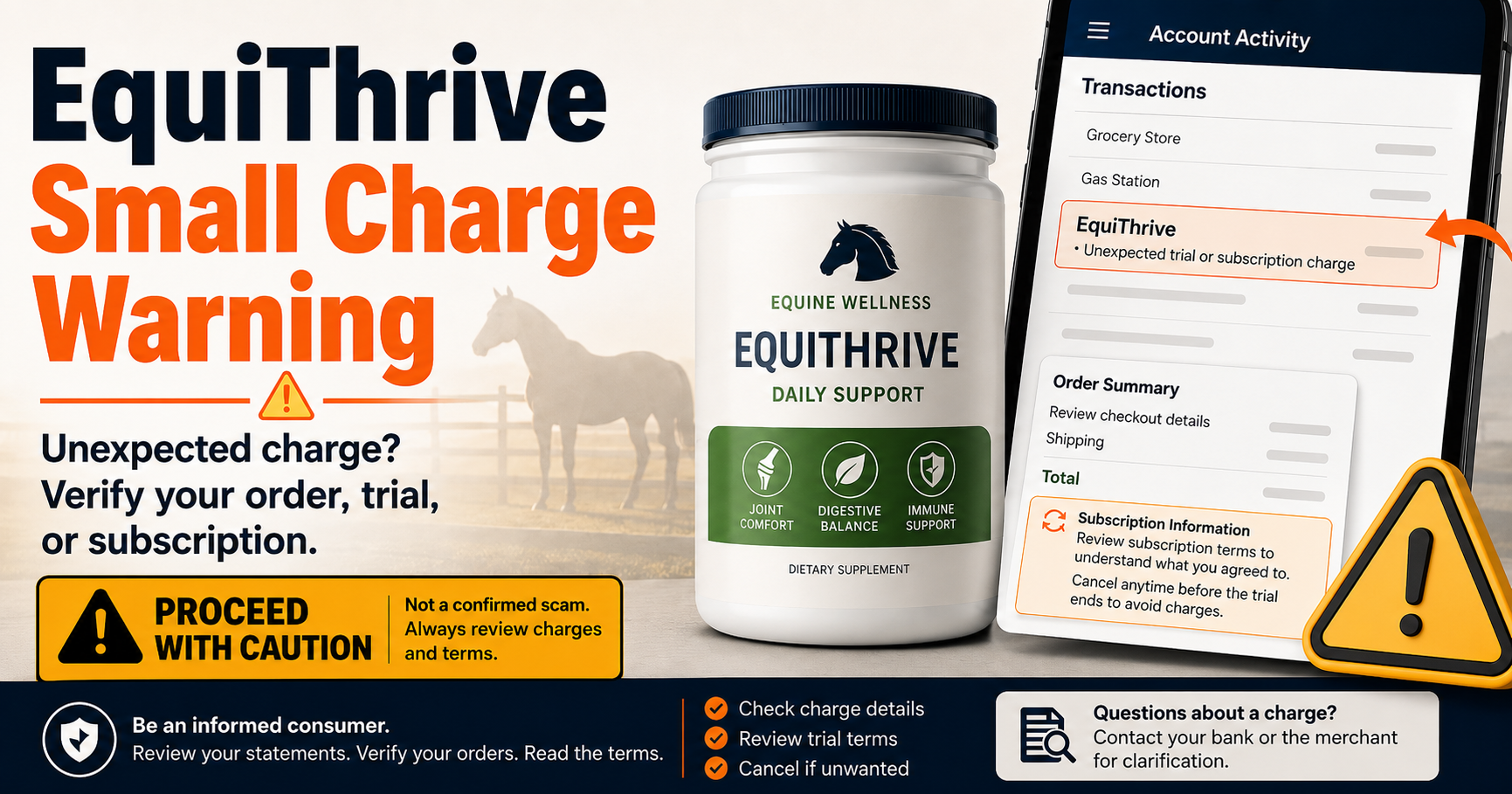
An unfamiliar Equithrive charge may be a legitimate order or Autoship renewal, but a small transaction you do not recognize should be verified promptly with the merchant and your card issuer.
What Is Equithrive?
Equithrive is an animal-health supplement brand associated with Thrive Animal Health in Lexington, Kentucky.
The company currently sells products including:
- Horse joint supplements
- Resveratrol and joint-support products
- Vitamin E supplements
- Electrolytes
- Hoof-support products
- Gut-support products
- Metabolic-support products
- Other equine nutritional supplements
- Pet nutritional products
Equithrive also offers an Autoship / Subscribe & Save program that can generate recurring charges when scheduled supplement shipments are processed.
Why Is Equithrive Charging Me?
An Equithrive or Thrive Animal Health charge does not automatically mean that your card was compromised.
Possible explanations include:
- A one-time Equithrive supplement purchase
- An Equithrive Autoship renewal
- A recurring supplement shipment
- A pet supplement purchase
- A veterinarian, trainer, barn, or farm-related purchase
- An order placed by a spouse or another authorized card user
- A pending card authorization
- A merchant descriptor that does not match the product name you remember
- An unauthorized purchase
- Possible card testing if the transaction is unusually small and no valid order exists
Start by comparing the charge date and amount with your recent purchases.
Search your email for:
- Equithrive
- Thrive Animal Health
- Autoship
- Subscribe & Save
- Horse supplement
- Joint pellets or powder
- Vitamin E
- Electrolyte
- Metabolic support
- The exact amount charged
Common Equithrive Statement Descriptors
The wording can vary depending on your bank, card issuer, payment processor, or checkout method.
Consumers may encounter descriptions involving:
- Equithrive
- EQUITHRIVE
- Equithrive charge
- Equithrive credit card charge
- Equithrive debit card charge
- Equithrive Autoship
- Equithrive subscription
- Thrive Animal Health
- Thrive Animal Health charge
- Equithrive Lexington KY
- Equithrive 866-721-1412
- Equithrive small charge
- Equithrive pending charge
If your statement contains a merchant telephone number, city, transaction ID, or other descriptor information, save it for your bank and Equithrive. Do not post private transaction IDs publicly.
What If the Equithrive Charge Is Only a Few Cents or Under $1?
A very small unfamiliar charge deserves attention, but its size alone does not prove what happened.
Possible explanations include:
- A temporary authorization
- A merchant-verification transaction
- A small legitimate purchase
- A merchant-descriptor error
- An unauthorized transaction
- A possible card-testing attempt
Card testing occurs when stolen or compromised payment information is used for a small transaction to determine whether the card is active before larger attempts are made.
Do Not Ignore a Small Charge You Cannot Identify
If neither you nor another authorized card user can identify the Equithrive transaction, contact your card issuer. Ask whether the transaction is pending or posted, what merchant information is available, and whether the card should be locked or replaced.
The Federal Trade Commission advises consumers to review their bank and credit-card statements carefully and contact the financial institution promptly when they find charges they did not authorize.
Does a Small Equithrive Charge Prove Equithrive Is Testing Cards?
No.
The appearance of the Equithrive name on a small transaction does not establish that Equithrive or Thrive Animal Health intentionally tested your card.
A legitimate merchant name can appear in connection with an unauthorized transaction because someone may have:
- Used stolen card information to make an actual order
- Entered your card information incorrectly
- Used a compromised payment account
- Created a transaction that was later reversed
It may also simply be a legitimate authorization or order that you have not yet identified.
That is why the safest response is to investigate the transaction rather than assume who caused it.
Could the Charge Be Equithrive Autoship?
Yes. Equithrive currently offers an Autoship / Subscribe & Save program for recurring supplement deliveries.
Customers choose a product and shipment frequency, and future shipments can then be processed automatically.
If you recognize Equithrive but do not remember making a new purchase, check whether you previously selected Subscribe & Save.
Sign in to your Equithrive account and review:
- Active subscriptions
- Upcoming shipment dates
- Shipment frequency
- Products included
- Order history
- Stored billing information
Equithrive says customers can adjust, pause, or cancel their Autoship program through their account.
See the current Equithrive Autoship information.
What If You Actually Ordered From Equithrive?
If you recently purchased horse or pet supplements, the charge may be legitimate.
Check:
- Your Equithrive order history
- Your order-confirmation email
- Your shipping confirmation
- Your Autoship settings
- Any recurring shipment
- Purchases made by a spouse
- Purchases made by a trainer or barn manager
- Veterinary or farm-related purchases
If you recognize the transaction but need help with an order, subscription, cancellation, or refund, contact Equithrive directly.
What If You Never Ordered From Equithrive?
Treat the transaction as potentially unauthorized if:
- You have never purchased from Equithrive.
- You do not recognize Thrive Animal Health.
- You have no relevant horse, pet, barn, trainer, or veterinary purchases.
- No authorized card user recognizes the charge.
- You cannot find a receipt or order confirmation.
- The charge is very small and unexplained.
- Additional unfamiliar transactions appear around the same time.
If those conditions apply, do not wait for a larger transaction before contacting your financial institution.
How to Investigate an Equithrive Charge
- Check whether the transaction is pending or posted.
- Save the complete statement descriptor.
- Search your email for Equithrive and Thrive Animal Health.
- Check Equithrive Autoship.
- Ask every authorized card user.
- Review PayPal, Apple Pay, Google Pay, or other wallets if applicable.
- Contact Equithrive if a legitimate order may exist.
- Contact your card issuer if no valid purchase can be identified.
For a more detailed billing-specific walkthrough, see Equithrive Charge on Credit Card, Autoship & Refund Help on ChargeOnMyCard.com.
That specific sister-site page covers statement descriptors, recurring shipments, Autoship, refunds, and unauthorized transactions, making it directly relevant to this issue. :contentReference[oaicite:2]{index=2}
Official Equithrive Contact Information
Official website: Equithrive.com
Customer service: 866-721-1412
Email: [email protected]
Address:
Thrive Animal Health
1038 Nandino Blvd.
Lexington, KY 40511
Contact page: Equithrive Contact Us
If you call about a transaction, provide only enough information for the company to search its records.
You may be able to provide:
- Your name
- Transaction date
- Transaction amount
- Email address you may have used
- Shipping address associated with a possible order
Do not send your complete card number, CVV, bank password, PIN, Social Security number, or authentication code by email.
Should I Contact Equithrive or My Bank First?
If you recognize Equithrive and believe the transaction may be associated with a legitimate order or Autoship subscription, contacting Equithrive can help identify the purchase.
If you have no relationship with Equithrive at all and believe the payment information may have been used without authorization, your bank or card issuer should generally be contacted promptly.
Your financial institution controls:
- Card locks
- Card replacement
- Fraud investigations
- Payment disputes
- Chargebacks
- Monitoring for additional attempts
What To Say to Your Bank About an Equithrive Charge
If you cannot identify the transaction, you can explain:
“I found an Equithrive transaction that I do not recognize. I checked my purchases and asked the other authorized card users, and I cannot find a legitimate order. Please tell me whether this is pending or posted, what merchant information is available, and what steps I should take for an unauthorized transaction.”
If the amount is unusually small, you can add:
“Because the transaction is small and unfamiliar, I am concerned my card information may have been tested or otherwise compromised. Should the card be locked or replaced?”
Let the card issuer determine the appropriate fraud response rather than assuming that the merchant itself intentionally created a card-testing transaction.
What Information Can Your Bank See?
Your bank or card issuer may have more information than appears in the shortened statement descriptor.
Ask whether it can provide:
- The full merchant descriptor
- Merchant telephone number
- Merchant location
- Whether the payment was card-present or online
- Whether a digital wallet was used
- Whether the transaction is pending or settled
- Whether other authorization attempts were made
That information can help distinguish a recognized purchase from an unauthorized transaction.
What If More Small Charges Appear?
Multiple unexplained transactions from different merchants can be a stronger indication that payment-card information has been compromised.
If you notice additional unfamiliar charges:
- Contact the card issuer immediately.
- Ask whether the card should be locked.
- Ask whether a replacement card number is needed.
- Review all recent transactions.
- Turn on transaction alerts.
- Review digital-wallet accounts connected to the card.
- Change passwords if an online account may have been compromised.
What If the Equithrive Charge Is Recurring?
A recurring Equithrive charge may be an Autoship shipment rather than fraud.
If you previously bought Equithrive products, sign in and determine whether you enrolled in Subscribe & Save.
If you did not knowingly authorize recurring shipments, save:
- The original checkout information
- Receipts
- Subscription settings
- Cancellation confirmation
- Support correspondence
- Dates and amounts of each transaction
Recurring-billing confusion is different from card testing. If you knowingly made an initial purchase but dispute the later renewal, describe the issue accurately to both the merchant and your card issuer.
For another example of why it is important to distinguish a real service from a disputed recurring charge, see our TestLibrary subscription and billing guide.
What If You Receive an Unexpected Verification Code Too?
If an unexplained card transaction appears around the same time as an unexpected payment or verification code, do not share the code with anyone.
An unsolicited verification code can indicate that someone entered your email, telephone number, or payment information during an attempted checkout or account-access process.
Our Visa Click to Pay scam and unexpected OTP warning explains why a genuine verification message can still indicate an unauthorized attempt involving your information.
How To Protect Yourself After an Unauthorized Charge
- Turn on transaction alerts.
- Review both pending and posted transactions.
- Check for other small unfamiliar charges.
- Review cards stored in shopping accounts.
- Check PayPal and digital wallets.
- Change passwords if account access may have been compromised.
- Use unique passwords for email, shopping, and payment accounts.
- Enable multi-factor authentication when available.
- Follow your card issuer’s instructions about replacement.
Official Consumer Resources
- Equithrive Official Website
- Equithrive Official Contact Page
- Equithrive Autoship / Subscribe & Save
- FTC: Payments You Didn’t Authorize Could Be a Scam
- FTC ReportFraud
Related Charge and Payment Guides
- Equithrive Charge on Credit Card, Autoship & Refund Help
- Visa Click to Pay Scam? Unexpected OTP, Email & Text Warning
- TestLibrary Scam or Legit? Subscription and Billing Complaints
Equithrive Scam and Charge FAQs
Is Equithrive a scam?
No evidence reviewed suggests that Equithrive itself is a fake company. Equithrive is a real animal-health supplement brand associated with Thrive Animal Health. The scam-related concern arises when someone sees an Equithrive transaction that they did not authorize or cannot identify.
What is an Equithrive charge on my credit card?
It may be a one-time Equithrive purchase, Autoship renewal, recurring supplement delivery, pet or horse product, purchase by another authorized user, pending authorization, or unauthorized transaction.
Why is my Equithrive charge so small?
A small amount can have several explanations, including a temporary authorization, actual small transaction, merchant verification, or possible card-testing attempt. If no legitimate order exists, contact your card issuer rather than assuming the transaction is harmless.
Is Equithrive card testing people?
An unfamiliar small transaction does not establish that Equithrive or Thrive Animal Health is intentionally testing cards. Card testing is one possible explanation for an unexplained small transaction, but a bank may also determine that it was an authorization, legitimate purchase, descriptor issue, or unauthorized order placed by another party.
Does Equithrive have a subscription?
Yes. Equithrive currently offers an Autoship / Subscribe & Save program that automatically processes future supplement shipments according to the selected delivery schedule.
How do I cancel Equithrive Autoship?
Equithrive says customers can manage, pause, adjust, or cancel their Autoship subscriptions through their Equithrive account. Check the current Autoship page and account settings for your specific subscription.
What is Thrive Animal Health on my statement?
Thrive Animal Health is associated with Equithrive. If you purchased Equithrive products, the company or related payment information may appear in your records even if you remember the product name rather than the corporate name.
What is the Equithrive phone number?
Equithrive’s current official contact page lists 866-721-1412.
Should I dispute an Equithrive charge?
First check receipts, Equithrive Autoship, authorized card users, and the merchant details available from your bank. If no legitimate order or authorization can be found, contact the card issuer promptly and ask about disputing the transaction.
Should I replace my card?
Your card issuer should make that determination based on the transaction and account activity. If the charge is confirmed to be unauthorized or additional suspicious attempts appear, the issuer may recommend locking or replacing the card.
Bottom Line
Equithrive is a legitimate animal-health supplement brand, but an unfamiliar Equithrive charge should not be ignored.
If you recognize the company, first check whether the charge matches an order or Autoship renewal.
If you have never purchased from Equithrive, no authorized card user recognizes the transaction, and you cannot locate a matching order, contact your card issuer promptly.
A very small transaction can sometimes be associated with card testing, but it can also have other explanations. Verify the transaction before concluding who caused it.
Have You Seen an Equithrive Charge?
Share the non-sensitive details of your experience below. Your report may help other consumers identify legitimate Equithrive purchases, Autoship renewals, merchant descriptors, authorizations, and potentially unauthorized transactions.
- What descriptor appeared on your statement?
- Was the transaction pending or posted?
- Approximately how much was the charge?
- Had you ever purchased from Equithrive?
- Did you have an active Autoship subscription?
- Did another authorized card user make the purchase?
- Did Equithrive locate an order?
- What information did your bank provide?
- Did your bank recommend replacing the card?
- Did additional unfamiliar charges appear?
Please do not post your full card number, bank-account number, transaction ID, order number, email address, phone number, home address, passwords, authentication codes, or other sensitive information.
Page researched and updated: September 18, 2026.
ThinkItsAScam.com is an independent consumer-information website and is not affiliated with Equithrive, Thrive Animal Health, any supplement company, veterinarian, payment processor, card network, bank, or financial institution. Equithrive appears to be a legitimate business. This article discusses how to identify unfamiliar charges, verify Autoship purchases, and respond to potentially unauthorized transactions. A small transaction does not by itself establish card testing, merchant misconduct, or fraud. Product offerings, billing descriptors, subscription terms, contact information, and policies can change. Verify individual transactions through your own receipts, Equithrive, and your financial institution. This article is for general consumer education and is not legal or financial advice.
Leave a Reply