If you received an unexpected letter from Payne Richards & Associates saying that unclaimed money, abandoned property, a refund, or other funds may belong to you, you may be wondering whether the notice is legitimate.
Payne Richards & Associates is a real unclaimed-funds retrieval business. It searches public unclaimed-property records, contacts potential owners, and offers to help recover funds for a fee.
However, consumers generally do not need to hire a private finder to claim state-held unclaimed property.
The National Association of Unclaimed Property Administrators says searching for and claiming unclaimed property through an official state program is free.
So the most important question is not simply whether Payne Richards & Associates exists. It is whether paying a finder fee provides enough value compared with filing the claim yourself at no cost.
Quick Verdict
Payne Richards & Associates is an established private finder service, not a government unclaimed-property office. Before signing an agreement, verify the property directly with the state holding the funds, determine whether you can file the claim yourself, and read the finder-fee agreement carefully.
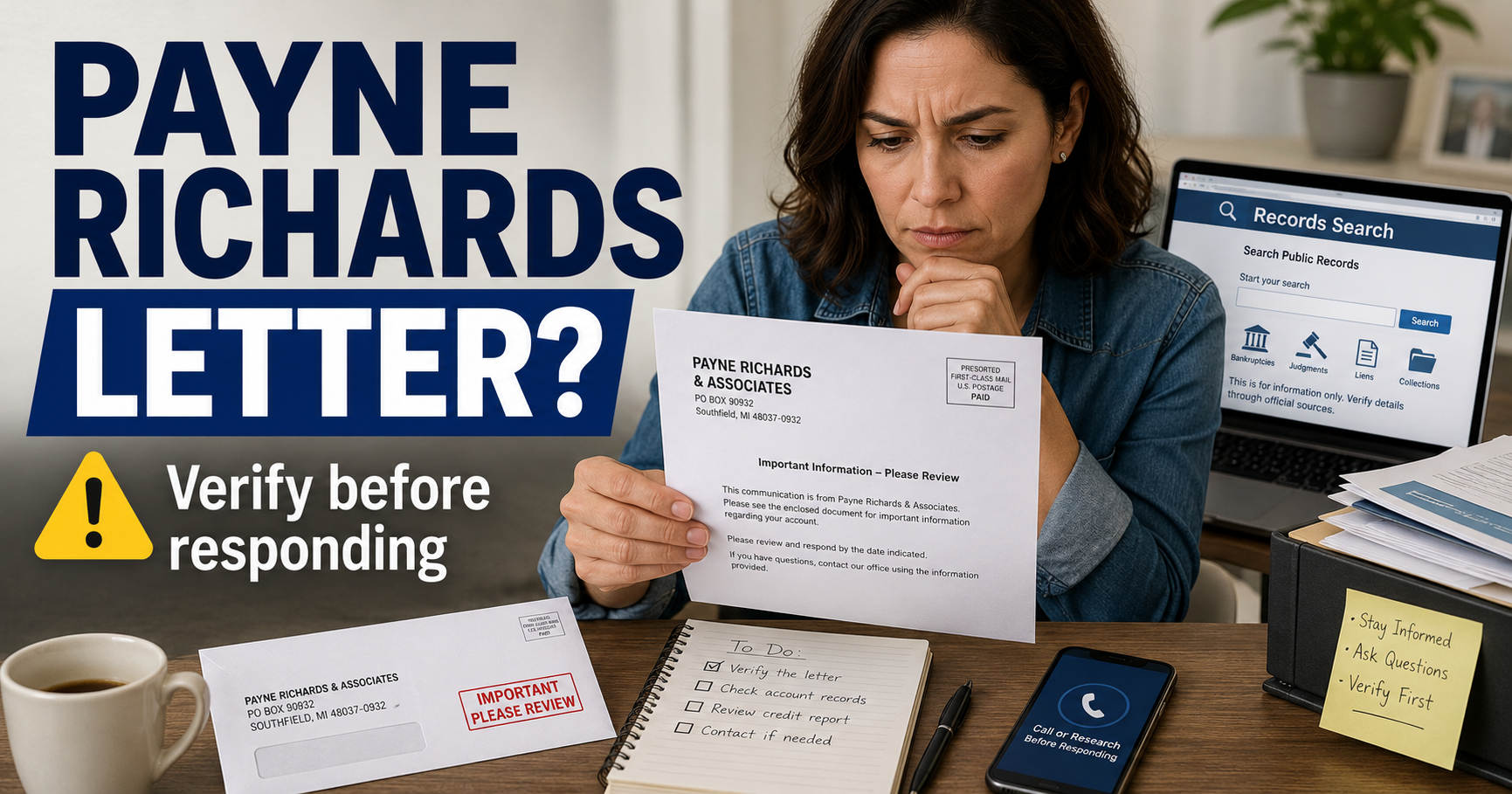
Payne Richards & Associates is a real unclaimed-funds retrieval service, but consumers can usually search for and claim state-held unclaimed property themselves for free through an official state program.
What Is Payne Richards & Associates?
Payne Richards & Associates is a private company that provides unclaimed-funds retrieval services.
The Better Business Bureau currently lists the company at:
Payne Richards & Associates
3651 Pegasus Drive, Suite 101
Bakersfield, CA 93308-6836
661-399-1108
BBB says the business began operating in 2002 and describes its service as sending letters to people who may have unclaimed funds being held by a government agency and then charging a fee when funds are recovered.
The website associated with the company is:
Is Payne Richards & Associates a Scam?
The evidence supports that Payne Richards & Associates is a real operating unclaimed-funds retrieval company.
BBB currently lists the company as accredited with an A+ rating and reports more than two decades in business.
That does not mean every consumer needs its service, every letter necessarily identifies the correct person, or every recipient will agree that the fee is worthwhile.
Those are separate issues.
Why Did Payne Richards & Associates Send Me a Letter?
Private unclaimed-property finders obtain information about abandoned or unclaimed property and attempt to locate the apparent owner.
NAUPA explains that third-party finders may obtain owner information through public records and state disclosure procedures.
A letter may therefore contain information about:
- An uncashed refund
- A dormant bank account
- An insurance payment
- A utility deposit
- Stocks or securities
- An old payroll check
- An overpayment
- Other property transferred to a state unclaimed-property program
Receiving an accurate letter does not mean Payne Richards & Associates currently possesses the money.
Does Payne Richards & Associates Hold Your Money?
Consumers sometimes misunderstand wording in unclaimed-property letters and believe the finder itself is holding the funds.
Recent BBB complaints show some consumers were confused about references to funds, trusts, or third parties.
In one published 2026 BBB response, Payne Richards & Associates stated that it was not the custodian or recipient of the funds involved in the complaint.
That is why you should independently determine:
- Which state or government agency holds the property
- The name of the reported owner
- The original company that reported the property
- The approximate amount
- Whether you can claim it yourself
Can You Claim Unclaimed Money Yourself for Free?
Yes, in most cases involving state-held unclaimed property.
NAUPA states that there is no fee to search for or claim missing money through an official state unclaimed-property program.
Each state maintains its own program.
You can start with:
- NAUPA’s Official State Search Directory
- MissingMoney.com, which NAUPA identifies as an official multi-state search resource
If you find the property yourself, the state generally provides instructions for submitting the claim without hiring a private recovery company.
Why Would Someone Use Payne Richards If the State Claim Is Free?
A finder service may still provide value to some consumers.
Examples could include:
- You did not know the property existed.
- The company located you after years of moves.
- The claim involves complicated ownership records.
- The owner is deceased.
- Documentation is difficult to obtain.
- You prefer someone else to help manage the process.
The service is similar to paying someone to perform a process you may be able to complete yourself.
Whether that is worthwhile depends on the amount of money involved, complexity of the claim, fee, and amount of assistance actually provided.
How Much Does Payne Richards & Associates Charge?
The exact fee should be stated in the agreement presented to you.
Recent BBB reviews and complaints repeatedly describe agreements involving a fee of approximately 10% of recovered funds.
However, do not rely on another consumer’s agreement when evaluating yours.
Read your specific contract and confirm:
- The percentage or dollar fee
- When the fee becomes due
- Whether the fee applies if you later file the claim yourself
- What services the company agrees to perform
- Any cancellation provision
- Which state’s law applies
Finder Fees Can Vary by State
Unclaimed-property finder laws are not identical nationwide.
Some states cap fees or regulate finder agreements.
For example, California’s State Controller says an investigator helping recover California unclaimed property generally cannot charge more than 10% of the property returned.
California also requires specific disclosures and says owners can always file directly with the State Controller for free.
Other states can have different limits, registration requirements, waiting periods, or contract rules.
Check the unclaimed-property office in the state that actually holds your funds before assuming a particular fee or agreement is permitted.
Payne Richards & Associates Reviews in 2026
Public reviews are mixed but currently lean positive overall.
As of September 18, 2026, the BBB profile displayed a customer rating of approximately 4.4 out of 5 based on more than 170 reviews.
Many positive reviewers say the company:
- Located money they did not know existed
- Successfully helped them recover funds
- Provided clear instructions
- Completed the process as promised
Other reviews and complaints raise concerns about communication, delays, fees, contracts, or whether the consumer could have completed the claim independently.
Reviews represent individual consumer experiences and are not independent findings that every positive or negative allegation is correct.
Payne Richards & Associates Complaints
BBB currently reports:
- 30 complaints during the previous three years
- 10 complaints closed during the previous 12 months
Recent complaint themes include allegations involving:
- Letters sent to the wrong person or address
- Requests for identification documents
- Confusion over whether the funds actually belonged to the recipient
- Disputes over finder fees
- Consumers claiming they recovered funds themselves
- Disagreements over whether a signed agreement remained enforceable
These are consumer allegations and contract disputes, not findings that Payne Richards & Associates committed fraud.
What If the Name or Address in the Letter Is Wrong?
Do not provide additional identifying information simply because the letter shares your last name.
A 2026 BBB complaint involved a recipient who said the first name, middle initial, and address in the letter did not match.
In its published response, Payne Richards & Associates said that if the notice does not correspond to the recipient’s identity, the recipient should disregard it and no action is required.
If the property does not appear to belong to you, independently search the official state database rather than attempting to make the record fit your identity.
Why Does a Finder Need Identification?
Government unclaimed-property programs normally require proof that the claimant is the rightful owner.
Depending on the claim, documentation can include:
- Government-issued identification
- Proof of an old address
- Evidence of ownership
- Estate documents
- Death certificates
- Other records connecting the claimant with the property
That means a request for identification is not automatically evidence of fraud.
However, identity documents are sensitive.
Before sending a Social Security number, driver’s license, passport, or other identification, verify:
- The company
- The property
- The state holding the funds
- The contract you signed
- Why each document is required
- How the information will be transmitted
How to Verify a Payne Richards Letter
- Do not sign immediately. Give yourself time to research the notice.
- Identify the state holding the property.
- Go to the state’s official unclaimed-property site.
- Search your name yourself.
- Confirm the property and original holder.
- Check whether you can file directly.
- Read the Payne Richards agreement.
- Confirm the percentage fee and when it becomes due.
- Verify the company through PRClaims.com or independently obtained contact information.
- Keep copies of every document.
How Did Payne Richards Find Me?
Unclaimed-property information can become available through public state records.
NAUPA explains that third-party finders commonly use public-record laws and other lawful data sources to identify people who may own unclaimed property.
This can make an unexpected letter feel unusually specific.
The company knowing your name, prior address, or approximate amount of unclaimed money does not mean it has access to your bank account or currently controls the funds.
Do You Need to Pay Before Receiving the Money?
Read the agreement carefully.
For California-held unclaimed property, the State Controller specifically warns that an investigator agreement requiring payment before the state approves the claim and returns the property is invalid under California’s finder rules.
A demand for an unrelated upfront fee before you can even verify supposed funds should receive additional scrutiny.
This differs from a contingency-style finder agreement in which a stated percentage becomes payable after property is recovered.
What If You Already Signed a Payne Richards Agreement?
Do not assume that filing a claim yourself automatically cancels a contract you already signed.
Recent BBB complaints include disputes in which consumers said they later recovered the money themselves while Payne Richards & Associates asserted that a previously signed agreement still required payment.
If you already signed:
- Locate the complete agreement.
- Check the fee provision.
- Check any cancellation language.
- Determine which state holds the property.
- Contact that state’s unclaimed-property office.
- Ask whether the finder filed or initiated a claim associated with your property.
- Keep records showing who performed each step.
- If a significant contract dispute remains, consider advice from a qualified attorney in the applicable jurisdiction.
ThinkItsAScam.com cannot determine whether an individual finder agreement is enforceable.
What If You Already Filed the State Claim Before the Letter Arrived?
Document the timeline carefully.
Save:
- Your state claim confirmation
- The date you submitted it
- Your claim number
- The Payne Richards letter
- The date you received the letter
- Any agreement presented to you
- Email or telephone communications
If a later fee dispute occurs, those records may help establish who initiated the claim and when.
What If the Letter Says the Money Is in a Trust Account?
Do not assume that phrase means Payne Richards & Associates itself holds the money.
Verify the identity of the actual custodian through the relevant state unclaimed-property program.
If the wording is unclear, ask:
- Who currently holds the money?
- Which government agency has jurisdiction?
- What is the official property or claim number?
- What company originally reported the money?
- Can the state confirm the property directly?
How to Search Every State for Missing Money
NAUPA provides links to official state unclaimed-property programs.
It also identifies MissingMoney.com as a free multi-state search resource used by participating states.
Check states where you:
- Currently live
- Previously lived
- Worked
- Owned property
- Operated a business
Unclaimed property may be reported to a state you no longer live in.
Warning Signs of an Actual Unclaimed-Money Scam
Whether or not a message uses the Payne Richards name, be cautious if someone:
- Claims you must pay immediately to prevent losing the money
- Demands gift cards
- Requests cryptocurrency
- Requires a wire to a personal account
- Refuses to identify the government agency holding the property
- Will not provide a written contract
- Threatens arrest or legal trouble for refusing the service
- Asks for online-banking passwords
- Requests one-time security codes
- Will not allow you to verify the property independently
Finder Service vs. Advance-Fee Scam
A legitimate unclaimed-property finder and an advance-fee scam are not the same thing.
A finder service generally identifies real property and offers assistance under a written agreement in exchange for a disclosed fee.
A classic advance-fee scam typically claims you will receive money, a prize, settlement, inheritance, loan, or other benefit only after sending money first.
If someone claims you must pay money before you are even allowed to independently verify that the funds exist, treat the request cautiously.
Official Unclaimed Property Resources
- NAUPA Official State Unclaimed Property Directory – Find the official program for each state.
- MissingMoney.com – Free multi-state search supported by participating state programs.
- California State Controller – About Unclaimed Property Investigators – California finder rules, fees, and consumer guidance.
- Payne Richards & Associates Website
Related Think It’s a Scam Warning
Frequently Asked Questions
Is Payne Richards & Associates legitimate?
Payne Richards & Associates is a real unclaimed-funds retrieval business based in Bakersfield, California. BBB lists the company as operating since 2002.
Is Payne Richards & Associates a government agency?
No. It is a private business that offers unclaimed-property recovery services for a fee.
Why did Payne Richards & Associates send me a letter?
The company may have identified unclaimed property associated with your name through public or government records and is offering to assist with recovery.
Can I claim the money myself?
Usually yes when the property is being held by a state unclaimed-property program. NAUPA says state programs allow consumers to search and claim their missing money for free.
How much does Payne Richards charge?
The fee depends on the agreement. Recent public reviews and complaints frequently reference a 10% fee, but you should rely on the actual contract offered to you. State laws may also limit finder fees.
Is a 10% unclaimed-property finder fee legal?
It can be, depending on the state and circumstances. For example, California generally limits investigator fees for state-held unclaimed property to 10%. Other states have different rules.
Do I have to use Payne Richards & Associates?
No. NAUPA says third-party finder services are optional. You can search official state databases and file eligible claims yourself for free.
Does Payne Richards & Associates actually hold my money?
Generally the property is held by a government unclaimed-property program or another identified custodian rather than the finder. Verify the specific property with the relevant state agency.
Why does Payne Richards need identification?
Unclaimed-property claims require proof that the claimant is the rightful owner. However, verify the property and company before transmitting sensitive identity documents.
What if the letter has the wrong name or address?
Do not provide information to make the record match you. Verify the property independently. In a published 2026 BBB response to a wrong-person complaint, Payne Richards & Associates said a recipient whose identifying information did not match should disregard the letter.
What if I already signed the agreement?
Review the contract before filing separately or refusing a fee. State finder laws and the specific agreement can affect whether a fee remains enforceable. Contact the state unclaimed-property office and obtain legal advice if a material contract dispute develops.
Where should I search for unclaimed money first?
Use NAUPA’s official state directory or MissingMoney.com. Both direct consumers toward government unclaimed-property programs without charging a search fee.
Bottom Line: Payne Richards & Associates Scam or Legit?
Payne Richards & Associates is a real private unclaimed-funds retrieval company.
The service can help locate and recover funds that a consumer did not know existed, and many public reviewers report successful recoveries.
However, official state unclaimed-property programs generally allow owners to search for and claim their own property for free.
Before signing a finder agreement, independently confirm the property, identify the state holding it, determine whether you can complete the claim yourself, and understand the exact percentage fee and contract terms.
Recent consumer complaints involving Payne Richards & Associates focus largely on identity mismatches, fee disagreements, contracts, and confusion about how the unclaimed-property process works. Those complaints should be treated as individual allegations rather than proof that the company itself is fraudulent.
The simplest first step is to search your name through your official state unclaimed-property program before paying anyone to recover the funds for you.
Have You Received a Payne Richards & Associates Letter?
Share the non-sensitive details of your firsthand experience below.
- Which state held the unclaimed property?
- Did you verify the money through the state’s official website?
- What percentage fee was offered?
- Had you already filed a claim yourself?
- Did you sign an agreement?
- Did Payne Richards assist with the recovery?
- How long did the process take?
- Was there a disagreement about the fee?
Please do not post your Social Security number, driver’s license number, passport information, property claim number, exact account balance, home address, phone number, email address, bank information, copies of identification, or other sensitive information in the comments.
Page researched and reviewed: September 18, 2026.
Disclaimer
ThinkItsAScam.com is an independent consumer-information website and is not affiliated with Payne Richards & Associates, PRClaims.com, NAUPA, MissingMoney.com, any state unclaimed-property agency, the Better Business Bureau, or any organization mentioned in this article.
Payne Richards & Associates is a real private unclaimed-property retrieval service. This article discusses public business records, state and national unclaimed-property guidance, consumer reviews, complaint allegations, finder fees, and methods for independently verifying unclaimed property. It does not allege that Payne Richards & Associates or its employees operate the scams described.
Unclaimed-property and finder laws vary by state, and contract rights dependon individual circumstances. This article is provided for general consumer information and is not legal or financial advice.
Leave a Reply