If you are searching for “spot delivery scam,” “spot delivery agreement scam,” “yo-yo financing scam,” or “dealer says financing fell through,” you may have taken a vehicle home only to receive a call saying that your original financing was not approved.
The dealership may now be asking you to sign a new contract with a higher interest rate, larger down payment, longer loan term, higher monthly payment, additional co-signer, or unwanted products.
Spot delivery is not automatically a scam. It is a real form of conditional vehicle delivery in which you take possession of a car before third-party financing is completely final. However, the practice can become deceptive or abusive when a dealer makes you believe the sale is final and then uses the vehicle, your deposit, or your trade-in to pressure you into a worse agreement.
Quick Verdict
Proceed With Caution — Spot Delivery Is Not Automatically a Scam, but Yo-Yo Financing Can Be Deceptive.
A legitimate spot delivery should clearly disclose that financing is still conditional and explain what will happen if the original terms cannot be approved.
The scam-like version, commonly called a yo-yo financing scam, happens when a dealer lets you drive the vehicle home, later claims the financing failed, and pressures you to accept more expensive terms.
Do not sign replacement paperwork immediately. Ask for the financing problem in writing, review every document you originally signed, contact the proposed lender independently, and check the laws that apply in your state.
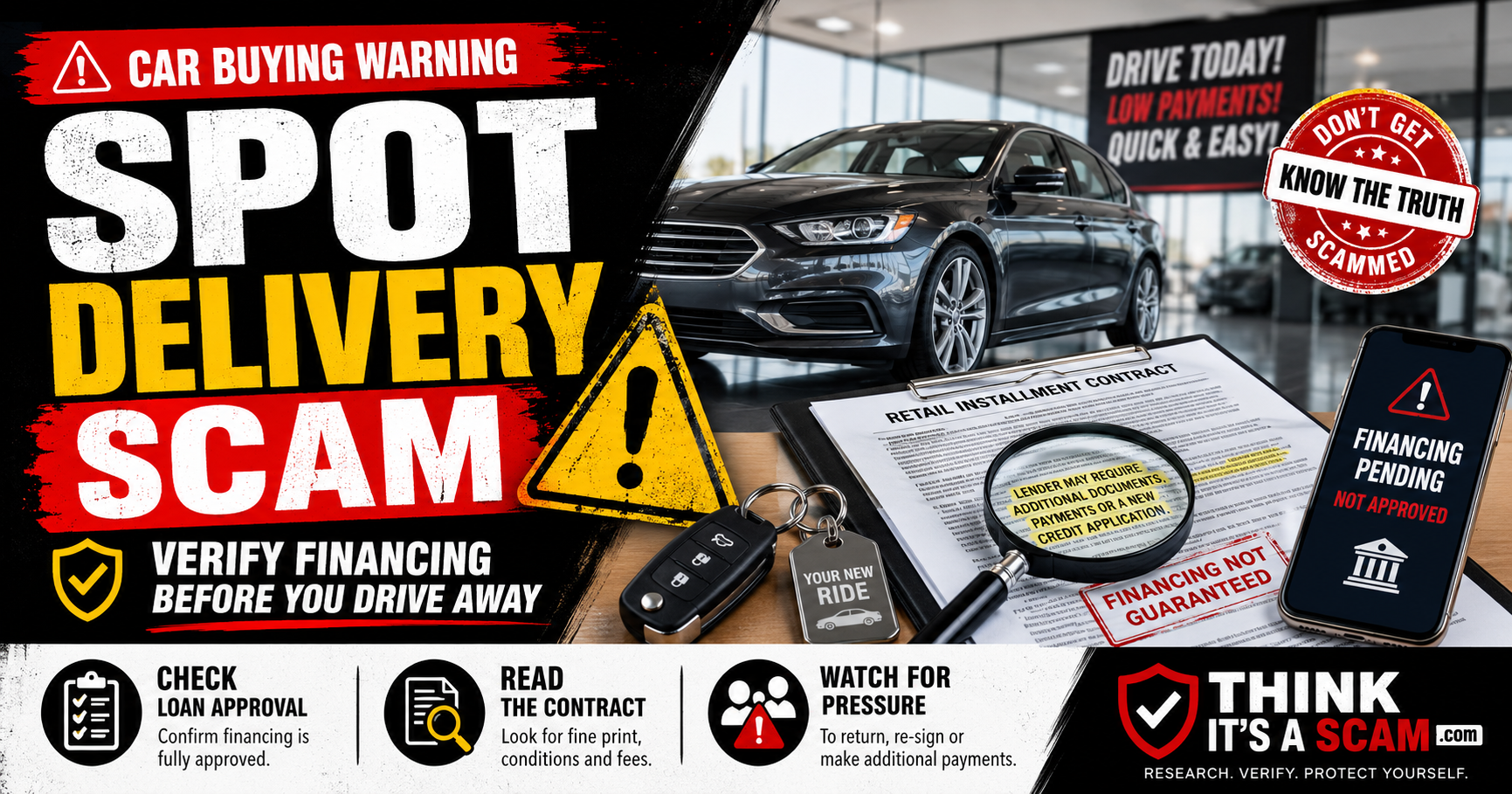
Is Spot Delivery a Scam?
Spot delivery itself is not necessarily a scam. Many dealerships use conditional delivery when a customer buys a vehicle at night, on a weekend, or before a bank or finance company has issued final approval.
The dealership may believe that a lender will accept the deal, but the loan has not yet been purchased or finalized. The buyer is allowed to take the car home while the dealer continues arranging financing.
The situation becomes a serious warning sign when the dealer:
- Told you that financing was final when it was not.
- Did not clearly disclose that the delivery was conditional.
- Calls you back days or weeks later with significantly worse terms.
- Claims you must sign immediately or face arrest or criminal charges.
- Refuses to return your down payment after canceling the original deal.
- Refuses to return your trade-in or its agreed value.
- Sold your trade-in before the financing was completed.
- Threatens repossession without explaining the contractual basis.
- Asks you to sign documents with blank spaces or changed numbers.
- Adds warranties, insurance, GAP coverage, or other products you did not approve.
This abusive version may be described as a spot delivery scam, yo-yo sale, yo-yo financing, conditional delivery scam, or financing switch.
How the Spot Delivery Scam Works
The exact details vary, but a typical spot delivery or yo-yo financing dispute follows this pattern:
- You select a vehicle and apply for financing through the dealership.
- The dealer presents an interest rate, monthly payment, down payment, and loan term.
- You sign purchase and financing paperwork.
- You provide a deposit, trade in another vehicle, or both.
- The dealer lets you drive the new vehicle home.
- You believe the purchase and loan are complete.
- Days later, the dealership says the bank rejected the financing.
- The dealer tells you to return and sign another agreement.
- The replacement agreement has a higher rate, higher payment, longer term, additional down payment, co-signer requirement, or added products.
- The dealer pressures you by saying your trade-in is gone, your deposit cannot be refunded, or the new vehicle will be repossessed.
The buyer may feel trapped because the new car is already in the driveway, friends and family have seen it, insurance has been changed, the old vehicle has been traded in, and transportation plans now depend on the new vehicle.
That emotional and financial pressure is what gives yo-yo financing its name. The buyer is pulled back to the dealership after believing the transaction was finished.
What Is a Spot Delivery Agreement?
A spot delivery agreement is a document stating that the buyer may take the vehicle before financing is final. It may also be called:
- A conditional delivery agreement.
- A bailment agreement.
- A borrowed vehicle agreement.
- A financing contingency agreement.
- A temporary delivery agreement.
- A rescission or unwind agreement.
The document may say that the dealer has a certain number of days to place the loan with a bank or finance company. If the dealer cannot obtain financing under the expected conditions, the agreement may require the vehicle to be returned.
It may also discuss mileage, damage, insurance, deposits, trade-ins, temporary registration, and what happens if the transaction is canceled.
Do not assume the large retail installment contract is the only document that matters. A conditional-delivery clause may appear in a separate form or in smaller language within the purchase documents.
Warning Signs of a Yo-Yo Financing Scam
The Dealer Said You Were Fully Approved
Be cautious if the salesperson or finance manager repeatedly said that you were “approved,” “all set,” or “completely done,” but later claims the agreement was only conditional.
Compare those statements with the written documents. Save texts, emails, voicemails, advertisements, and notes about what dealership employees told you.
The New Financing Is Much More Expensive
A major warning sign is being called back for a new contract containing:
- A higher annual percentage rate.
- A larger monthly payment.
- A longer repayment period.
- A larger down payment.
- A lower value for your trade-in.
- A co-signer requirement.
- Additional warranties or insurance.
- New fees that were not previously disclosed.
Do not focus only on whether the monthly payment looks affordable. A longer loan can reduce the monthly payment while substantially increasing the total amount you pay.
You Are Told to Sign Immediately
Statements such as “come in today,” “sign before we close,” or “you have one hour to decide” are pressure tactics.
You should be allowed to review the proposed agreement, compare it with the original documents, contact the lender, and obtain independent advice.
The Dealer Will Not Explain Why Financing Failed
Ask the dealership to identify the lender that declined or rejected the original transaction and to provide the reason in writing when available.
Contact the lender using independently verified contact information. Do not rely only on a phone number supplied during a pressured dealership conversation.
The Dealer Refuses to Return Your Property
A dealer may try to make the buyer feel that walking away is impossible because the deposit is “nonrefundable” or the trade-in has already been sold.
Your rights depend on your contract and state law. Do not accept a verbal refusal as the final answer. Request a written explanation and an itemized accounting of all money and property involved.
The Dealer Threatens Arrest
A dealer may have contractual rights to request the return of a vehicle if a genuinely conditional transaction cannot be financed. That does not mean every disagreement is automatically theft or a criminal matter.
Do not hide, damage, abandon, or sell the vehicle. At the same time, do not sign a more expensive contract solely because someone threatens police action. Preserve the messages and contact a consumer attorney, legal aid office, state attorney general, or motor vehicle dealer regulator promptly.
Can the Dealer Raise the Interest Rate After You Drive Home?
A dealer may attempt to renegotiate the financing if the original sale was clearly conditional and a lender would not accept the agreement.
However, that does not automatically mean you must accept the higher rate or different terms. You can normally reject a replacement financing offer that you do not want.
The next step may be to enforce the original agreement, arrange different financing, pay the balance through another method, or unwind the transaction. Which option applies depends on the contracts you signed and the laws in your state.
Ask the dealer to show you the exact contract language allowing the financing terms to be changed or the transaction to be canceled.
What to Do When the Dealer Says Financing Fell Through
Do not panic, and do not immediately sign another agreement. Take the following steps:
- Ask for the problem in writing. Request the name of the lender, the date the dealer learned of the problem, and the reason the original financing was not completed.
- Review every original document. Look for terms such as conditional delivery, spot delivery, bailment, assignment, lender approval, financing contingency, rescission, or unwind.
- Compare the original and new terms. Check the sale price, interest rate, APR, monthly payment, loan length, amount financed, down payment, trade-in value, fees, and add-ons.
- Contact the lender independently. Verify whether the lender received your application and whether the dealer’s explanation is accurate.
- Do not sign blank or incomplete documents. Every field should be completed before you sign.
- Keep the vehicle insured. Do not cancel insurance while the dispute is unresolved.
- Limit unnecessary mileage. The dealer may claim mileage or damage charges if the transaction is unwound.
- Preserve all evidence. Save contracts, receipts, texts, emails, voicemails, credit applications, advertisements, and photographs.
- Check state-specific law. Contact your state attorney general, consumer protection office, dealer licensing agency, legal aid organization, or a consumer attorney.
- Communicate in writing. Follow phone conversations with an email summarizing what was said.
Do You Have to Sign the New Car Loan?
You do not have to accept a replacement loan simply because the dealer says it is the only financing now available.
You may decide that the new rate, payment, term, or down payment is unacceptable. Tell the dealer in writing that you do not agree to the replacement terms.
Do not sign merely because you are embarrassed about returning the car or because the dealership says your trade-in has already been sold. Signing creates another contract and may make the dispute more difficult.
Before signing, calculate the total cost of the replacement loan over its entire term. A small increase in the rate or term can add thousands of dollars to the final cost.
What If You Already Signed the New Agreement?
If you signed replacement financing under pressure, gather copies of both the original and replacement agreements immediately.
Write down:
- What you were originally promised.
- When the dealer first said financing was complete.
- When you were told that the financing failed.
- What threats or pressure were used.
- How the new agreement differs from the first one.
- Whether your trade-in or deposit was used as leverage.
- Whether you were given time to read the new documents.
Contact a consumer attorney or legal aid organization familiar with automobile sales and financing. The effect of signing a second agreement depends on the documents, disclosures, state law, and circumstances surrounding the transaction.
What If the Dealer Wants the Car Back?
Do not ignore the request or assume that keeping the vehicle will resolve the problem. Read the conditional delivery documents and obtain state-specific legal advice promptly.
If you decide or are advised to return the vehicle:
- Photograph and video the interior and exterior.
- Record the mileage and fuel level.
- Remove your personal belongings and personal data from the vehicle.
- Bring a witness when possible.
- Ask the dealership to inspect the vehicle while you are present.
- Obtain a signed receipt showing the date, time, mileage, condition, keys returned, and identity of the employee accepting it.
- Get the cancellation or unwind terms in writing.
- Request written confirmation of what will happen to your deposit and trade-in.
Do not leave the vehicle at an unattended lot without proof that an authorized dealership representative accepted it.
Can the Dealer Keep Your Down Payment?
Whether a dealer can deduct mileage, damage, rental charges, or other amounts depends on the contract and state law.
If the dealer cancels the transaction because it could not obtain financing, request the return of your down payment in writing. Ask the dealership to identify the exact contract provision or law supporting any deduction.
Do not accept an unexplained statement that all deposits are automatically nonrefundable. Request an itemized written accounting.
If the dealership refuses to return money that you believe is owed, include that refusal in complaints filed with the appropriate consumer agencies.
What If the Dealer Sold Your Trade-In?
A sold trade-in can make a spot delivery dispute especially serious. Ask for written confirmation of:
- Whether the trade-in has actually been sold.
- The date it was sold.
- The amount received.
- Whether an existing loan was paid off.
- How the agreed trade-in value will be returned or credited.
- Whether the title has been transferred.
State laws differ on when a dealer may sell a trade-in and what compensation is required if the original transaction is canceled.
Do not agree to worse financing merely because the dealership says returning your old car is inconvenient. Contact your state’s dealer regulator or a consumer attorney if the trade-in cannot be returned.
Does the Three-Day Cooling-Off Rule Apply?
Do not assume that every dealership purchase includes a federal three-day right to cancel.
The federal Cooling-Off Rule generally applies to certain sales made at a consumer’s home, workplace, dormitory, or temporary seller location. A typical vehicle purchase completed at a dealership usually does not receive an automatic federal three-day cancellation period under that rule.
A state law, dealership policy, written return guarantee, conditional-delivery agreement, or another contractual right may still allow the transaction to be canceled.
Read the documents rather than relying on a general belief that every major purchase can be canceled within three days.
How to Avoid a Spot Delivery Problem
- Arrange financing through a bank or credit union before visiting the dealership.
- Ask whether the financing is final before taking the vehicle.
- Get the answer in writing.
- Ask whether any spot delivery, conditional delivery, or bailment agreement is included.
- Do not sign documents containing blanks.
- Take copies of every document before leaving.
- Confirm the interest rate, APR, payment, loan term, sale price, and total amount financed.
- Verify that optional products were not added without permission.
- Ask what happens to your deposit and trade-in if financing is rejected.
- Consider leaving your trade-in with you until financing is confirmed.
- Do not rely solely on verbal promises.
- Be prepared to leave without the vehicle if the dealer will not clearly explain whether financing is final.
Questions to Ask Before Taking the Car Home
- Has a specific lender given final approval?
- What is the lender’s name?
- Has the lender accepted the exact interest rate and loan term shown in the contract?
- Is this a spot delivery or conditional delivery?
- How long does the dealership have to finalize financing?
- Can the dealer change the rate or payment later?
- What happens if I reject replacement financing?
- Will my full down payment be returned?
- Will my trade-in be held until financing is final?
- Are there mileage or damage charges if the transaction is canceled?
- Can I have all of these answers in writing?
Where to Report a Spot Delivery Scam
First, send the dealership a written description of the problem and the resolution you are requesting. Keep a copy and proof of delivery.
If the problem is not resolved, possible complaint routes include:
- ReportFraud.ftc.gov – Report potentially deceptive dealership conduct to the Federal Trade Commission.
- Consumer Financial Protection Bureau Complaint – For problems involving an auto lender, finance company, loan servicer, or certain buy-here-pay-here dealers.
- State Consumer Protection Offices – Find your state attorney general or consumer protection agency.
- USAGov Vehicle Complaint Guide – Find the appropriate agency for dealer, lender, manufacturer, or vehicle complaints.
- Your state motor vehicle dealer licensing board or department of motor vehicles.
- A local legal aid office, consumer attorney, or bar association referral service.
- Your military installation’s legal assistance office if you are a servicemember.
Include copies of your contracts, payment records, trade-in documents, advertisements, communications, and a timeline of what happened.
Frequently Asked Questions
What is a spot delivery scam?
A spot delivery scam generally refers to an abusive yo-yo financing transaction. A dealer lets a customer take a vehicle home before financing is final, then calls the customer back and pressures them to accept a higher rate, larger down payment, longer term, or other worse conditions.
Is spot delivery legal?
Spot delivery is permitted or regulated in many states, but the requirements differ. Misrepresenting that financing is final, failing to provide required disclosures, withholding property improperly, or changing terms outside a legally permitted period may violate state or federal consumer protection laws.
Can a dealership change my interest rate after I sign?
The dealership may attempt to offer different financing if the original transaction was clearly conditional and no lender accepted it. You are not automatically required to accept the new rate. Review the agreement and state law before deciding what to do.
Do I have to return the car if financing falls through?
You may have to return the vehicle if your signed agreement clearly states that delivery was conditional and financing was not completed. However, the dealer may also have obligations involving notice, deadlines, deposits, and trade-ins. Obtain state-specific advice rather than ignoring the request.
Can the dealer keep my deposit?
Not necessarily. The answer depends on the contract, the reason the transaction failed, vehicle condition, mileage, and state law. Request a written and itemized explanation of any amount the dealer refuses to return.
Can a dealer sell my trade-in before financing is approved?
Rules differ by state. If the trade-in has been sold and the original transaction is canceled, you may be entitled to its agreed value or another remedy. Contact your state dealer regulator or a consumer attorney.
How long does a dealership have to find financing?
There is no single nationwide deadline that applies to every spot delivery. The contract and state law may establish a specific number of business or calendar days.
Can the dealer have me arrested for not returning the car?
A dealer may threaten legal action when a conditional transaction fails, but a contract dispute is not automatically proof of vehicle theft. Do not conceal or dispose of the vehicle. Preserve the threats, communicate in writing, and seek legal help immediately.
Should I sign the second contract?
Do not sign until you understand why the first agreement failed, how the terms changed, and what alternatives are available. You can reject replacement financing that is unaffordable or materially worse.
Bottom Line: Spot Delivery Scam or Legitimate Practice?
Spot delivery is a legitimate conditional financing practice when the dealer clearly explains that financing is not final and follows the applicable contract and state requirements.
It becomes a potential yo-yo financing scam when the dealer makes the buyer believe the transaction is complete, later demands worse terms, and uses the vehicle, deposit, trade-in, or threats as leverage.
The safest approach is to arrange financing before shopping or wait until the dealership confirms final lender approval in writing. If you have already taken the vehicle home and the dealer is changing the deal, do not sign immediately. Preserve your documents, verify the financing directly, and obtain state-specific consumer or legal assistance.
Official Consumer Resources
- CFPB Guidance on Spot Delivery and Yo-Yo Financing
- FTC: Avoiding a Yo-Yo Financing Scam
- FTC Guide to Financing or Leasing a Car
- USAGov: Where to File a Vehicle Complaint
- State Consumer Protection Office Directory
- Report Fraud to the FTC
Related Scam Warnings
TIAS is expanding its vehicle purchase and automotive fraud coverage. You may also want to review:
Have You Experienced a Spot Delivery Problem?
Share your experience below to help other car buyers understand how these transactions work.
- Did the dealer tell you that financing was final?
- How many days passed before the dealer called?
- Did the interest rate or monthly payment increase?
- Were you asked for a larger down payment or co-signer?
- Did the dealer return your deposit?
- Was your trade-in returned or sold?
- Did you reject the replacement financing?
- Were you able to resolve the problem through a regulator or attorney?
Please do not post your Social Security number, driver’s license number, vehicle identification number, loan account number, home address, payment card information, credit application, or unredacted contract documents in the comments.
If a vehicle transaction also involves a request to buy a history report, see our VINClarity guide.
Disclaimer
ThinkItsAScam.com is an independent consumer information website. This article is for general educational purposes and does not provide legal or financial advice. Spot delivery is not automatically fraudulent, and dealership obligations vary by contract and state law. The term “spot delivery scam” is used here to discuss potentially deceptive or abusive yo-yo financing practices, not to accuse every dealership, salesperson, lender, spot delivery agreement, or conditional vehicle sale of fraud. Consult a qualified attorney or appropriate consumer protection agency for advice about your specific transaction.
Leave a Reply