Consumers searching for “RTX 5070 swap scam”, “RTX 5070 wrong item”, or “RTX 5070 Ti scam” are often trying to figure out what happened after ordering an expensive graphics card and finding something completely different inside the package.
Documented cases involving modern NVIDIA GPUs have included buyers receiving lower-value graphics cards, altered cards, missing GPU components, rocks, and even a bag of salt instead of the graphics card they ordered.
This type of scheme is often described as a GPU return-swap scam, box swap, return fraud, or switcheroo scam.
If this happened to you, do not throw away the box or immediately ship the item back. First, document exactly what arrived.
Quick Verdict
GPU return-swap fraud is real, but receiving the wrong graphics card does not automatically mean the retailer or seller intentionally scammed you.
A previous buyer may have removed the valuable GPU and returned a substituted product. A third-party seller may have misrepresented an item. A warehouse may have mistakenly restocked a tampered return. A shipping or fulfillment error is also possible.
The priority is to preserve evidence showing what you ordered, what package arrived, and what was actually inside it.
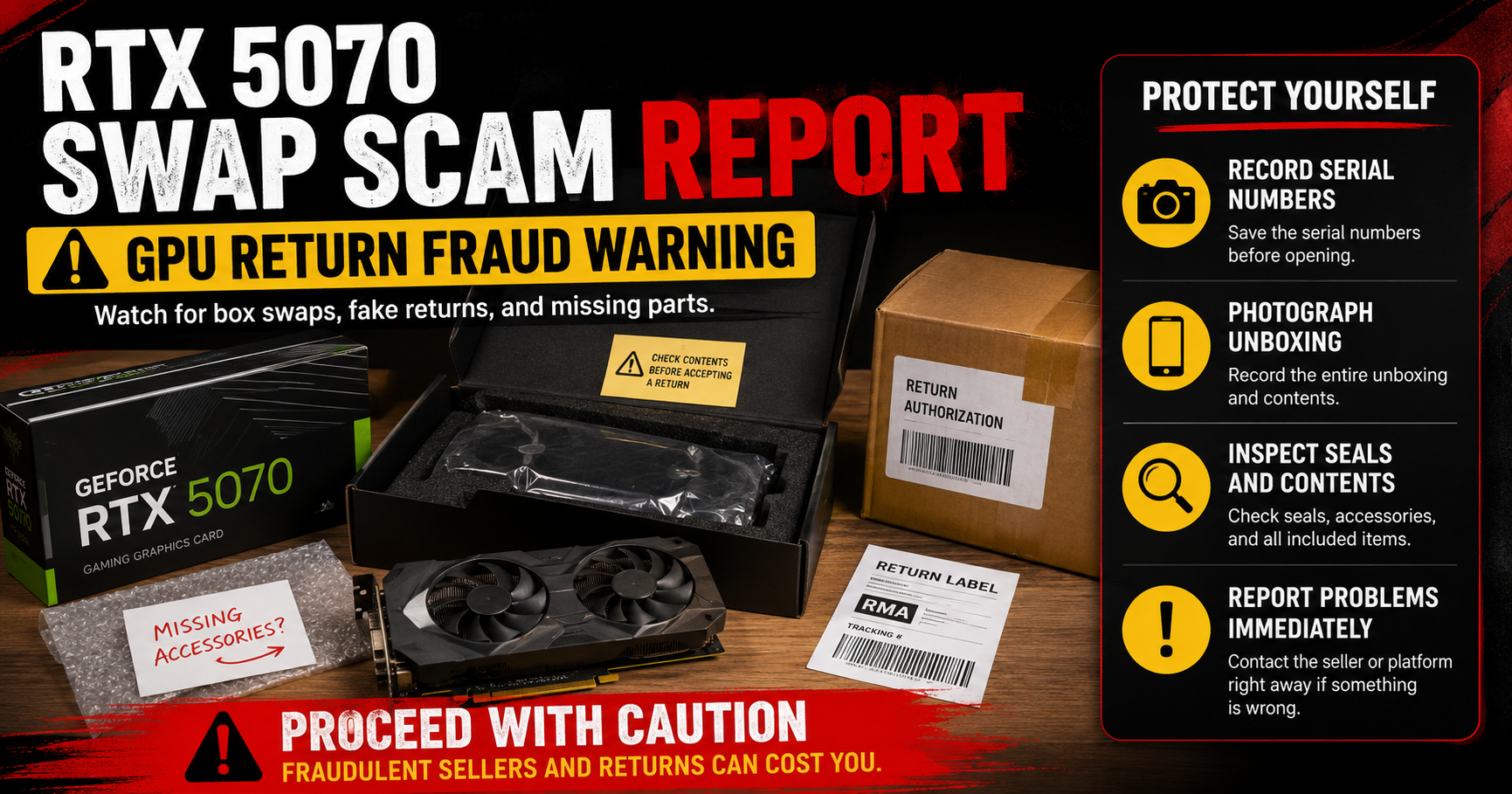
RTX 5070 and other high-value graphics cards can be targeted by return-swap fraud. Photograph packaging, seals, model numbers, serial numbers, and the complete unboxing before discarding anything.
What Is an RTX 5070 Swap Scam?
A GPU return-swap scam can happen when someone buys an expensive graphics card, keeps the valuable product or components, substitutes something cheaper, and sends the altered package back for a refund.
If the returned package is not fully inspected before being placed back into inventory, another customer may later receive it.
A basic version may work like this:
- A buyer orders a high-value graphics card.
- The real GPU is removed.
- A cheaper GPU, electronic component, or object of similar weight is placed inside.
- The package is resealed and returned.
- The return passes inspection or is mistakenly restocked.
- An innocent customer later receives the altered package.
More sophisticated schemes may involve swapping model labels, removing the GPU die or memory modules, replacing serial-number stickers, or using a lower-tier card that looks similar to the advertised model.
Are RTX 5070 Swap Scams Actually Happening?
Yes. Public reports involving RTX 50-series graphics cards show that several versions of this problem have occurred.
RTX 5070 Ti Replaced With Salt
In August 2025, Tom’s Hardware reported that a PC hardware enthusiast who ordered an RTX 5070 Ti through Amazon recorded the unboxing and discovered a bag of table salt inside the graphics-card package.
The video provided unusually useful evidence because it documented the package as it was being opened.
RTX 5080 Box Contained an RTX 5060 Ti
In January 2026, another reported case involved a buyer who ordered an ASUS RTX 5080 and received what appeared to be a relabeled RTX 5060 Ti instead.
The lower-tier card reportedly had physical differences that helped identify it, including a different power connector.
RTX 5090 Returned With Important Components Removed
In March 2026, Tom’s Hardware reported a case from the seller’s side of the transaction. An eBay seller said a working RTX 5090 was returned after the GPU die and memory components had allegedly been removed.
The outside of the card still appeared relatively normal, showing why sophisticated hardware swaps can be difficult to detect during a quick return inspection.
These reports do not mean every retailer, seller, warehouse, or returned GPU is affected. They demonstrate why buyers and sellers of high-value PC hardware should document transactions carefully.
What Might Be Inside a Swapped GPU Box?
Reported incidents involving graphics cards have included:
- A lower-value graphics card
- An older GPU
- Broken circuit boards
- Unrelated electronic components
- Cards with altered labels
- A GPU with valuable internal components removed
- Rocks or other weight-matching objects
- A bag of salt or similar material
Fraudsters may attempt to match the approximate package weight so that a simple warehouse weight check does not reveal the substitution.
Why Are RTX 50-Series GPUs Attractive Targets?
High-end graphics cards combine several characteristics that make them attractive for return fraud:
- High resale value
- Compact physical size relative to value
- Strong demand
- Multiple visually similar models
- Active used and resale markets
- Valuable GPU and memory components
High prices can also make buyers more willing to purchase quickly when they see limited inventory or an unusually attractive price.
Check the Package Before Opening It
When receiving an expensive graphics card, inspect the shipping package before breaking any seals.
Look for:
- Extra tape
- Damaged or doubled seals
- Torn cardboard
- Labels placed over other labels
- Unexpected warehouse or return stickers
- Evidence that the retail box was previously opened
- An unusually light or heavy package
- Items moving inside the package when they normally should not
Do not assume a clean-looking seal proves the contents have never been disturbed. Packaging and labels can sometimes be replaced or carefully resealed.
Should You Record the GPU Unboxing?
For a high-value GPU, recording the unboxing can be worthwhile.
A useful continuous video can show:
- The unopened shipping box.
- The shipping label.
- The condition of the package.
- The retail box and security seals.
- The box being opened.
- The contents as they are first revealed.
- The model and serial-number labels.
An unboxing video does not guarantee that a retailer, marketplace, card issuer, or court will decide a dispute in your favor.
It can, however, create valuable documentation showing the condition and contents of the shipment when you opened it.
Photograph the Serial Numbers Before Installation
Before installing an expensive graphics card, photograph:
- The model number on the retail box
- The serial number on the box
- The model label on the GPU
- The serial number on the GPU
- Warranty or security labels
- The power connector
- The physical condition of the card
Compare the identifying information on the product with the box and your invoice.
This can also be valuable later if a serial-number label becomes damaged or difficult to read.
How to Tell If You Received the Wrong GPU
A lower-end graphics card may resemble the model you ordered, especially within the same manufacturer’s product family.
Check the:
- Exact model number
- Serial number
- Power connector type
- Number and position of fans
- Display outputs
- Card dimensions
- Manufacturer labels
- Packaging accessories
If the card can be safely installed, trusted hardware-identification software may also show the GPU model and device information.
If something appears obviously altered, damaged, or inconsistent, document the condition before doing additional troubleshooting or disassembly.
Do Not Disassemble a Suspicious GPU Immediately
If you suspect that a newly delivered GPU was tampered with, avoid immediately removing the cooler or taking the card apart unless instructed to do so by the retailer or manufacturer.
Disassembly can complicate a dispute because the seller may later question when the product was altered.
Photograph the condition first and contact the retailer.
What to Do If You Received the Wrong Item
1. Stop and Document Everything
Before repacking anything, take photos and video of:
- The shipping package
- The shipping label
- The retail box
- Security seals
- Model and serial numbers
- Packing material
- The item actually received
- The invoice or packing slip
2. Keep Every Piece of Packaging
Do not discard:
- The shipping carton
- Retail packaging
- Plastic bags
- Foam inserts
- Labels
- Tape
- Accessory boxes
- Receipts
3. Contact the Retailer or Marketplace Immediately
Open a support case as soon as possible.
Clearly explain that the product received was not the product ordered.
Provide the order number and offer photographs or video showing the discrepancy.
4. Get the Return Instructions in Writing
Do not automatically ship an expensive GPU back to an address supplied through an unfamiliar message.
Use the retailer’s official support process and save the:
- Return authorization
- Return address
- Shipping label
- Tracking number
- Drop-off receipt
- Proof of delivery
5. Ask for Escalation if Necessary
If ordinary customer service cannot resolve the problem, ask whether the case can be escalated to a returns, fraud, account-review, or higher-level support team.
Keep your explanation factual and consistent.
Can You Dispute the Credit Card Charge?
If the retailer or marketplace does not resolve the problem, contact your card issuer promptly and ask about its merchandise-dispute process.
The Federal Trade Commission explains that credit-card billing errors can include items that were not accepted or were not delivered as agreed.
Federal credit-card protections include important deadlines. The FTC advises consumers to contact the card issuer immediately and, to preserve Fair Credit Billing Act rights, send the required written dispute within 60 days after the first statement containing the billing error was sent.
Include copies of useful documentation such as:
- The original listing
- Receipt
- Order confirmation
- Photos
- Unboxing video
- Serial numbers
- Tracking information
- Support correspondence
- Return receipts
Debit-card protections can differ from credit-card protections, so contact your bank promptly if you paid by debit card.
Why a Credit Card Is Usually Safer for Expensive Online Purchases
The FTC recommends credit cards as a safer payment method for online shopping because federal law provides dispute rights when something goes wrong with the transaction.
For an expensive GPU, avoid sellers that insist on payment through:
- Gift cards
- Wire transfers
- Cryptocurrency
- Payment outside a marketplace’s official checkout
Those payment methods can make recovery much harder.
Should You File a Police or IC3 Report?
If a high-value graphics card was deliberately replaced, stolen, or fraudulently substituted, you may also consider documenting the incident with appropriate authorities.
The FBI’s Internet Crime Complaint Center accepts reports involving suspected internet-enabled fraud.
A police or IC3 report does not guarantee a refund, but a report number may provide additional documentation showing that you formally reported the incident.
FBI Internet Crime Complaint Center
Buying New vs. Open-Box or Marketplace GPUs
An open-box or used graphics card is not automatically unsafe.
However, a previously returned item may deserve additional inspection because another consumer has already possessed it.
Before buying expensive hardware from a marketplace or resale listing:
- Check who actually sells the product.
- Review the seller’s history and feedback.
- Read the return policy.
- Confirm the marketplace’s buyer-protection rules.
- Keep screenshots of the listing.
- Avoid prices dramatically below the normal market.
- Use the marketplace’s own payment system.
The FTC also recommends checking marketplace refund rules before purchasing and keeping records of the listing and seller communications.
Could It Be a Warehouse Mistake Instead of a Scam?
Yes.
Receiving the wrong item does not by itself prove criminal fraud.
Possible explanations include:
- A prior customer committed return fraud.
- A seller intentionally misrepresented the item.
- A return was incorrectly inspected and restocked.
- A warehouse selected the wrong product.
- Labels were applied incorrectly.
- A shipment was damaged or altered in transit.
When contacting support, describe what happened rather than making claims about who caused it before the facts are known.
How to Reduce the Risk of a GPU Swap Problem
- Buy from established retailers or sellers with strong histories.
- Check whether the item is new, used, refurbished, open-box, or resale.
- Review the return policy before ordering.
- Use a credit card when possible.
- Save the original product listing.
- Record the delivery and unboxing of very expensive hardware.
- Photograph model and serial numbers immediately.
- Inspect seals and packaging.
- Verify the exact GPU before discarding the box.
- Report discrepancies immediately.
Official Consumer Resources
- FTC Online Shopping Guidance – Shopping safety, payment methods, records, returns, and disputes.
- FTC Credit Card and Billing Disputes – Federal guidance on disputing credit-card charges.
- FBI IC3 – Report suspected internet-enabled fraud.
- CustomerServiceNumbers.com – Locate customer-service contacts for major retailers and manufacturers.
- CorporateOfficeHeadquarters.com – Find corporate contact information and consumer reviews.
Related Think It’s a Scam Articles
Rather than linking broadly to unrelated scams, these articles are more useful for consumers researching questionable online purchases:
Frequently Asked Questions
Is the RTX 5070 swap scam real?
Return-swap fraud involving high-value graphics cards is real. Public reports have documented RTX 50-series buyers receiving substituted products or packages with the graphics card missing. That does not mean every wrong-item delivery was intentionally caused by the retailer.
Has an RTX 5070 Ti really been replaced with something else?
Yes. A widely reported August 2025 case involved an RTX 5070 Ti order in which the recipient recorded an unboxing and reportedly found a bag of table salt inside the package.
What should I do if my GPU box contains the wrong item?
Stop, photograph the entire package and contents, preserve all packaging, contact the retailer immediately, and save all support and return documentation.
Should I return the wrong GPU immediately?
Contact the retailer first and obtain official return instructions. Document the item and packaging thoroughly before shipping it back.
Should I film myself opening an expensive GPU?
It can be helpful. A continuous video showing the shipping label, unopened package, seals, and contents may strengthen your documentation, although it does not guarantee that a dispute will be decided in your favor.
What if the box contains a cheaper graphics card?
Photograph the card before installing or altering it. Compare its exact model number, labels, serial number, connectors, and physical design with the product you ordered.
Can I dispute the purchase with my credit card company?
Possibly. The FTC explains that credit-card billing disputes can cover merchandise that was not delivered as agreed. Contact the card issuer promptly and follow its dispute requirements and federal deadlines.
Does an Amazon, eBay, or marketplace order guarantee the GPU is genuine?
No marketplace can eliminate all fraud, fulfillment mistakes, or tampered returns. Check who the actual seller is, review buyer-protection policies, and inspect expensive hardware promptly after delivery.
Have You Experienced a GPU Swap?
If you ordered an RTX 5070, RTX 5070 Ti, RTX 5080, RTX 5090, or another expensive graphics card and received something different, share the non-sensitive details of your experience below.
- Which GPU did you order?
- Was it sold as new, used, open-box, or refurbished?
- Did the package appear previously opened?
- What was actually inside?
- Did model or serial numbers match?
- Did you record the unboxing?
- How did the retailer or marketplace respond?
- Did you receive a refund or replacement?
Please do not post your order number, full name, home address, telephone number, payment-card information, account login, tracking number, or other sensitive information in the comments.
Page researched and reviewed: September 18, 2026.
Disclaimer
ThinkItsAScam.com is an independent consumer-information website and is not affiliated with NVIDIA, Amazon, eBay, ASUS, MSI, any graphics-card manufacturer, retailer, marketplace, shipping company, the Federal Trade Commission, or the FBI.
This article discusses publicly reported GPU return-fraud incidents and general consumer-protection steps. Individual reports do not establish that a retailer, marketplace, manufacturer, seller, warehouse, or carrier intentionally participated in fraud. Specific refund, chargeback, warranty, and legal rights vary by transaction and circumstances.
Leave a Reply