If you searched for Jones Day scam, Jones Day scam email, Jones Day text scam, or Jones Day impersonation scam, you may have received an unexpected legal notice, payment demand, inheritance message, recovery offer, job interview request, email, text, phone call, or social-media message using the Jones Day name.
Jones Day is a legitimate international law firm. The scam concern is different: Jones Day has issued an official warning that criminals are impersonating the firm and its lawyers to persuade people to send money or disclose personal and financial information.
A message can display a real Jones Day lawyer’s name, photograph, biography, signature, logo, or professional-looking letterhead and still be fraudulent.
Quick Verdict
Jones Day is legitimate, but Jones Day impersonation scams are real. The firm warns about fake emails, texts, phone calls, messaging-app contacts, social-media accounts, fraudulent websites, forged documents, payment demands, inheritance claims, recovery offers, and fake job interviews. Do not send money or sensitive information until you independently verify the communication through JonesDay.com.
Share Your Jones Day Scam Experience ↓
On this page:
What is the scam? ·
Official warning ·
Common messages ·
How to verify ·
2026 security incident ·
If you paid ·
If you shared information ·
Where to report
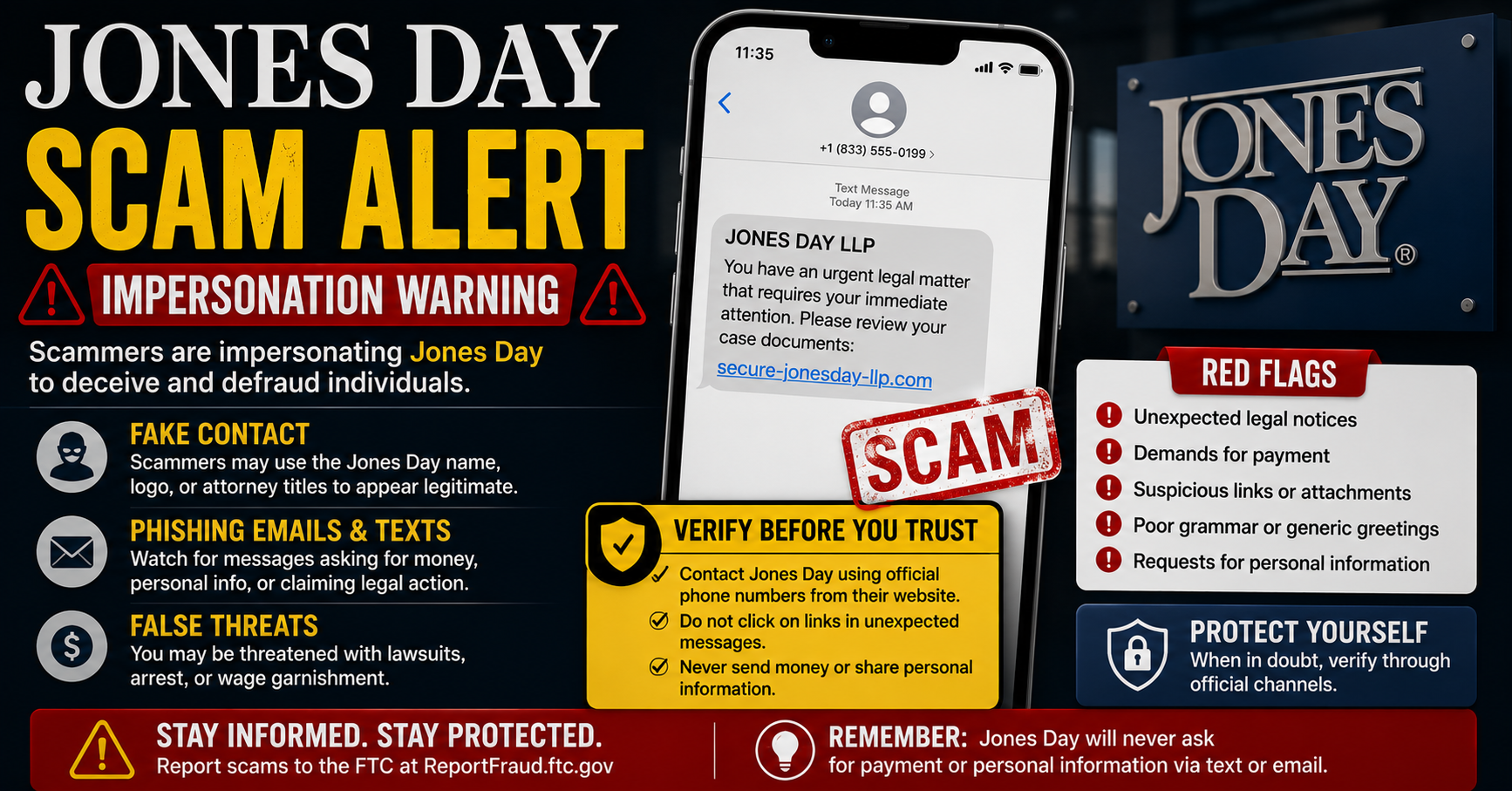
Jones Day is a legitimate law firm, but criminals can copy real attorney names, logos, signatures, and legal language. Verify unexpected communications through JonesDay.com before responding or paying.
What Is the Jones Day Scam?
The phrase Jones Day scam generally refers to criminals impersonating Jones Day, its attorneys, or supposed representatives of the firm.
The actual law firm is not the scam.
An impersonator may claim to be:
- A Jones Day attorney
- A paralegal or legal assistant
- A firm representative
- An investigator
- A claims or settlement administrator
- An inheritance attorney
- A recruiter or hiring manager
- A fraud-recovery specialist
- An attorney who can recover cryptocurrency or investment losses
The scammer uses the reputation of a real law firm to make an invented legal, financial, employment, or recovery story appear legitimate.
Jones Day’s Official Fraud Warning
Jones Day published an official fraud notice warning that criminals have attempted to impersonate the firm and its lawyers.
The firm says these schemes may arrive through:
- Text messages
- Telephone calls
- Messaging apps
- Social-media accounts
- Fraudulent websites
Jones Day also warns that impersonators may use:
- Forged legal documents
- Copied lawyer biographies
- Copied signatures
- Look-alike email domains
- Real lawyer names
- Professional-looking payment instructions
Read the firm’s current Official Jones Day Fraud Notice.
Important Jones Day Payment Warning
Jones Day states that it does not solicit payments or provide payment instructions for legal services through unsolicited social-media in-app messages, mobile texts, or emails. An unexpected message telling you to send money should be independently verified before any payment is made.
Common Jones Day Scam Messages
Urgent Legal Payment or Invoice
A message may claim that you owe:
- A legal fee
- An overdue invoice
- A settlement payment
- A tax liability
- A court-related charge
- An administrative fee
The sender may threaten legal consequences or insist that the payment must be made immediately.
Inheritance or Settlement Scam
A supposed Jones Day attorney may claim that you are entitled to:
- An inheritance
- An estate distribution
- An insurance payment
- A court settlement
- Unclaimed funds
You are then told that a legal fee, tax, transfer cost, administrative charge, or other payment is required before the money can be released.
That closely matches the classic advance-fee scam pattern. See our Advance-Fee Scam Warning for a detailed explanation of pay-first inheritance, settlement, refund, loan, and recovery scams.
Cryptocurrency or Scam-Recovery Offer
Another variation targets people who have already lost money.
The impersonator may claim Jones Day can recover:
- Stolen cryptocurrency
- Investment losses
- Money sent to another scammer
- Funds supposedly frozen by a bank or exchange
- Assets connected with an international investigation
The victim is then asked to pay a retainer, tax, administrative fee, processing charge, recovery fee, or other upfront payment.
The Federal Trade Commission warns that recovery scammers sometimes pretend to represent law firms specifically because the legal connection makes the recovery story sound credible.
Fake Jones Day Job Interview
Jones Day’s fraud notice specifically warns about suspicious interview requests conducted through chat or text.
A fake recruiter may:
- Offer a remote position you never applied for
- Conduct an interview entirely by text or messaging app
- Ask for bank information for payroll
- Request copies of identity documents
- Send a fake check for equipment
- Tell you to send money to a supposed equipment vendor
Verify any Jones Day recruiting communication through the firm’s official website rather than through the contact information supplied by the recruiter.
Fake Legal Documents
Professional appearance does not prove authenticity.
Jones Day warns that impersonators may use:
- Firm logos
- Names of real lawyers
- Copied biographies
- Copied signatures
- Legal terminology
- Case or reference numbers
- Official-looking letterhead
- Fraudulent payment instructions
Modern editing tools make it easy to copy the visual elements of a real organization.
Warning Signs of a Fake Jones Day Communication
You Were Contacted Unexpectedly
Be cautious if someone contacts you about a lawsuit, inheritance, settlement, investigation, recovered money, invoice, or legal matter that you know nothing about.
You Are Told to Pay Immediately
Urgent requests involving wire transfers, cryptocurrency, gift cards, payment apps, prepaid cards, or other difficult-to-reverse payment methods require additional verification.
The Email Address Is Slightly Different
A fraudulent domain may contain:
- An extra letter
- A missing letter
- A hyphen
- A substituted character
- A different domain extension
Do not judge the message by the displayed sender name alone. Review the complete address and compare the named lawyer with Jones Day’s official directory.
You Are Told to Keep the Matter Secret
Scammers frequently discourage victims from speaking with:
- Their bank
- Family members
- Another lawyer
- An accountant
- An employer
- Law enforcement
Secrecy prevents other people from questioning the scammer’s story.
You Are Sent a Login Link
A fake legal notice may include a link to:
- View supposedly confidential documents
- Review a case file
- Confirm your identity
- Access a settlement portal
- Open a secure message
- Sign into Microsoft 365 or another email service
The destination may be a phishing page designed to steal your password.
How to Verify a Jones Day Email, Call, Text, or Letter
Jones Day recommends independently verifying suspicious communications rather than using contact information supplied by the sender.
- Do not reply to the suspicious message.
- Do not call the number in the message.
- Do not click links or open attachments.
- Navigate independently to JonesDay.com.
- Search for the named lawyer in the official directory.
- Locate the relevant Jones Day office independently.
- Call the published office number.
- Ask whether the lawyer and communication are genuine.
Useful official directories:
What If the Message Names a Real Jones Day Attorney?
That does not prove the message is genuine.
Jones Day specifically warns that criminals may copy lawyer biographies and signatures.
An impersonator can obtain a lawyer’s:
- Name
- Title
- Photograph
- Practice area
- Office location
- Professional biography
from publicly available information.
The correct verification method is to locate that lawyer independently through JonesDay.com and contact the firm through an official channel.
What If Caller ID Says Jones Day?
Do not rely on caller ID alone.
Caller names and telephone numbers can be spoofed.
If an unexpected caller claims to represent Jones Day:
- End the call.
- Do not provide account information or verification codes.
- Find the relevant Jones Day office independently.
- Call the official number yourself.
What If You Received a Jones Day Attachment?
Do not open an unexpected attachment merely because it looks like a legal document.
Jones Day’s fraud notice warns about forged documents, while the FTC warns that phishing emails may use links or attachments to steal login credentials or install malicious software.
If you already opened an unexpected attachment:
- Do not enable macros or unusual permissions.
- Update your security software.
- Run a trusted security scan if appropriate.
- Change passwords if you entered credentials afterward.
- Contact your employer’s IT or security team if you used a work device.
Did Jones Day Have a 2026 Cybersecurity Incident?
Yes, but it is important not to confuse that incident with the Jones Day impersonation scams described above.
In April 2026, a Jones Day spokesperson told news organizations that the firm had experienced a phishing-related cybersecurity incident in which an unauthorized third party accessed a limited number of dated files involving 10 clients.
Jones Day said the affected clients had been notified.
The security incident does not establish that an unexpected Jones Day-branded email, text, inheritance notice, recovery offer, or payment demand is connected to that event.
Jones Day Recovery Scams and Advance Fees
A supposed lawyer telling you that money has already been recovered can be particularly convincing.
The FTC warns that refund and recovery scammers may pretend to represent:
- A law firm
- A government agency
- A consumer-protection organization
- A fraud investigator
- A recovery company
The scammer then asks for money before releasing the supposed recovery.
Fees may be described as:
- A retainer
- An administrative fee
- A processing fee
- A tax
- A legal filing charge
- A transfer fee
Never rely on the caller’s claimed identity. Verify Jones Day involvement directly with Jones Day.
Business Email Compromise and Fake Legal Payment Instructions
Law firms and attorneys can also be impersonated in business email compromise schemes.
A criminal might send a business a fake message claiming:
- A settlement payment is due.
- Wire instructions have changed.
- An invoice must be paid to a new bank account.
- A confidential transaction must be completed immediately.
If your business receives unexpected banking or payment instructions, independently verify them through a known contact route.
See our BEC Scam Explained: Business Email Compromise Warning for more examples.
What If You Already Sent Money?
Act quickly.
- Stop communicating with the suspected scammer.
- Contact your bank, card issuer, wire service, cryptocurrency exchange, or payment app immediately.
- Ask whether the transaction can be stopped, recalled, frozen, or reversed.
- Preserve the message and payment instructions.
- Save phone numbers, email addresses, websites, account numbers, wallet addresses, and receipts.
- Report the impersonation to the platform used to contact you.
- File a report with the FBI Internet Crime Complaint Center when appropriate.
Speed can be especially important with wire transfers and other fast-moving payments.
What If You Shared Personal Information?
If you gave an impersonator passwords, financial information, identification documents, a Social Security number, or authentication codes:
- Change compromised passwords immediately.
- Change the password anywhere else it was reused.
- Enable multi-factor authentication.
- Review recent account login activity.
- Contact your bank or card issuer when financial information was shared.
- Monitor bank and credit-card accounts.
- Review your credit reports.
- Consider a fraud alert or credit freeze if identity information was exposed.
- Watch for follow-up phishing attempts.
If identity theft may be involved, use IdentityTheft.gov to create an FTC recovery plan.
What If You Only Clicked the Link?
Clicking a suspicious link does not automatically mean your information was stolen, but take additional precautions if the page requested a login, downloaded something, or behaved unexpectedly.
The FTC recommends:
- Updating security software
- Running a security scan if malicious software may have downloaded
- Changing passwords if credentials were entered
- Using multi-factor authentication
See the FTC’s phishing guidance.
Where to Report a Jones Day Impersonation Scam
- Jones Day Fraud Notice and Verification Guidance
- FBI Internet Crime Complaint Center — IC3.gov
- Federal Trade Commission — ReportFraud.ftc.gov
- The bank, card company, wire service, exchange, or payment platform used to send money
- The email, social-media, messaging, or telephone platform used by the impersonator
When filing a report, preserve the original messages, sender information, URLs, attachments, requested payment method, and transaction records.
Official Jones Day and Consumer Resources
- Official Jones Day Fraud Notice
- Jones Day Lawyer Directory
- Jones Day Office Directory
- FTC: Refund and Recovery Scams
- FTC: How to Recognize and Avoid Phishing
- FBI Internet Crime Complaint Center
- IdentityTheft.gov
Related ThinkItsAScam.com Warnings
- Advance-Fee Scam Warning: How Pay-First Scams Work
- BEC Scam Explained: Business Email Compromise Warning
- Sullivan & Cromwell Scam Email: Verify the Sender
- Meta Verified Message Scam: Fake Account Warning
Jones Day Scam FAQs
Is Jones Day a scam?
No. Jones Day is an established international law firm. The scam concern involves criminals impersonating Jones Day or its attorneys through emails, texts, calls, social-media accounts, messaging apps, fake websites, or forged legal documents.
Does Jones Day warn about scams?
Yes. Jones Day maintains an official fraud notice warning about criminals impersonating the firm and its lawyers.
Does Jones Day send payment instructions by text?
Jones Day states that it does not solicit payments or provide payment instructions for legal services through unsolicited social-media in-app messages, mobile texts, or emails.
What if a Jones Day email names a real lawyer?
That does not prove the email is genuine. Jones Day specifically warns that scammers may copy biographies, signatures, and other information belonging to real lawyers. Locate the attorney independently in the Jones Day lawyer directory and verify the message through an official contact route.
Can scammers copy the Jones Day logo?
Yes. Jones Day warns about forged documents and copied firm or attorney information. Logos and professional-looking letterhead are not sufficient proof of authenticity.
Is a Jones Day inheritance email legitimate?
Do not assume so. Jones Day’s fraud notice specifically identifies inheritance-related communications as a scam warning sign. Independently contact Jones Day before responding or paying any fee.
Can Jones Day recover cryptocurrency I lost?
A legitimate lawyer may provide real legal services in appropriate circumstances, but an unexpected person claiming Jones Day has recovered your cryptocurrency and demanding an upfront fee should be independently verified. Recovery scams frequently impersonate law firms and other trusted organizations.
Does Jones Day conduct job interviews by text?
Jones Day’s fraud notice specifically lists interview requests conducted by chat or text as a potential scam warning sign. Verify recruiting communications through the official Jones Day website.
Did Jones Day have a data breach in 2026?
In April 2026, a Jones Day spokesperson said an unauthorized third party had accessed a limited number of dated files involving 10 clients following a phishing-related incident. The affected clients were notified. That security incident is separate from criminal impersonation schemes using the Jones Day name.
What should I do if I sent money to a Jones Day impersonator?
Contact the financial institution or payment provider immediately and ask whether the transaction can be stopped, recalled, frozen, or reversed. Preserve all communications and report the incident through IC3 and other appropriate channels.
How do I verify a Jones Day lawyer?
Go directly to JonesDay.com, use the firm’s official lawyer directory, and contact the relevant Jones Day office through a number published on the firm’s website. Do not rely on contact information supplied by the person you are investigating.
Bottom Line
Jones Day is legitimate, but criminals are actively capable of impersonating real lawyers and law firms.
Jones Day’s own fraud notice warns about fake emails, texts, phone calls, messaging-app contacts, social-media messages, fraudulent websites, forged documents, inheritance claims, payment demands, recovery offers, and suspicious interview requests.
A real attorney’s name, signature, biography, photograph, logo, or office information does not prove that the person contacting you is actually that attorney.
If the communication was unexpected, stop before sending money or information. Navigate independently to JonesDay.com and verify the communication through the firm’s official lawyer and office directories.
Have You Received a Jones Day Scam Message?
Share the non-sensitive details of your experience below. Your report may help others recognize current Jones Day impersonation tactics.
- How were you contacted?
- Did the sender use the name of a real Jones Day lawyer?
- What did the message claim?
- Was it about an inheritance, settlement, legal bill, recovery, or job?
- Was payment requested?
- What payment method was requested?
- Did the message contain a website or attachment?
- Did the sender ask for identity documents or account information?
- Were you able to verify the communication with Jones Day?
Please do not post your full name, email address, phone number, home address, case number containing personal information, bank details, card numbers, Social Security number, passwords, authentication codes, or other sensitive information.
Page researched and updated: September 18, 2026.
ThinkItsAScam.com is an independent consumer-information website and is not affiliated with Jones Day, any Jones Day lawyer, the Federal Trade Commission, FBI, IC3, financial institutions, or payment providers. Jones Day is a legitimate law firm. This article concerns criminals who may impersonate the firm or its attorneys and should not be interpreted as an accusation that Jones Day is responsible for fraudulent communications. The April 2026 cybersecurity incident discussed above is separate from impersonation scams unless reliable evidence establishes a connection in a particular case. Scam tactics, domains, email addresses, telephone numbers, and payment methods can change. This article is for general consumer education and is not legal, cybersecurity, or financial advice.
Leave a Reply