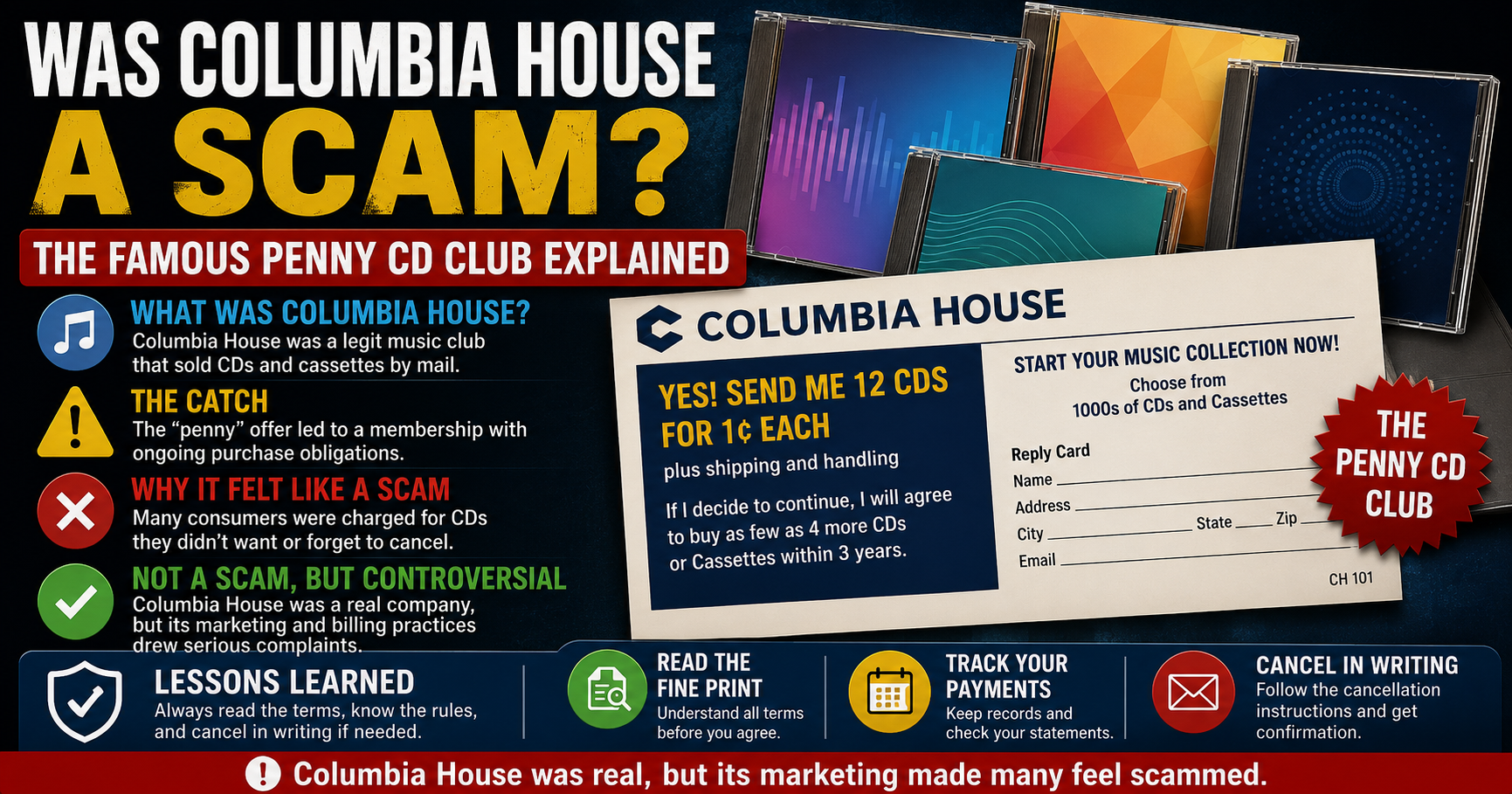
If you grew up in the 1980s, 1990s, or early 2000s, you may remember Columbia House advertisements offering stacks of records, tapes, or CDs for an almost unbelievable introductory price — sometimes as little as one penny.
The offers were real. Columbia House really did ship music and movies to millions of members. But the introductory bargain came with purchase obligations, regular club mailings, and a negative-option system that could result in additional products being shipped unless the member declined them.
That combination is why people still search for “Columbia House scam” decades later.
Quick Verdict
Columbia House was a legitimate mail-order club, not a fake company, but its negative-option membership model became highly controversial.
Customers generally received the products promised in the introductory offer. The catch was that joining the club also meant agreeing to additional purchase requirements and, during much of its history, responding to featured-selection notices to prevent unwanted shipments.
For consumers who understood and managed the membership carefully, Columbia House could provide inexpensive music. For others, the combination of tiny introductory prices, later purchase obligations, shipping costs, and automatic featured selections made the experience feel misleading or difficult to manage.
2026 update: Columbia House announced that it would stop accepting new orders after September 15, 2026, bringing its long-running mail-order operation to an end or wind-down after more than seven decades.
What Was Columbia House?
Columbia House began as the Columbia Record Club in 1955 and became one of the best-known mail-order entertainment businesses in the United States.
Over the decades, its clubs sold:
- Vinyl records
- 8-track tapes
- Cassette tapes
- Compact discs
- VHS tapes
- DVDs and Blu-ray discs
Its most memorable advertisements offered a large introductory bundle for a token price, followed by an agreement to purchase additional titles at regular club prices.
Was the Penny CD Offer Real?
Yes. The famous introductory offers were genuine promotions.
The exact number of albums and introductory price varied over the years. Consumers may remember offers such as eight CDs for a penny, 12 CDs for a penny, multiple albums for $1, or similar promotions.
What mattered was the rest of the agreement.
Joining typically required the member to purchase a specified number of additional products over a certain period. Those later purchases were not priced at one penny.
The extremely inexpensive introductory shipment therefore should not be viewed as a standalone purchase. It was an incentive to join an ongoing membership program.
How Columbia House’s Negative-Option System Worked
The feature that generated some of the strongest criticism was known as a negative-option plan.
Members periodically received a notice describing a featured selection.
Depending on the club and time period, the basic process worked like this:
- Columbia House notified the member about an upcoming featured selection.
- The member had a limited period to decline it.
- If the member did nothing, the selection could be shipped automatically.
- The member would then be billed for the product.
This is different from an ordinary purchase where nothing happens unless the customer affirmatively places an order.
With a negative-option offer, failing to respond could be treated as acceptance.
Was Negative-Option Billing Illegal?
No. Negative-option marketing is not automatically illegal.
The Federal Trade Commission has regulated prenotification negative-option plans for decades. These rules were designed specifically for businesses such as book, record, tape, and CD clubs that notified subscribers about upcoming merchandise and shipped it unless the customer declined.
The important consumer-protection issue is whether the material terms are clearly disclosed and whether customers are given a meaningful opportunity to reject unwanted products.
Negative-option marketing still exists today in different forms, including free trials, automatic renewals, subscription services, continuity programs, and recurring memberships.
Why Did People Call Columbia House a Scam?
Most of the controversy was not about whether Columbia House existed or whether it delivered products.
The complaints generally centered on how the membership worked.
The Introductory Offer Dominated the Advertising
An offer such as multiple CDs for a penny was difficult to ignore.
Consumers who focused on the introductory bargain without fully understanding the later purchase requirement could end up paying considerably more than expected.
Featured Selections Could Be Shipped Automatically
If a member failed to decline a featured selection before the deadline, merchandise could arrive even though the customer had not actively chosen it that month.
Regular Club Prices Were Different From the Introductory Price
The later purchases required under the agreement were sold at regular club prices rather than the deeply discounted introductory rate.
Shipping and Handling Added to the Cost
The effective price of a mail-order purchase could include shipping or handling charges in addition to the advertised product price.
Membership Did Not Necessarily End Automatically
Historical Columbia House membership terms could continue beyond fulfillment of the required purchases until the member affirmatively canceled.
That distinction was easy for some customers to miss.
Did Columbia House Actually Deliver What Customers Ordered?
Generally, yes.
That is an important distinction between Columbia House and a traditional fake-store scam.
The business sent real records, tapes, CDs, and movies to members. Its controversial reputation developed primarily from its:
- Introductory pricing
- Purchase commitments
- Negative-option selections
- Regular club pricing
- Shipping costs
- Cancellation requirements
A real company can still use a business model that customers find confusing, frustrating, or overly aggressive.
Did the FTC Ever Take Action Against Columbia House?
Yes, although an important distinction should be made.
In 2005, Columbia House agreed to settle Federal Trade Commission allegations involving telemarketing calls to consumers who had asked not to be called or whose numbers appeared on the National Do Not Call Registry.
The company agreed to pay a civil penalty.
That case involved telemarketing practices. It should not be misrepresented as an FTC determination that the entire Columbia House music-club program was fraudulent.
FTC records from the case are nevertheless useful because they describe how Columbia House’s membership clubs and negative-option mailings operated.
What Happened to Columbia House?
Technology eventually undermined the mail-order entertainment business.
Consumers moved from physical music toward:
- MP3 downloads
- iTunes and other digital stores
- Streaming music
- Streaming movies and television
- Online retailers
Columbia House exited the music business in 2010 and continued primarily with movies.
In 2015, its parent company, Filmed Entertainment Inc., filed for Chapter 11 bankruptcy protection and pursued a sale of the remaining Columbia House DVD Club business.
The Columbia House name nevertheless survived under later ownership and continued operating a much smaller mail-order business.
Columbia House 2026 Closure
In August 2026, Columbia House posted a notice saying that it would no longer accept new orders after September 15, 2026.
News organizations subsequently reported that Columbia House customer service confirmed that the business was winding down.
The website notice was reportedly removed after receiving widespread attention, so the most precise description is that Columbia House announced an end to new orders and the wind-down of its remaining mail-order operation.
The announcement came approximately 71 years after the Columbia Record Club began in 1955.
What Columbia House Can Teach Consumers About Modern Subscriptions
The products have changed, but the underlying lesson remains relevant.
Today’s version of an unusually attractive introductory offer may involve:
- A $1 trial
- A discounted first month
- A free report or quiz result
- A cash-back promotion
- A product trial
- A discounted first year
The important question is what happens after the introductory offer.
Before entering payment information, check:
- Whether you are making a one-time purchase or starting a membership.
- How much the regular price will be.
- When the first recurring charge occurs.
- Whether products will ship automatically.
- How to decline or cancel.
- Whether cancellation stops all future products or only one part of the membership.
- Whether refunds are available after a renewal or shipment.
Modern Subscription Complaints With Similar Themes
These current Think It’s a Scam articles involve some of the same consumer issues: low introductory pricing, recurring memberships, automatic renewal, or confusion about what happens after enrollment.
- MyIQ Scam or Legit? Subscription Complaints Explained
- ShipmentsFree Scam or Legit? Unexpected Membership Charges
- TestLibrary Scam or Legit? Subscription Complaints
- Derma Care Scam? Trial and Subscription Complaints
Frequently Asked Questions
Was Columbia House a real company?
Yes. Columbia House was a real mail-order entertainment company that operated for decades and shipped records, tapes, CDs, movies, and other physical media to members.
Was Columbia House actually a scam?
Columbia House was not a traditional fake-company scam. Customers generally received the products offered. However, its purchase obligations and negative-option system generated controversy because members could receive and be billed for featured selections unless they declined them.
Did Columbia House really sell CDs for one penny?
Yes. Columbia House used extremely inexpensive introductory promotions, including penny offers. The promotions came with additional membership obligations, so the introductory price did not represent the total cost of participating in the club.
Why did Columbia House automatically send CDs?
Columbia House used a negative-option membership model. Members were notified about featured selections and could be sent the selection if they did not decline it within the required period.
When did Columbia House stop selling music?
The Columbia House business exited music sales in 2010 and continued primarily with DVDs and other movies.
Did Columbia House go bankrupt?
Its parent company, Filmed Entertainment Inc., filed for Chapter 11 bankruptcy protection in 2015 and sought to sell the Columbia House DVD Club business. The Columbia House brand later continued under new ownership.
Is Columbia House still operating in 2026?
Columbia House announced that it would stop accepting new orders after September 15, 2026. Customer service reportedly confirmed the wind-down of the remaining operation.
More music-business history: Our guide to 1970s tax scam records and collectible vinyl explores obscure releases, artist accounts and how to identify a pressing. That is a separate story from Columbia House’s record-club subscriptions.
Do You Remember Columbia House?
Columbia House became part of music history for millions of consumers.
If you were a member, share your experience below:
- What introductory offer did you receive?
- Did you understand the purchase requirement?
- Did you ever receive an unwanted featured selection?
- Was cancellation easy or difficult?
- What album do you still remember ordering?
Firsthand experiences can help document how one of America’s most famous subscription businesses actually worked for consumers.
Page researched and reviewed: September 18, 2026.
Disclaimer
ThinkItsAScam.com is an independent consumer-information website and is not affiliated with Columbia House, Columbia Records, Sony Music Entertainment, Edge Line Ventures, the Federal Trade Commission, or other companies and organizations mentioned in this article.
This article discusses historical marketing practices, publicly available regulatory records, news reporting, and consumer experiences. Describing a business practice as controversial or discussing consumer complaints does not establish that a company committed criminal fraud.
Leave a Reply