If you searched for traffic citation text scam, traffic ticket text scam, DMV text scam, or fake traffic ticket text, you may have received an unexpected message claiming that you owe money for a speeding ticket, court fine, parking citation, traffic-camera violation, or other driving offense.
These scams have become more convincing in 2026. Some messages now include official-looking court notices, government seals, case numbers, hearing dates, names of real judges or officers, and QR codes that supposedly let you pay the fine immediately.
Do not pay, click a link, or scan a QR code based solely on an unexpected traffic-citation text. Verify the citation independently through the court, DMV, clerk, or issuing agency using contact information you obtain yourself.
Quick Verdict
Likely Scam if an unexpected text demands immediate payment, threatens license or registration penalties, or tells you to scan a QR code or follow a payment link. Legitimate citation procedures differ by jurisdiction, so do not assume every electronic communication is impossible. Instead, independently verify the alleged ticket through the actual court or government agency before responding or paying.
Share Your Traffic Ticket Text Experience ↓
On this page:
What is the scam? ·
QR code version ·
DMVCKS link warning ·
DMVKWT link warning ·
DMV version ·
Fake court notices ·
Verify a ticket ·
If you clicked ·
If you paid
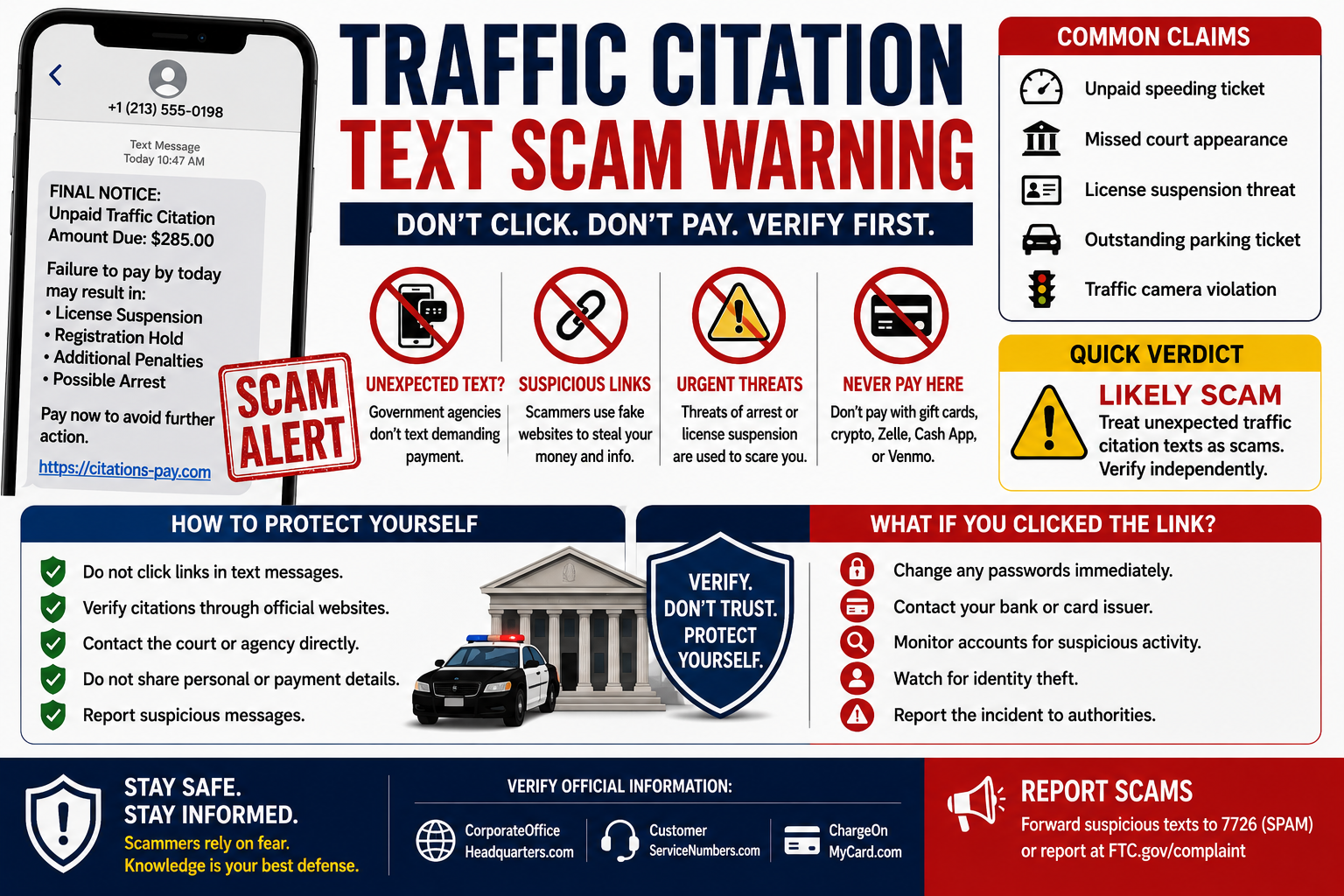
Traffic citation scams can use fake court notices, case numbers, QR codes, DMV warnings, and license-suspension threats. Verify any citation independently before paying.
DMVCKS.com Text: What Is Known About This Link?
Domain note added October 2, 2026: If an unexpected DMV payment text sends you to dmvcks[.]com, do not use that link to pay or enter personal information. Verify any alleged ticket with the actual court or motor-vehicle agency through independently obtained contact details.
Online Threat Alerts identifies this exact domain as a DMV phishing site. Our review found that third-party warning, but did not find an official agency alert naming DMVCKS or a verifiable firsthand recipient report. We have not independently confirmed the site’s operator or any claimed losses. Treat the link as unverified; the available evidence does not establish it as an authorized DMV payment service.
The broader impersonation pattern is documented: New York DMV warns about texts threatening suspension unless a ticket is paid quickly. California DMV says it does not send text messages with payment links. These agency warnings establish the general scheme, not a finding about this particular domain.
What if I already used a DMVCKS link?
Use the steps for a clicked link or disclosed information below. If you entered card details, contact your card issuer promptly using the number on your card. If you sent money, follow the payment-recovery steps.
DMVKWT.com Text: Is This a Real DMV Payment Link?
Domain note added October 3, 2026: If an unexpected DMV text or email directs you to dmvkwt[.]com, do not use it to pay a claimed fine or enter personal information. We have not verified this domain as an authorized DMV service. Check the alleged citation through the real court or motor-vehicle agency using contact information obtained independently.
Online Threat Alerts published a warning naming DMVKWT on October 2, 2026. Our review found that third-party warning, but no official agency alert naming this exact domain or verifiable firsthand recipient report. The operator, number of recipients and any losses remain unconfirmed. Similar wording does not establish that DMVKWT and DMVCKS share an operator.
The broader scam is documented: New York DMV’s March 19, 2026 warning describes short payment deadlines and license-suspension threats. California DMV says it does not send texts containing payment links. Neither warning identifies DMVKWT specifically.
What should I do if I already opened a DMVKWT link?
Close the page and do not provide information or download files. Opening a link alone does not establish that your device was compromised. If you supplied a password or identity information, follow the account and identity protection steps below. If you entered card details, contact your card issuer promptly using the number on your card. If you paid, see the payment-recovery steps.
What Is the Traffic Citation Text Scam?
The traffic citation text scam is a government-impersonation and phishing scheme.
A recipient receives an unexpected text claiming there is an unresolved:
- Traffic citation
- Speeding ticket
- Parking ticket
- Red-light camera violation
- Speed-camera citation
- Toll violation
- Court fine
- Failure to appear
The message then pressures the recipient to act quickly.
Common threats include:
- Driver’s-license suspension
- Vehicle-registration suspension
- Vehicle impoundment
- Additional fees
- Court enforcement
- Wage garnishment
- Damage to a credit score
- Prosecution
- An arrest warrant
A link or QR code is provided so the victim can supposedly resolve the violation immediately.
The destination may instead be a phishing website designed to steal money, card information, driver’s-license information, Social Security numbers, passwords, or other personal data.
New 2026 Traffic Hearing QR Code Scam
In April 2026, the Federal Trade Commission warned about a newer and more convincing version of the traffic-violation scam.
Instead of a simple message saying “you owe a ticket,” the text may contain an image that looks like an official notice of a traffic hearing.
The fraudulent notice may include:
- A state or court seal
- A supposed case number
- A hearing date
- A hearing time
- A payment amount
- A QR code
- Warnings about additional enforcement
The victim may be told there are two choices:
- Appear at the supposed court hearing.
- Scan the QR code and immediately pay the balance.
The FTC says scammers use the QR code to direct victims toward fraudulent sites that can attempt to steal personal or payment information or cause malicious software to be downloaded.
FTC: Traffic Violation Text Scam Warning
Do Not Scan the QR Code to “Check” Whether It Is Real
A QR code is simply another form of link. Scanning it can open a phishing site just as easily as tapping a suspicious URL. Verify the supposed case through the real court instead.
Fake DMV Overdue Ticket Texts
Another widespread version impersonates a state Department or Division of Motor Vehicles.
The text may claim that an overdue traffic ticket has been entered into a supposed:
“DMV violation database.”
The message can threaten:
- Driver’s-license suspension
- Vehicle-registration suspension
- Loss of driving privileges
- An added service fee
- Prosecution
- Negative credit consequences
The Federal Trade Commission has specifically warned consumers about this DMV impersonation pattern.
FTC: Overdue Traffic Ticket Text Scam
Fake Court Traffic Summons Texts
Some 2026 scams go beyond impersonating a DMV.
They impersonate an actual court.
In June 2026, the U.S. District Court for the District of New Mexico warned about fraudulent traffic-violation texts that contained unusually detailed information.
The messages reportedly included:
- The name of an issuing officer
- The name of an assigned judge
- The name of a court clerk
- A supposed case number
- A scheduled court date
- A warning that an arrest warrant could be issued
- A link directing the recipient to act immediately
Scammers even used the names of real judges, law-enforcement officers, and court personnel.
Real names do not make the message genuine.
U.S. District Court: 2026 Traffic Violation Text Warning
Why Can the Fake Traffic Text Look So Real?
Scammers can copy information from public sources.
A fraudulent traffic notice might contain:
- A real court name
- A real judge’s name
- A real police officer’s name
- A courthouse address
- A government seal
- Official-looking formatting
- A realistic citation number
- A fake government-style domain
Professional formatting is not proof of authenticity.
The safest verification happens outside the message.
Common Traffic Citation Scam Variations
Fake Speeding Ticket
The message claims a speed violation remains unpaid and penalties are about to increase.
Fake Traffic Camera Citation
The recipient is told that a red-light or speed camera recorded a violation.
Fake Parking Citation
The text says one or more unpaid parking tickets are connected to the recipient’s license plate.
DMV License Suspension
The scam says the DMV will suspend driving privileges if payment is not received by a short deadline.
Vehicle Registration Hold
The message threatens cancellation or suspension of vehicle registration.
Fake Court Hearing
The recipient receives a supposed court date and is told that paying now will cancel the hearing.
Fake Arrest Warrant
The text claims failure to respond will cause the court to issue a bench warrant.
Fake Toll Violation
A closely related scam claims unpaid tolls are accumulating late fees or putting the recipient’s registration at risk.
Warning Signs of a Traffic Ticket Text Scam
You Were Not Expecting the Citation
You receive the message despite having no reason to believe you recently received a citation or court notice.
The Message Demands Immediate Payment
The deadline may be only a few hours or one day away.
It Contains a QR Code
A QR code can conceal the destination just like a shortened web link.
The Domain Is Unfamiliar
A fake site may include terms such as:
- DMV
- Court
- Traffic
- State
- Violation
- Ticket
Those words in a domain do not establish that the website belongs to a government agency.
The Message Threatens Immediate Suspension
Threats involving a license, registration, or vehicle are intended to make the recipient act before checking the claim.
The Message Threatens Arrest
A supposed bench-warrant warning sent with an immediate payment link is a serious reason to stop and independently verify the matter.
It Demands Unusual Payment Methods
Be highly suspicious if the supposed government agency requests payment through:
- Gift cards
- Cryptocurrency
- Bitcoin ATMs
- Zelle
- Cash App
- Venmo to an individual
- Wire transfer
Can a Real Government Agency Ever Send a Text?
Do not use a blanket rule that every government-related text must be fraudulent.
Communication procedures vary by state, county, municipality, court, and program. Some agencies may offer legitimate electronic reminders or notifications.
What matters is that an unsolicited text should not be your only source for confirming that you owe a citation.
If a message says you owe money:
- Do not use the text’s payment link.
- Do not scan its QR code.
- Identify the court or agency independently.
- Use the agency’s official website or published telephone number.
- Search for your citation through an official case or citation system when available.
What About a Federal Traffic Ticket?
Federal violation notices have a separate official payment system through the Central Violations Bureau.
The Central Violations Bureau currently warns that people are receiving bogus texts, emails, and calls saying they failed to pay a federal ticket.
Scammers have also created fake websites designed to resemble the official CVB website.
https://www.cvb.uscourts.gov/
The CVB says that if someone genuinely received a federal violation notice and failed to answer it after a scheduled court date, a U.S. Marshal may contact the person by telephone and direct the person to the appropriate U.S. District Court or official CVB payment process.
That is different from receiving an unsolicited text containing a payment link.
Central Violations Bureau: Ticket Scam Guidance
How to Verify a Traffic Citation Safely
If the message might possibly relate to a real ticket, verify it without using anything provided by the sender.
- Do not click the link.
- Do not scan the QR code.
- Do not reply with personal information.
- Note which agency or court the message claims to represent.
- Search independently for that agency’s official website.
- Use the court’s official case-search or citation-search tool when available.
- Call the clerk or agency using a number published on the official site.
- Ask whether the citation or case number is genuine.
If you already have a paper citation, use the court and payment information printed on the legitimate citation or independently verify it through the issuing jurisdiction.
What If the Text Includes My Real Name or License Plate?
Personal information does not prove that the sender is legitimate.
Scammers may obtain names, addresses, telephone numbers, vehicle information, or other data from public records, data brokers, previous breaches, social media, compromised accounts, or other sources.
Some jurisdictions have even warned that scammers can use publicly available traffic-citation information to make fraudulent calls or messages more convincing.
Verify the underlying citation rather than trusting the message because it contains correct details.
What If the Message Has a Real Judge or Police Officer’s Name?
That can still be fraudulent.
Federal courts have documented 2026 scams where messages used the actual names of judges, officers, and court employees.
A scammer can obtain those names from public websites.
Do not contact the person through information in the text. Call the court or agency through an independently obtained official number.
What If the Text Says My License Will Be Suspended Tomorrow?
Do not let the deadline stop you from verifying the claim.
Go directly to the official agency or court.
If a real citation has reached a point where it affects your driver’s license or vehicle registration, the relevant government office should be able to verify that through its official records.
What If You Clicked the Traffic Citation Link?
The next step depends on what happened after you clicked.
If You Did Not Enter Information
- Close the website.
- Do not download anything.
- Do not approve browser notifications or device permissions.
- Do not return to the site to investigate it further.
- Delete or report the original text after preserving a screenshot if needed.
If You Entered a Password
- Change the password through the legitimate website or app.
- Change other accounts using the same password.
- Enable multi-factor authentication.
- Review recent account activity.
If You Entered Credit or Debit Card Information
- Contact the card issuer immediately using the number printed on the card.
- Explain that the card information may have been entered on a phishing site.
- Review recent and pending transactions.
- Follow the issuer’s instructions about securing or replacing the card.
If You Entered a Social Security Number or Identity Information
Use IdentityTheft.gov to review appropriate identity-theft recovery steps.
What If You Scanned the QR Code?
Scanning a QR code alone does not automatically mean money or information was stolen.
If the code opened a site:
- Close the site.
- Do not enter information.
- Do not download files or apps.
- Review the device for unexpected downloads or permission requests.
- Keep the phone and operating system updated.
If you entered information after scanning the code, take the same protective steps you would after using a phishing link.
What If You Already Paid the Fake Traffic Ticket?
Act quickly.
- Contact the bank, card issuer, payment company, or financial institution used for the payment.
- Explain that the transaction resulted from a suspected government-impersonation or phishing scam.
- Ask whether the payment can be stopped, disputed, recalled, or reversed.
- Save the text message.
- Save screenshots of the website.
- Save the URL or QR-code destination.
- Save payment confirmations and receipts.
- Report the scam to the FTC.
How to Report a Traffic Citation Scam Text
The Federal Trade Commission recommends reporting and deleting suspicious texts.
- Use your phone’s Report Junk or spam-reporting feature.
- Forward unwanted scam texts to 7726 (SPAM).
- Report suspected fraud at ReportFraud.ftc.gov.
- Notify the real court or agency if its name is being impersonated.
If you lost money or sensitive financial information, also contact the relevant bank, card issuer, or payment provider promptly.
Official Traffic Scam Resources
- FTC — 2026 Traffic Violation QR Code Text Scam
- FTC — Fake DMV Overdue Traffic Ticket Texts
- U.S. Courts Central Violations Bureau — Fake Ticket Messages
- U.S. District Court — 2026 Fraudulent Traffic Violation Text Warning
- FTC ReportFraud
- IdentityTheft.gov
Related Scam Warnings
If the message claims to represent Texas authorities, see our Texas DMV text scam guide for state-specific verification guidance.
For New Jersey ticket payments, see our NJMCDirect.online vs. NJMCDirect.com guide to verify the official payment site and check whether a citation was actually paid.
These ThinkItsAScam.com articles involve similar phishing or government-impersonation tactics:
- Missed Jury Duty Scam: Fake Warrants, Calls & Arrest Threats
- USPS Scam Text PDF Warning: Fake Delivery Notice
Traffic Citation Text Scam FAQs
Is a text saying I owe a traffic ticket a scam?
An unexpected text demanding immediate traffic-ticket payment should be treated as suspicious. The FTC and multiple courts have documented widespread scams involving fake citations, DMV notices, traffic hearings, and payment links. Verify the alleged ticket independently before paying.
Does the DMV send texts about unpaid tickets?
Procedures vary by jurisdiction, but the FTC has specifically warned about scammers impersonating state DMVs and sending overdue-ticket payment demands. Do not rely on a text alone. Contact the appropriate state or court through an official source.
What is the traffic ticket QR code scam?
The scam sends an official-looking traffic-hearing notice containing a QR code. The recipient is pressured to scan the code and pay a supposed fine. The FTC warns that the code can direct victims to fraudulent sites designed to steal money or personal information.
Can a fake traffic text contain a real judge’s name?
Yes. Federal courts have documented fraudulent 2026 texts using the real names of judges, police officers, and court staff.
Can a fake citation include a case number?
Yes. A case or citation number can be fabricated. Verify the number through the real court’s official records rather than through a link supplied in the message.
Can a traffic ticket scam threaten an arrest warrant?
Yes. Some current scams tell recipients that failure to pay or appear will cause a bench warrant to be issued. Independently contact the actual court rather than paying because of the threat.
What if the text says my license will be suspended?
Do not click the message’s link merely because it threatens a license suspension. Verify your status with the actual court, DMV, or issuing agency through its official website or telephone number.
How can I tell if a traffic ticket website is real?
Do not judge a site by its logos or appearance. Find the correct court or agency independently and navigate to its payment system from the official government website. For federal violation notices, the official Central Violations Bureau site is CVB.USCourts.gov.
What if I really do have an unpaid ticket?
A scam message and a real outstanding citation can exist at the same time. Verify the ticket independently and use the payment method provided by the actual court or government agency rather than the unsolicited text.
Should I reply to the text to ask for more information?
No response is necessary to verify the alleged ticket. Use the real court or agency’s independently obtained contact information instead.
What if I already paid?
Contact your financial institution or payment provider immediately, explain that the payment may have resulted from an impersonation scam, and ask whether the transaction can be stopped or disputed. Preserve the message and payment records and report the scam to the FTC.
How do I report the scam text?
Use your phone’s report-junk feature, forward the message to 7726 (SPAM), and report suspected fraud at ReportFraud.ftc.gov.
Bottom Line: Traffic Citation Text Scam
Unexpected texts demanding immediate payment for traffic citations, DMV violations, court fines, or supposed hearings are a well-documented scam pattern.
Current versions can be extremely convincing. They may contain:
- Government seals
- Real court names
- Real judges or officers
- Fake case numbers
- Fake hearing dates
- QR codes
- Payment links
- License-suspension threats
- Arrest-warrant threats
The safest response is not to decide whether the message “looks real.”
Do not click. Do not scan. Do not pay. Independently verify the citation with the actual court or agency.
Have You Received a Traffic Citation Scam Text?
Share the non-sensitive details below to help other consumers identify current versions of the scam.
- Which agency or court did the message claim to represent?
- Did it mention a DMV?
- Did it contain a citation or case number?
- Did it include a picture of a court notice?
- Was there a QR code?
- Did it contain a payment link?
- Were license or registration penalties threatened?
- Did it threaten a court appearance or arrest warrant?
- Did you independently check the citation?
- What did the actual court or agency tell you?
Please do not post your full name, telephone number, home address, driver’s-license number, license-plate number, citation number tied to personal information, Social Security number, payment-card information, passwords, authentication codes, or other sensitive personal information.
Page researched and updated: September 18, 2026.
ThinkItsAScam.com is an independent consumer-information website and is not affiliated with any Department or Division of Motor Vehicles, court, clerk’s office, law-enforcement agency, U.S. District Court, Central Violations Bureau, Federal Trade Commission, payment processor, or other government agency. Legitimate traffic-citation procedures differ by jurisdiction. This article discusses documented impersonation and phishing schemes and should not be interpreted as advice to ignore a genuine citation, court notice, summons, or legal obligation. Verify actual citations directly with the appropriate government agency or court. This article is for general consumer education and is not legal or financial advice.
Leave a Reply