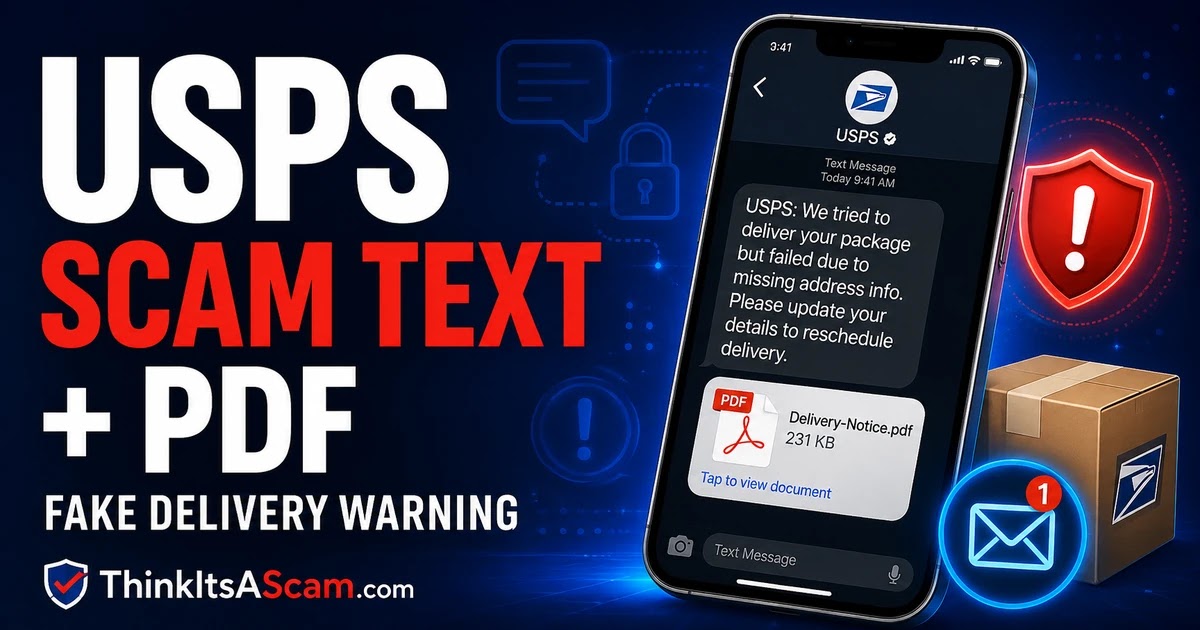
Consumers continue to report USPS scam text messages with PDF attachments, suspicious links, and fake package delivery notices.
The message may claim that a package cannot be delivered because of an incomplete address, unpaid postage, missing information, or another delivery problem. Some versions attach a PDF and instruct the recipient to open it before taking action.
These messages can be part of a phishing attack known as smishing, designed to steal payment information, passwords, personal information, or other sensitive data.
An unexpected USPS text containing a PDF attachment, unfamiliar link, address-verification request, or demand for a small delivery payment should be treated as suspicious. The U.S. Postal Inspection Service says USPS tracking texts must be initiated by the customer and legitimate USPS tracking messages do not contain links.
What Is the USPS Scam Text PDF?
The USPS Scam Text PDF is a variation of the widespread package-delivery smishing scam.
Instead of placing the phishing link directly in the text message, the scammer may attach a PDF that resembles an official:
- Package delivery notice
- Address correction form
- Shipping document
- Tracking notice
- Redelivery notification
The PDF may then contain a button or link directing the recipient to a website designed to look like USPS.
Using a PDF can make the message appear more official and may encourage a recipient who would normally distrust a strange text link to open the document.
USPS Smishing: What USPS Says
The U.S. Postal Inspection Service warns consumers about USPS package-tracking smishing scams.
According to USPIS, USPS provides legitimate package-tracking text services, but customers must first request tracking for a particular package.
Official USPS tracking texts are not randomly sent to people about unidentified packages and legitimate tracking messages do not contain links.
How the USPS PDF Text Scam Works
A common version follows this pattern:
- You receive an unsolicited text claiming to be from USPS.
- The message says a package could not be delivered.
- You are told to open a PDF attachment or follow a link.
- The PDF contains a delivery notice, button, or other instruction.
- You are directed to a website designed to resemble USPS.
- The website asks for your name, address, phone number, email address, or payment information.
- The information is sent to scammers rather than USPS.
Some versions ask for a very small delivery or address-correction payment. The small amount can make the request seem harmless, while obtaining usable card information may be the scammer’s real objective.
Why Is There a PDF Attachment?
The PDF attachment is designed to add credibility to the message.
Consumers regularly receive legitimate PDFs containing:
- Invoices
- Receipts
- Shipping documents
- Tickets
- Business notices
Scammers take advantage of that familiarity.
A fraudulent USPS PDF may contain a clickable button or link that leads to a phishing website rather than USPS.com.
The attachment itself does not prove that the message came from USPS.
Common USPS Scam Text Messages
The wording changes frequently, but fake messages often claim:
- Your package cannot be delivered.
- Your shipping address is incomplete.
- A ZIP code is missing or incorrect.
- Your package is being held at a distribution center.
- You owe an unpaid postage or redelivery fee.
- You must update your address immediately.
- Your package will be returned unless you respond.
- A PDF contains important delivery instructions.
Do not judge the message solely by spelling, grammar, logos, or professional formatting. Modern phishing messages can look convincing.
Warning Signs of a Fake USPS Text
You Never Requested USPS Text Tracking
An unsolicited package-tracking text is one of the strongest warning signs.
The Message Contains a Link
USPIS says legitimate USPS tracking messages do not contain links.
The Text Contains an Unexpected PDF
A random delivery message requiring you to open an attachment does not match the normal USPS tracking-text process.
You Are Asked to Pay a Small Fee
Be especially cautious if an unexpected text asks for card information to pay a small redelivery, address-correction, postage, or processing charge.
The Website Only Looks Like USPS
Scammers can copy USPS colors, logos, photographs, and page layouts.
Look at the actual domain rather than the appearance of the page.
The Message Creates Urgency
Warnings that a package will immediately be returned, destroyed, canceled, or permanently delayed are designed to make recipients act before verifying the claim.
How to Check a Real USPS Package
If you are expecting a package, do not use the suspicious text message to check it.
- Close the message.
- Open your browser separately.
- Go directly to USPS.com.
- Enter the tracking number from your legitimate purchase or shipping confirmation.
- Check the tracking history for any actual delivery issue.
If you do not have a tracking number, contact the merchant or sender independently.
What If You Opened the PDF?
If you opened the PDF but did not click anything or enter information, do not panic.
Close the document, delete the suspicious message, and avoid interacting with any links or buttons in the attachment.
Keep your phone, browser, operating system, and security software updated.
If the PDF caused a download, installation request, security warning, unusual browser behavior, or other unexpected activity, run an appropriate security scan and review the device for unfamiliar applications or profiles.
What If You Clicked the USPS Scam Link?
If you followed the link, the next steps depend on what information you provided.
If You Did Not Enter Any Information
- Close the website.
- Do not download anything.
- Delete the suspicious message.
- Watch for follow-up phishing attempts.
If You Entered a Password
- Change the affected password immediately through the legitimate website or app.
- Change other accounts that use the same password.
- Enable multi-factor authentication.
- Review recent account activity.
If You Entered Credit or Debit Card Information
- Contact the card issuer using the number printed on the card.
- Explain that the card information may have been entered on a phishing site.
- Review recent and pending transactions.
- Follow the issuer’s instructions regarding replacing or securing the card.
USPIS advises consumers who interacted with the fraudulent URL to notify their financial institution.
What If a USPS Charge Appears on Your Card?
A USPS-related charge is not automatically fraudulent. Consumers legitimately pay USPS for postage, shipping labels, PO Boxes, stamps, and other postal products and services.
However, if you entered your card information after receiving a suspicious delivery text and then see a USPS-related or unfamiliar transaction, compare it carefully with your actual purchases.
For information about one USPS billing descriptor, see:
USPS 114500042 Charge on Credit or Debit Card – ChargeOnMyCard.com
If a transaction is unauthorized, contact your bank or card issuer directly rather than using a telephone number contained in the suspicious text.
How to Report a USPS Scam Text
The U.S. Postal Inspection Service provides specific instructions for reporting USPS-related smishing.
- Do not click the suspicious link.
- Copy the text of the message.
- Email the information to spam@uspis.gov.
- Include a screenshot showing the sender and date.
- Explain whether you clicked the link, provided information, or lost money.
- Forward the suspicious text message to 7726 (SPAM) to help report the sender.
You can also report fraud through the Federal Trade Commission at ReportFraud.ftc.gov.
Real USPS Customer Service and Complaint Help
If you have an actual USPS package, delivery, tracking, mail, or customer-service problem, use independently verified contact information rather than the phone number or link in a suspicious text.
- USPS Customer Service – CustomerServiceNumbers.com – USPS customer service, tracking support, contact information, and consumer assistance.
- USPS Corporate Office and Consumer Contact Information – USPS headquarters, Consumer Advocate, complaint, and escalation information.
USPS Charges and Consumer Reviews
These additional resources can help distinguish a scam from a legitimate USPS billing or service problem:
- USPS 114500042 Credit Card Charge – ChargeOnMyCard.com – Research a USPS-related card descriptor or unfamiliar transaction.
- USPS Complaints and Reviews – ZeroStars.org – Read and share experiences involving legitimate USPS delivery, tracking, service, and complaint issues.
Related Scam Warnings
- Apple Pay Alert Text Scam – Fake financial alerts designed to steal account or payment information.
- Visa Click to Pay Scam Warning – Unexpected payment texts, emails, and verification-code requests.
- Geek Squad Subscription Scam Warning – A phishing and refund scam that can also use PDF attachments.
Bottom Line: Is the USPS PDF Text a Scam?
If an unexpected text claims to be from USPS and includes a PDF, suspicious link, delivery-fee request, or address-verification page, do not interact with it.
Open USPS.com yourself and check the package using a tracking number you already have. Never enter payment or personal information through an unsolicited delivery text.
Have You Received a USPS Scam Text With a PDF?
Share the non-sensitive details of the message below.
- Did the message contain a PDF attachment?
- What did the PDF claim?
- Did it say your address was incomplete?
- Were you asked to pay a small delivery or redelivery fee?
- Did the PDF contain a button or link?
- Did the message arrive from an unusual number or email-style sender?
Please do not post your own phone number, home address, tracking number, payment-card information, passwords, or other private information.
Your experience may help other consumers recognize new variations of the USPS package-delivery scam.
Disclaimer
ThinkItsAScam.com is an independent consumer information website. We are notaffiliated with the United States Postal Service, U.S. Postal Inspection Service, CustomerServiceNumbers.com, CorporateOfficeHeadquarters.com, ChargeOnMyCard.com, or ZeroStars.org except that the latter consumer websites may be operated as related independent informational resources. This article is intended for consumer education and does not provide legal, financial, or cybersecurity advice. Verify package and account information through official USPS channels.
“`
Leave a Reply