If you searched for Texas DMV text scam, TxDMV text scam, Texas DMV scam text, or Texas traffic ticket text scam, you may have received a message claiming that you owe money for a traffic ticket, toll violation, vehicle-registration problem, or other supposed Texas motor-vehicle violation.
Texas officials have confirmed that these fraudulent text messages are actively circulating.
On March 25, 2026, the Texas Department of Motor Vehicles warned Texans about fake violation notices that impersonate TxDMV and threaten prosecution, suspension of vehicle registration, or loss of driving privileges unless money is paid.
TxDMV makes two particularly important points:
- TxDMV does not issue or collect fines for toll or traffic violations.
- TxDMV does not contact people about alleged registration violations through unsolicited text messages.
Quick Verdict
If an unexpected text claims TxDMV is collecting an unpaid traffic ticket, toll fine, or registration-violation payment, treat it as a scam. TxDMV says it does not issue or collect traffic or toll fines and does not send unsolicited texts about alleged registration violations. Do not click the link, reply, or pay. Verify any real vehicle, license, toll, or court issue independently through the correct Texas agency.
Share Your Texas DMV Scam Text ↓
On this page:
What is the scam? ·
2026 TxDMV warning ·
Current scam example ·
What TxDMV actually does ·
Driver-license threats ·
Toll texts ·
How to verify ·
If you clicked
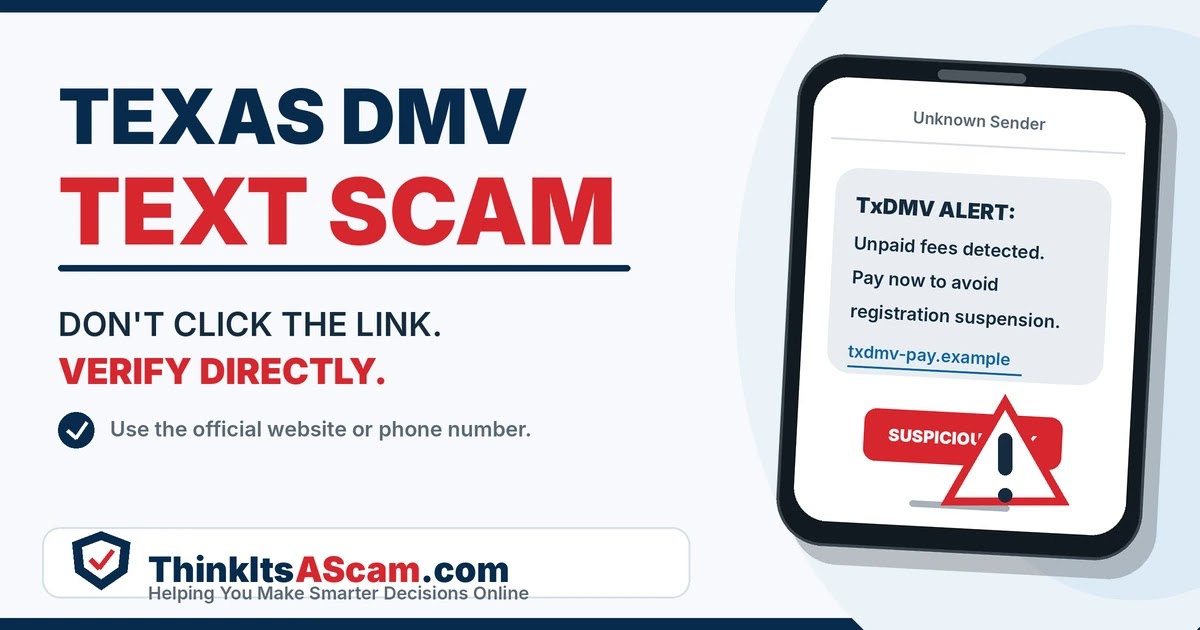
TxDMV warns that scammers are sending fake texts about traffic tickets, toll violations, registration suspensions, and driving privileges. Verify the claim directly with the correct Texas agency before paying.
What Is the Texas DMV Text Scam?
The Texas DMV text scam is a smishing or text-phishing campaign in which scammers impersonate the Texas Department of Motor Vehicles, or TxDMV.
The text may falsely claim that you:
- Have an unpaid traffic ticket
- Owe a toll violation
- Have an outstanding DMV fine
- Have an unresolved registration violation
- Will have your vehicle registration suspended
- Will lose your driving privileges
- Will face prosecution
- Must pay an additional service or collection fee
The message then directs you to a link where you are supposedly supposed to pay.
The site may imitate a Texas government website and request:
- Your name
- Home address
- Date of birth
- Driver-license information
- Vehicle information
- Credit or debit card details
- Bank information
- Passwords or account credentials
The objective is to steal money or personal and financial information.
TxDMV Issued a New Scam Warning in March 2026
On March 25, 2026, the Texas Department of Motor Vehicles issued an official warning titled:
“Fake Fines, Real Fraud: TxDMV warns Texans about ongoing text scam.”
TxDMV said Texas drivers were receiving alarming messages falsely claiming to come from TxDMV or similarly named agencies.
The agency said the texts were threatening:
- Immediate prosecution
- Vehicle-registration suspension
- Loss of driving privileges
- Penalties involving unpaid traffic tickets
- Penalties involving supposed toll violations
The messages typically contain a link urging the recipient to pay immediately.
TxDMV’s Key Warning
TxDMV is not a law-enforcement agency and does not issue or collect fines for traffic or toll violations.
TxDMV also says it does not communicate about alleged registration violations through unsolicited text messages.
Read the official March 2026 TxDMV scam warning.
What Does the Current Texas DMV Scam Text Look Like?
The Texas Department of Public Safety highlighted the same scam campaign in its April 2026 Cyber Security Newsletter.
One documented example falsely claimed that the “Texas Department of Motor Vehicles” had an unsettled traffic ticket associated with the recipient.
The scam text threatened consequences such as:
- Entry into a supposed DMV violation-tracking system
- Vehicle-registration suspension
- Suspension of driving privileges
- Referral to a collection contractor
- A large additional service fee
- Civil action
- Credit-score damage
The message then directed the recipient to a website that was not TxDMV.gov.
The text also tried to instruct the recipient to reply or reopen the message so the payment link would become clickable.
Texas DPS warned:
- Do not reply.
- Do not click the link.
- Report the message as junk or spam.
- Delete it.
- Verify questionable claims only through official websites.
Texas DPS April 2026 Cyber Security Newsletter
Why Do Scammers Use the TxDMV Name?
The TxDMV name sounds authoritative and is familiar to Texas vehicle owners.
A message involving a vehicle can also create immediate anxiety because people may worry about:
- Losing their registration
- Being unable to drive
- Getting additional fines
- Receiving a court summons
- Having their vehicle impounded
- Missing a toll bill
The scam works best when the victim acts before checking which Texas agency actually handles the supposed problem.
What Does the Texas Department of Motor Vehicles Actually Handle?
Understanding TxDMV’s actual responsibilities makes many scam texts easier to spot.
TxDMV handles areas including:
- Motor-vehicle titles
- Vehicle registration
- Motor-vehicle dealer licensing
- Motor-carrier credentials
- Oversize and overweight permits
- Certain complaints involving dealers and motor carriers
TxDMV’s official contact page currently lists:
Toll-free: 1-888-368-4689
Austin: 512-465-3000
Hours: Monday through Friday, 8 a.m.–5 p.m. Central Time.
Important: TxDMV Does Not Issue Texas Driver Licenses
This is one of the most useful ways to evaluate a Texas DMV scam text.
The Texas Department of Motor Vehicles does not issue or renew Texas driver licenses.
Texas driver licenses are handled by the Texas Department of Public Safety, or DPS.
TxDMV also says it does not maintain:
- Driver-license records
- Driving-history records
- Accident records
- Violation or citation records
TxDMV maintains information associated with motor-vehicle titles, registrations, and permits.
TxDMV vs. Texas DPS
TxDMV: Vehicle titles and registration.
Texas DPS: Driver licenses, driver eligibility, and related driver-license services.
If a text claims that TxDMV itself is suspending your driver’s license because you did not pay a TxDMV traffic fine, that does not match the agency responsibilities published by Texas.
For driver-license information, use the official Texas DPS Driver License website.
Texas DPS Driver License Contact Information
For questions involving a Texas driver license or driver eligibility, the current DPS Driver License Customer Service Center lists:
Phone: 512-424-2600
Hours: Monday through Friday, 7 a.m.–5:30 p.m., excluding holidays.
Do not call a driver-license number supplied by an unsolicited scam text. Obtain the number independently from DPS.Texas.gov.
Does TxDMV Collect Unpaid Texas Tolls?
TxDMV says it does not issue or collect fines for toll violations.
Texas has multiple toll authorities and toll-road operators. A real toll matter should be verified with the actual toll agency responsible for the road or account involved.
Do not assume a text is genuine merely because:
- You recently drove on a toll road
- You own a vehicle registered in Texas
- The message knows your area code
- The text mentions TxTag or another recognizable toll name
- The message includes a small balance that seems believable
Scammers can send these messages broadly to thousands of recipients without knowing whether any particular person actually used a toll road.
Does TxDMV Send Registration Renewal Notices?
TxDMV does provide legitimate vehicle-registration services and reminders.
That is different from an unsolicited text claiming you committed a registration violation and must immediately pay a penalty.
If you want to check your Texas vehicle registration, go directly to the official TxDMV registration service rather than following a link in a text:
TxDMV — Register or Renew Your Vehicle
TxDMV also works with county tax assessor-collector offices on vehicle registration.
How to Recognize a Fake TxDMV Website
Do not judge a site by its logo, Texas flag, government seal, or colors.
A phishing website can copy all of those.
Watch for:
- Domains that contain “txdmv” but do not end in the official TxDMV.gov domain
- Extra words before or after the agency name
- Unusual hyphens
- Extra letters or numbers
- Commercial-looking domain endings
- Countdown timers
- Threats that payment must occur within hours
- Requests for excessive personal information
A scammer can put the letters TxDMV anywhere in a domain name.
That does not make it an official state website.
What If the Text Uses Texas.gov?
Do not judge a text based only on words displayed on the screen.
Text messages can display one description while linking somewhere else.
Rather than tapping the message, open your browser separately and navigate to the appropriate Texas government website yourself.
Why Does the Text Know I Live in Texas?
It may not.
Texas DPS says these scam texts can be sent broadly and at random.
Scammers may target:
- Large blocks of telephone numbers
- Texas area codes
- Lists obtained from data brokers
- Previously exposed contact information
Receiving a Texas-specific message does not mean the sender has access to your TxDMV record.
What If the Text Knows My Name, Address, or Vehicle?
Correct personal information still does not establish that the sender is TxDMV.
Names, addresses, telephone numbers, and some vehicle-related information can potentially come from public records, commercial data sources, prior transactions, data breaches, or other databases.
Verify the supposed violation independently instead of trusting the message because some details are correct.
Common Texas DMV Scam Text Threats
“Your Vehicle Registration Will Be Suspended”
The text claims payment must be made immediately or the registration will become invalid.
TxDMV specifically warns that it does not send unsolicited texts concerning alleged registration violations.
“You Have an Unpaid Traffic Ticket”
TxDMV says it does not issue or collect traffic fines.
Verify an actual citation with the issuing court or law-enforcement agency.
“You Have an Unpaid Toll”
TxDMV says it does not issue or collect toll fines.
Verify the matter with the actual toll authority.
“Your Driver License Will Be Suspended”
Texas DPS—not TxDMV—handles driver licenses and driver eligibility.
“Your Credit Score Will Be Damaged”
Scammers add financial threats to make a small supposed payment seem easier than verifying the claim.
“Reply Y to Activate the Link”
Some scam campaigns instruct recipients to reply and reopen the message so a malicious URL becomes clickable.
Do not reply merely to investigate the message.
How to Verify a Texas DMV Text Safely
- Do not tap the link.
- Do not reply.
- Do not enter payment or identity information.
- Identify exactly what the message claims is wrong.
- Determine which Texas agency would actually handle that issue.
- Navigate to the agency’s official website independently.
- Use an official phone number or account portal to check the claim.
If the issue supposedly involves:
- Vehicle registration or title: Verify through TxDMV or your county tax office.
- Driver license: Verify through Texas DPS.
- Traffic ticket: Verify with the issuing court or jurisdiction.
- Toll charge: Verify with the actual toll-road authority.
Official Texas DMV Website and Phone Number
The official Texas Department of Motor Vehicles website is:
TxDMV.gov
Official customer-service numbers currently published by TxDMV include:
Start from TxDMV.gov rather than a payment link in an unexpected text.
What If You Clicked the Fake Texas DMV Link?
Clicking a link does not automatically mean your identity or money has been stolen.
What you should do depends on what happened next.
If You Only Opened the Website
- Close the page.
- Do not download files or apps.
- Do not allow browser notifications or device permissions.
- Do not enter personal information.
If You Entered a Password
- Change it through the real website or app.
- Change the password on other accounts if you reused it.
- Enable multi-factor authentication.
- Review recent account activity.
If You Entered Credit or Debit Card Details
- Contact the card issuer using the number on the card.
- Explain that your card information may have been entered on a phishing site.
- Review pending and recent transactions.
- Follow the issuer’s instructions regarding replacement or account security.
If You Entered Driver-License or Identity Information
Watch for further identity-theft attempts.
If sensitive identity information may have been compromised, review recovery options at IdentityTheft.gov.
What If You Already Paid the Fake Texas DMV Fine?
Act quickly.
- Contact the bank, card company, or payment provider used for the transaction.
- Explain that you paid a fraudulent government-impersonation message.
- Ask whether the transaction can be stopped, disputed, or reversed.
- Save the original text.
- Save screenshots of the fraudulent website.
- Save the URL.
- Save payment receipts and transaction information.
- Report the scam.
How to Report a Texas DMV Text Scam
TxDMV’s March 2026 warning tells consumers not to click or reply and recommends reporting the message to the FBI Internet Crime Complaint Center or Federal Trade Commission.
- FBI Internet Crime Complaint Center — IC3.gov
- FTC — ReportFraud.ftc.gov
- Use your phone’s report-junk or spam feature.
- Report the sender through your mobile carrier when appropriate.
If TxDMV is being impersonated and you want to confirm a message, contact TxDMV through its official website rather than replying to the sender.
Official Texas Resources
- Texas Department of Motor Vehicles — TxDMV.gov
- TxDMV — March 2026 Fake Fines, Real Fraud Warning
- TxDMV Contact Information
- TxDMV Vehicle Registration
- Texas DPS Driver License Services
- Texas DPS — April 2026 DMV and Toll Text Scam Warning
- FBI IC3
- FTC ReportFraud
Related Traffic Scam Warning
If the message claims to come from a court, city, another state’s DMV, or another traffic-enforcement agency rather than TxDMV, see our broader guide:
- Traffic Citation Text Scam: Fake Tickets, QR Codes & DMV Warnings — includes a DMVKWT link warning and evidence limits for readers checking that exact domain.
Texas DMV Text Scam FAQs
Is the Texas DMV text message a scam?
If an unsolicited message claims that TxDMV is collecting a traffic-ticket or toll fine or demanding payment for an alleged registration violation, treat it as a scam. TxDMV says it does not issue or collect traffic or toll fines and does not communicate alleged registration violations through unsolicited text messages.
Does Texas DMV send text messages?
TxDMV can use text messaging for certain legitimate informational or subscription-based services. The important distinction is that TxDMV says it does not send unsolicited texts alleging registration violations and demanding payment.
Does TxDMV collect traffic tickets?
No. TxDMV’s March 2026 warning specifically says the department is not a law-enforcement agency and does not issue or collect fines for traffic violations.
Does TxDMV collect unpaid toll fines?
No. TxDMV says it does not issue or collect toll-violation fines. Verify any actual toll bill with the toll authority responsible for the account or roadway.
Can TxDMV suspend my driver’s license?
Texas driver licenses are handled by the Texas Department of Public Safety, not TxDMV. TxDMV says it does not issue or renew driver licenses and does not maintain driver-license or citation records.
Does TxDMV handle vehicle registration?
Yes. Vehicle registration is one of TxDMV’s responsibilities. However, TxDMV specifically says it does not communicate alleged registration violations through unsolicited text messages.
What is the real Texas DMV website?
The official Texas Department of Motor Vehicles website is TxDMV.gov. If you receive a suspicious text, open your browser separately and go to the official site rather than following the message’s link.
What is the Texas DMV phone number?
TxDMV currently lists 1-888-368-4689 as its toll-free customer-service number and 512-465-3000 as its Austin number.
Why does the scam text mention an unpaid traffic ticket?
Traffic-ticket threats create urgency and may sound plausible to anyone who drives. TxDMV itself says it does not issue or collect traffic fines.
Why does the text threaten my vehicle registration?
Scammers use registration suspension because TxDMV genuinely handles vehicle registration, making the threat sound more believable. TxDMV says it does not send unsolicited texts about alleged registration violations.
What if the message says my driver’s license will be suspended?
Do not pay based on the text. Texas DPS handles driver licenses. Verify your driver-license status independently through DPS.Texas.gov.
What if I actually have an unpaid traffic ticket or toll?
A scam text and a real outstanding obligation can exist at the same time. Verify the ticket with the actual court or jurisdiction and verify a toll with the actual toll authority. Do not use the unsolicited message’s payment link.
Should I reply STOP to the Texas DMV scam text?
TxDMV’s 2026 warning says not to reply to suspicious messages. Use your phone’s spam or junk-reporting feature instead.
What if I clicked the link but did not enter anything?
Close the site and do not download files, grant permissions, or enter information. Clicking alone does not necessarily mean your information was stolen.
What if I entered my card information?
Contact your card issuer promptly using the number printed on your card, explain that the information may have been entered on a phishing site, and follow its instructions for securing the account.
Where should I report the Texas DMV text scam?
TxDMV recommends reporting suspected scams to the FBI Internet Crime Complaint Center at IC3.gov or the FTC at ReportFraud.ftc.gov.
Bottom Line: Texas DMV Text Scam
The Texas DMV text scam is an active and officially documented phishing campaign.
TxDMV issued a new warning in March 2026 after Texans received fake messages claiming that unpaid traffic tickets, toll violations, or other infractions would result in prosecution, registration suspension, or loss of driving privileges.
Three facts make many of these messages easy to evaluate:
- TxDMV does not issue or collect traffic fines.
- TxDMV does not issue or collect toll fines.
- TxDMV does not send unsolicited texts alleging registration violations.
And remember that Texas DPS—not TxDMV—handles Texas driver licenses.
If you receive one of these messages:
Do not click. Do not reply. Do not pay. Verify the claim through the correct official Texas agency.
Have You Received a Texas DMV Scam Text?
Share the non-sensitive details below to help other Texans recognize current versions of the scam.
- Did the text say TxDMV or Texas DMV?
- Did it mention a traffic ticket?
- Did it claim you owed a toll?
- Did it threaten vehicle-registration suspension?
- Did it threaten your driver’s license?
- Did it mention prosecution or legal action?
- Did it include a payment link?
- What did the domain look like?
- Did it ask you to reply before opening the link?
- Were you able to verify the claim through TxDMV, DPS, a court, or toll authority?
Please do not post your full name, telephone number, home address, driver’s-license number, license-plate number, VIN, citation number tied to personal information, Social Security number, payment-card information, passwords, authentication codes, or other sensitive personal information.
Page researched and updated: September 18, 2026.
ThinkItsAScam.com is an independent consumer-information website and is not affiliated with the Texas Department of Motor Vehicles, Texas Department of Public Safety, any Texas court, toll authority, county tax office, law-enforcement agency, Federal Trade Commission, FBI, payment provider, or other government agency. Legitimate motor-vehicle, toll, citation, and driver-license procedures depend on the responsible agency and circumstances. This article discusses documented phishing and impersonation scams and should not be interpreted as advice to ignore a genuine citation, toll bill, registration requirement, court notice, or legal obligation. Verify actual obligations through the appropriate official agency. This article is for general consumer education and is not legal or financial advice.
Leave a Reply