People searching for “www.ccspayment.com scam” commonly received a letter, text message, email, or phone call claiming that they owe a debt and directing them to CCSPayment.com.
The unfamiliar website and unexpected payment request can look suspicious. However, www.ccspayment.com is a genuine payment address associated with Credit Collection Services, commonly called CCS. The domain currently redirects visitors to a CCS self-service portal hosted on the company’s primary CCSUSA.com domain.
That does not automatically mean that every debt notice is accurate, belongs to the recipient, or came from an authorized CCS representative. Consumers should verify the creditor, account, amount, and website before providing information or making a payment.
Quick Verdict
Legitimate Website — But Verify the Debt Before Paying.
www.ccspayment.com is not a fake payment website. It redirects to the Credit Collection Services self-service portal at Self-Service.CCSUSA.com. CCS is an established debt collection company headquartered in Norwood, Massachusetts.
A legitimate payment portal does not prove that a particular collection notice is correct. The debt could be inaccurate, already paid, assigned to the wrong person, connected to a canceled account, or presented through a message impersonating the real company.
Contact the original creditor and CCS through independently verified information before submitting payment.
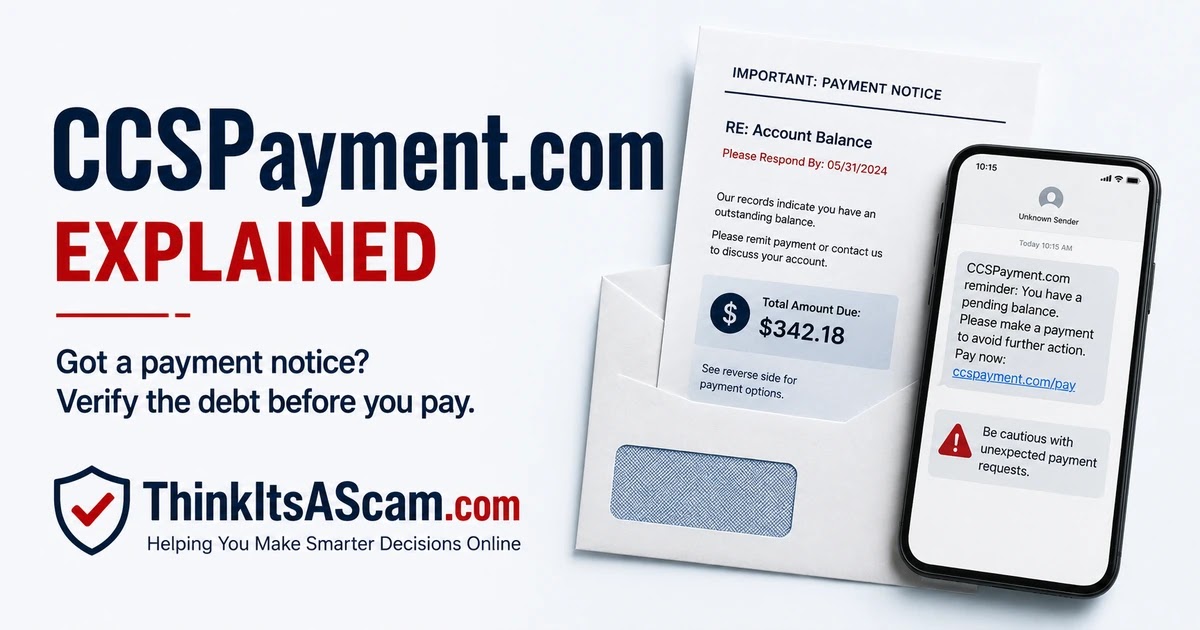
www.ccspayment.com Scam Review at a Glance
| Question | Finding |
|---|---|
| Is www.ccspayment.com legitimate? | Yes. It redirects to the Credit Collection Services portal on CCSUSA.com. |
| What is CCS? | Credit Collection Services is a debt collection company. |
| Why did CCS contact me? | A creditor may have assigned an unpaid account to CCS for collection. |
| Does the website prove I owe the debt? | No. Verify the debt, original creditor, amount, and identity information independently. |
| Should I click a text-message link? | It is safer to type the verified address into your browser or contact CCS through CCSUSA.com. |
| Can scammers impersonate CCS? | Yes. A caller, sender name, logo, or copied website design can be impersonated. |
What Is www.ccspayment.com?
www.ccspayment.com is an online payment and account-management address used by Credit Collection Services.
Entering the address currently redirects the visitor to a secure CCS self-service website on the domain:
self-service.ccsusa.com
The portal states that the communication is from a debt collector and that information obtained may be used to collect a debt.
The self-service system may allow consumers to:
- Review information associated with a collection account.
- Make a payment by check or payment card.
- Establish or review a payment plan.
- View payment history.
- Upload documents or correspondence.
- Submit information concerning an account.
Domain confirmation: Although CCS uses CCSUSA.com as its main corporate website, CCSPayment.com is an official payment address that redirects to the CCSUSA.com self-service system. The different domain names are a major reason recipients question whether the notice is legitimate.
What Is Credit Collection Services?
Credit Collection Services is part of The CCS Companies. The company states that it handles consumer payment obligations for clients in several industries, including:
- Banking and insurance.
- Healthcare.
- Cable and telecommunications.
- Energy and utilities.
- Retail.
- Government.
The company’s published corporate contact information is:
- Company: Credit Collection Services
- Corporate address: 725 Canton Street, Norwood, MA 02062
- Main telephone: 1-617-965-2000
- Collection-account extension: 4490
- Corporate website: CCSUSA.com
- Payment website: CCSPayment.com
Use contact information obtained independently from CCSUSA.com rather than relying exclusively on a telephone number included in an unexpected message.
Why Are People Calling CCSPayment.com a Scam?
The Debt Notice Arrived Unexpectedly
Many consumers first learn about CCS through an unexpected letter or text. They may not recognize either Credit Collection Services or the original creditor listed in the notice.
An unfamiliar collector does not necessarily mean the debt is fake. Creditors frequently assign unpaid accounts to outside collection agencies, and the collector’s name may be different from the business with which the consumer originally dealt.
CCSUSA.com and CCSPayment.com Are Different Domains
Consumers who independently find CCSUSA.com may become suspicious when their notice instead lists CCSPayment.com.
In this case, the payment domain is connected to the company. Visiting the exact CCSPayment.com address redirects to a self-service page on CCSUSA.com.
The Person Does Not Recognize the Amount
A collection amount may be disputed because:
- The underlying account was canceled.
- The balance was previously paid.
- An insurance payment was not properly credited.
- The amount includes charges the consumer questions.
- The account belongs to someone with a similar name.
- The original creditor has inaccurate identifying information.
- The consumer never opened the reported account.
These situations require investigation. They do not establish that CCSPayment.com itself is fraudulent.
Debt Collectors Can Be Impersonated
Scammers sometimes use the names of legitimate collection companies. They may copy a real company’s name, address, logo, telephone number, or website design while directing victims to a different payment destination.
Caller ID and sender names can also be spoofed. Never assume that a message is genuine simply because it displays “CCS,” “Credit Collection Services,” or another recognizable name.
Does CCS Send Text Messages?
Yes, legitimate CCS collection activity can include text messages.
The New Jersey Turnpike Authority specifically states that consumers whose E-ZPass accounts have been assigned to Credit Collection Services may receive CCS text messages.
According to the agency, a legitimate CCS message concerning such an account may include:
- A CCS telephone number.
- The website www.ccspayment.com.
- A reference or file number.
This does not mean every toll-related text is genuine. The New Jersey Turnpike Authority also warns that E-ZPass does not send unsolicited text messages demanding direct payment of an outstanding toll.
Do not confuse a legitimate CCS collection message with a toll-text scam.
Avoid paying from a text-message button. Contact the toll agency through its official website to determine whether it assigned the account to CCS, and then navigate independently to the verified CCS website.
How to Verify a CCS Debt Before Paying
1. Read the Complete Notice
Look for the following information:
- Your name and mailing address.
- The name of Credit Collection Services.
- The current creditor.
- The original creditor, when different.
- The account or file number.
- The amount claimed.
- An explanation of your dispute rights.
- A date by which a written dispute should be submitted.
2. Contact the Original Creditor
Locate the creditor’s telephone number on its official website, a prior bill, or another independently verified source. Do not use a number supplied solely by the person requesting payment.
Ask the creditor:
- Whether the account belongs to you.
- Whether a balance remains unpaid.
- What amount was assigned for collection.
- Whether Credit Collection Services currently handles the account.
- Whether any recent payments or insurance adjustments are missing.
3. Contact CCS Independently
Visit the official CCS contact page or call the independently published main number at 1-617-965-2000 and request the collection-account extension.
Provide only enough information to locate and verify the notice. Do not give a caller your online banking password, card PIN, or other credentials that a collector does not need.
4. Request Validation Information
The Consumer Financial Protection Bureau explains that a debt collector generally must provide validation information concerning the debt.
This information should help identify:
- The debt collector.
- The creditor associated with the debt.
- The consumer the collector believes owes it.
- The amount being collected.
- Interest, fees, payments, and credits included in the balance.
- The consumer’s dispute and verification rights.
5. Compare the Account With Your Records
Review bills, cancellation confirmations, insurance statements, bank records, receipts, and prior correspondence. A small unpaid balance can sometimes result from a final bill, returned payment, insurance adjustment, equipment charge, or cancellation that was not completed properly.
6. Review Your Credit Reports
Consumers can obtain credit reports through AnnualCreditReport.com, the federally authorized source for free credit reports.
An account’s absence from a credit report does not prove that the debt is invalid because not every creditor or collector reports every account. However, the reports may provide additional information or reveal identity-theft concerns.
How to Recognize a Fake CCS Payment Request
Be especially cautious if a caller or message:
- Directs you to a misspelled or unrelated website.
- Uses an address that merely contains “CCS” somewhere in a longer domain.
- Refuses to identify the original creditor.
- Will not provide validation information.
- Demands immediate payment before you can investigate.
- Threatens immediate arrest or criminal prosecution for an ordinary consumer debt.
- Requests gift cards, cryptocurrency, wire transfers, or prepaid debit cards.
- Asks for your online banking username or password.
- Claims you must keep the collection secret from your bank or family.
- Sends an attachment that requires installing software.
Check the Actual Domain Carefully
The verified payment address is:
https://www.ccspayment.com/
It may redirect to:
https://self-service.ccsusa.com/
A domain such as ccspayment.com.example.net would belong to Example.net—not CCSPayment.com. Likewise, additional words, altered spellings, unusual endings, or a different domain after the final dot should be investigated before proceeding.
On a phone, press and hold a link to preview its destination without opening it. On a computer, hover over it and examine the complete address.
What If the Name or Address Is Wrong?
A misspelled name, outdated address, or similar-name match does not automatically prove that the letter is fraudulent. It may indicate:
- A clerical error.
- Old creditor records.
- A skip-tracing match involving someone with a similar identity.
- A debt belonging to another household member.
- Identity theft.
- A fraudulent or misdirected notice.
Do not pay merely to make the communications stop. Tell CCS that you question the identity information and request documentation showing why the account was associated with you.
How to Dispute a CCS Collection Notice
If you do not recognize the creditor, believe the balance is wrong, or think the account belongs to someone else, dispute it promptly in writing.
The CFPB states that consumers generally have 30 days after receiving validation information to dispute all or part of a debt. A timely written dispute generally requires the debt collector to pause collection activity until it sends verification responding to the dispute.
Your dispute should identify:
- The CCS file or account number.
- The portion of the debt you dispute.
- Why you believe the information is incorrect.
- Which documents or account details you are requesting.
- Your current mailing address for the response.
Keep a copy of the letter and attachments. If mailing the dispute, consider using a trackable delivery method and retain proof that it was received.
The CFPB provides additional guidance for consumers contacted about debts they already paid or do not believe they owe.
Should You Pay Through CCSPayment.com?
If you have independently confirmed that:
- The account belongs to you.
- The original creditor assigned it to CCS.
- The amount is accurate.
- The collection is legally enforceable.
- The payment arrangement matches what you agreed to.
- You are using the exact official portal.
then CCSPayment.com is an official method for accessing the CCS self-service payment system.
Before submitting payment:
- Review the creditor and balance displayed.
- Confirm whether the payment is full, partial, or part of a payment plan.
- Read any settlement or payment-plan language carefully.
- Save screenshots of the terms and confirmation screen.
- Download or print the receipt.
- Keep proof of the payment indefinitely.
- Confirm that the original creditor and CCS update their records.
Old debts require additional care: Before acknowledging or making a payment on an old account, research the statute of limitations in your state or consult a qualified consumer attorney. A payment or written acknowledgment can affect a consumer’s legal position in some circumstances.
What If You Already Paid?
If you paid through the genuine CCS portal:
- Save the receipt and payment confirmation.
- Check that the correct amount left your account.
- Ask CCS when its records will reflect the payment.
- Confirm the payment with the original creditor.
- Request written confirmation when the account is resolved.
- Monitor your credit reports for inaccurate reporting.
If you later discover that the account was not yours or that the amount was wrong, contact CCS and the original creditor immediately. Explain the problem in writing and provide copies—not originals—of supporting documents.
What If You Entered Information on a Fake Website?
If the website was not the exact CCSPayment.com or CCSUSA.com domain:
- Contact your bank or card issuer immediately.
- Lock or replace the affected payment card when advised.
- Review recent transactions for unauthorized activity.
- Change any password that was entered or reused elsewhere.
- Enable multifactor authentication on important accounts.
- Monitor your credit reports.
- Consider a fraud alert or credit freeze if identity information was exposed.
- Report the incident to ReportFraud.ftc.gov.
- Preserve screenshots, messages, telephone numbers, receipts, and website addresses.
Your Debt Collection Rights
The Federal Trade Commission advises consumers to confirm that a debt belongs to them before paying and to request validation information.
Debt collectors generally may not:
- Harass, abuse, or repeatedly intimidate consumers.
- Lie about the amount or legal status of a debt.
- Falsely claim to be an attorney or government official.
- Threaten arrest for an ordinary unpaid consumer debt.
- Threaten actions they cannot legally take or do not intend to take.
- Use unfair or deceptive collection practices.
Consumers experiencing unresolved problems can submit a complaint through the Consumer Financial Protection Bureau or report suspected fraud to the FTC.
Frequently Asked Questions
Is www.ccspayment.com a scam?
No. The exact www.ccspayment.com domain is an official payment address associated with Credit Collection Services. It redirects to the company’s self-service portal on CCSUSA.com.
Is Credit Collection Services legitimate?
Yes. Credit Collection Services is an established debt collection company headquartered in Norwood, Massachusetts. However, the legitimacy of the company does not guarantee that every individual debt notice is accurate.
Why does CCSPayment.com redirect to CCSUSA.com?
CCSPayment.com functions as a payment-address gateway. It redirects users to the Credit Collection Services self-service system hosted on the company’s CCSUSA.com domain.
Why did I receive a CCS payment text?
A creditor may have assigned an unpaid account to Credit Collection Services. Confirm the identity of the original creditor and whether it actually placed your account with CCS before responding.
Does CCS collect New Jersey E-ZPass debt?
The New Jersey Turnpike Authority confirms that some accounts in collections may be handled by Credit Collection Services. Legitimate CCS communications may reference CCSPayment.com and include a file number. This does not make every E-ZPass text legitimate.
What companies use Credit Collection Services?
CCS states that it serves clients in banking, insurance, healthcare, cable, telecommunications, utilities, retail, and government. The creditor’s identity should be listed in the validation information for the particular account.
What if I do not recognize the original creditor?
Request validation information and contact the named creditor through independently verified contact details. Do not pay until you understand where the balance originated and why it is associated with you.
What if CCS has the wrong person?
Notify CCS in writing, dispute the debt, and request documentation supporting the identity match. Avoid sending unnecessary sensitive documents until you have confirmed the collector and understand why the information is required.
Can I ignore a CCS notice?
Ignoring a legitimate collection notice may allow the issue to continue and could limit your opportunity to exercise certain dispute rights promptly. Verify and respond appropriately, even if your response is a written dispute.
Can a debt collector have me arrested?
You cannot ordinarily be arrested merely for failing to pay a consumer debt. Threats of immediate arrest are a major warning sign of a fraudulent or abusive collection attempt.
Bottom Line: Is www.ccspayment.com Legit?
Yes. www.ccspayment.com is a legitimate Credit Collection Services payment address. It redirects to the CCS self-service portal hosted on CCSUSA.com.
The unfamiliar domain is not, by itself, evidence of a scam. Credit Collection Services is a real collection company, and at least one government toll authority publicly confirms that legitimate CCS collection messages may reference the website.
Nevertheless, consumers should not pay solely because the domain is genuine. A collection account may still contain an incorrect amount, belong to someone else, involve an already-paid balance, or be presented through an impersonation attempt.
The safest response is to contact the original creditor, verify that CCS received the account, review the required validation information, and navigate independently to the official payment portal.
Official Sources
- Official CCSPayment.com portal
- Credit Collection Services official website
- The CCS Companies contact information
- New Jersey Turnpike Authority CCS and E-ZPass warning
- CFPB debt-validation information
- FTC debt collection rights and scam guidance
Related TIAS Posts
- Williams and Fudge Scam or Legit? Debt Calls Explained
- Sunrise Credit Services Scam or Legit?
- MRS BPO Scam or Legit? Debt Calls Explained
- Unifin Text Scam Warning
- Traffic Citation Text Scam Warning
Have You Received a CCSPayment.com Notice?
Share your experience below to help other consumers understand CCS letters and text messages.
- Did you receive a letter, text, email, or phone call?
- Which original creditor was listed?
- Did the notice direct you to the exact CCSPayment.com domain?
- Were you able to verify the account with the creditor?
- Did CCS provide validation information?
- Was the balance correct?
- Were you able to resolve or dispute the account?
Do not post your CCS file number, account number, Social Security number, address, telephone number, payment details, or other private information.
Page updated: September 4, 2026.
Disclaimer
ThinkItsAScam.com is an independent consumer-information website and is not affiliated with Credit Collection Services, The CCS Companies, CCSPayment.com, CCSUSA.com, the New Jersey Turnpike Authority, the Federal Trade Commission, the Consumer Financial Protection Bureau, or any creditor using CCS.
This article uses search phrases such as “www.ccspayment.com scam,” “CCS payment scam,” and “Credit Collection Services scam” because consumers use those terms when researching unfamiliar collection notices. Their inclusion does not allege that Credit Collection Services, The CCS Companies, their employees, or their legitimate clients are engaged in fraud.
Debt validity, collection rights, credit reporting, statutes of limitation, and dispute procedures depend on the account, jurisdiction, and individual circumstances. This article provides general consumer information and is not legal or financial advice.
Leave a Reply