October 5, 2026 update: U.S. Google Trends showed unifin scam rising 50% over the past seven days. Recent BBB complaints also document continuing confusion around legitimate Unifin communications that reached the wrong person, which is different from a scammer impersonating Unifin.
If you searched for Unifin text scam, Unifin scam, Unifin debt collector text, or is Unifin legit, you may have received an unexpected message about a debt, account balance, payment option, or reference number.
Unifin, Inc. is a real third-party debt collection company, and legitimate Unifin communications can include text messages.
However, receiving a real company name in a text does not prove that the message is genuine or that the debt belongs to you.
An unexpected Unifin message can potentially be:
- A legitimate collection text about your account
- A legitimate Unifin message sent to the wrong or reassigned phone number
- A genuine message about a debt you dispute
- A message involving inaccurate or outdated account information
- An impersonation or phishing attempt using the Unifin name
Quick Verdict
Unifin is a legitimate debt collector, and it does use text messaging. Do not assume an unexpected Unifin text is a scam, but do not pay or disclose sensitive information solely because a text says it is from Unifin. Verify the communication through Unifin’s official website, confirm the creditor and debt, and request validation information if you do not recognize the account.
Share Your Unifin Text Experience ↓
On this page:
What is Unifin? ·
Why is Unifin texting me? ·
Wrong-person texts ·
Verify a message ·
Debt validation ·
Stop texts ·
Scam warning signs
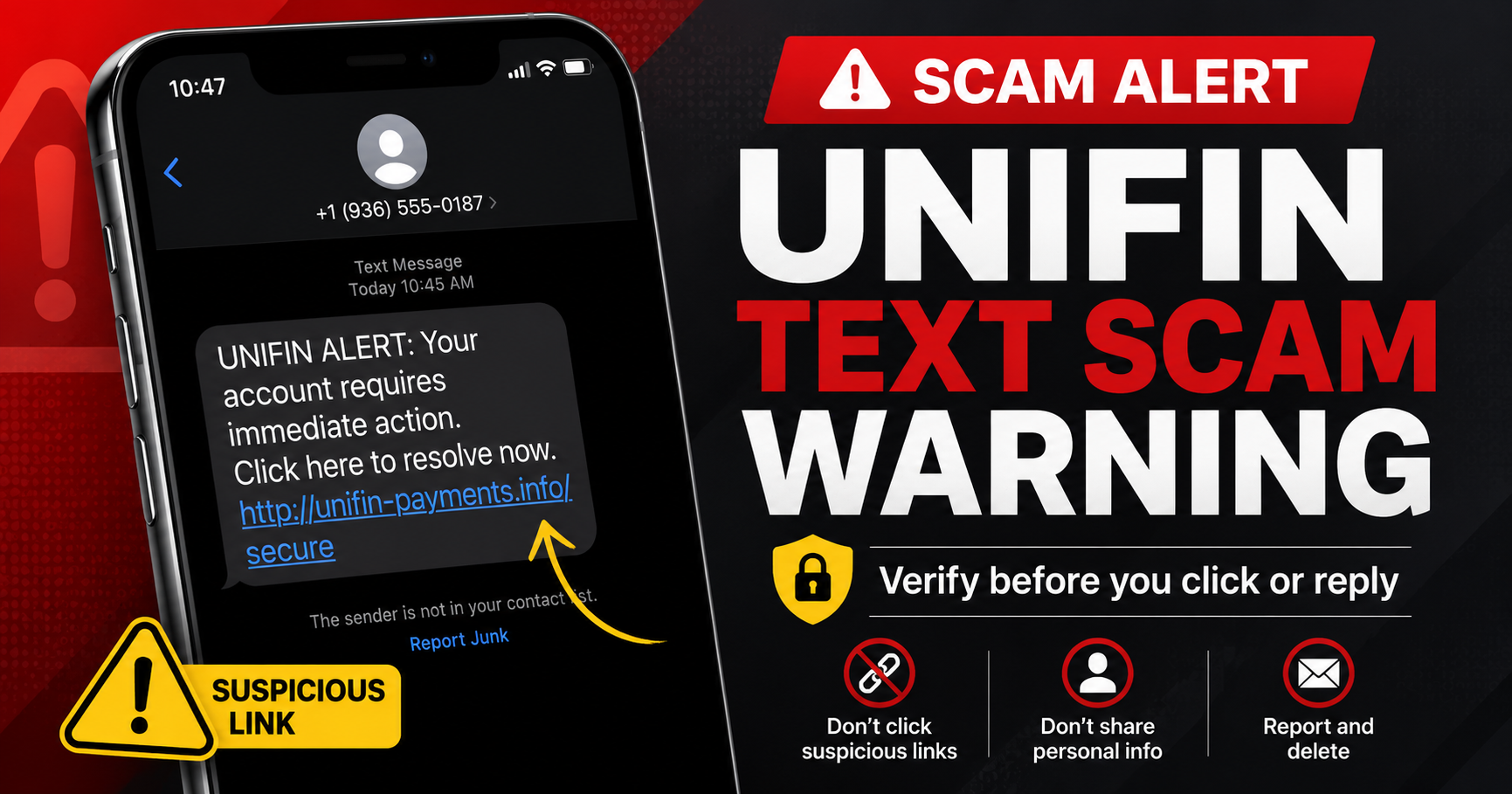
Unifin is a real debt collector and can send legitimate text messages. Verify the sender, debt, creditor, and reference information independently before paying or sharing sensitive information.
What Is Unifin?
Unifin, Inc. is a third-party debt collection company.
Its official website currently describes Unifin as a digital debt collection agency that works with consumers regarding past-due accounts and offers online repayment options.
Current official company information includes:
- Company: Unifin, Inc.
- Website: UnifinInc.com
- NMLS: 976731
- Office: 5996 W. Touhy Ave., Suite 2000, Niles, IL 60714
- Mail: PO Box 1608, Skokie, IL 60076
- Customer service: 888-572-3987
- Email: info@unifininc.com
Unifin’s current published customer-service hours are Monday through Friday from 7 a.m. to 7 p.m., Saturday from 8 a.m. to 5 p.m., and closed Sunday.
Visit the official Unifin website
Is Unifin a Legitimate Debt Collector?
Yes. Unifin itself is an established debt collection company.
The Better Business Bureau currently lists Unifin as a BBB Accredited collection agency with a B rating.
As of October 5, 2026, the BBB complaints page displayed:
- 682 complaints during the previous three years
- 187 complaints closed during the previous 12 months
Complaint totals and ratings can change.
Consumer complaints do not prove that the company is fraudulent. They can, however, help identify issues consumers are experiencing, including disputed debts, wrong-person contacts, repeated communications, billing questions, and customer-service concerns.
Recent wrong-recipient examples: A September 15 BBB complaint alleged that a Unifin collection email was sent to someone other than the person named in the debt notice. In its response, Unifin said the email address had been believed to be a good contact for its customer and that the unintended recipient’s address was added to its do-not-contact list. September 14 and September 2 complaints similarly described texts reaching people who said the debt was not theirs; Unifin’s responses said those phone numbers had been used in an attempt to reach another customer. These are individual complaint records and company responses, not findings that Unifin acted unlawfully.
Does Unifin Really Send Text Messages?
Yes.
Unifin’s official website specifically tells consumers what to do if they receive a call, text message, email, or letter mentioning Unifin.
Its FAQ also says:
Because scam attempts can involve messages using debt-collector names, consumers should verify Unifin-related texts before responding.
This means that the presence of a text message is not itself evidence of fraud.
Why Is Unifin Texting Me If I Don’t Owe Any Debt?
One possibility is that the message was intended for someone else.
Recent BBB complaints provide several examples of consumers reporting Unifin texts or emails concerning people or debts they did not recognize.
In multiple 2026 responses, Unifin said it had contacted a telephone number or email address that it believed belonged to the consumer it was trying to reach.
Unifin then said it placed the incorrect recipient’s telephone number or email address on its do-not-contact list.
This is an important distinction:
An unwanted Unifin text does not automatically mean someone is impersonating Unifin.
It could be an authentic communication sent to:
- A recycled phone number
- A former customer’s old number
- A number incorrectly associated with an account
- Someone with a similar name
- A consumer who disputes the alleged debt
If the message clearly concerns another person, do not provide that person’s information or your own sensitive information to try to resolve it.
Why Would Unifin Contact Me Instead of the Original Creditor?
A company listed on your credit report or old statement may remain the creditor while another company handles collection activity.
Unifin’s FAQ explains that a creditor can place an account with Unifin for collection while the creditor continues to own the account.
Therefore, you might recognize the original creditor but not recognize the name Unifin.
Ask for:
- The current creditor
- The original creditor, when different
- The account or reference ID
- The balance
- Information explaining how the amount was calculated
- Your dispute rights
How to Verify a Unifin Text Safely
Do not begin verification by clicking the link in the text.
- Save or screenshot the message.
- Record the sending number and any reference ID.
- Open your browser separately.
- Go directly to UnifinInc.com.
- Open Unifin’s official communication-verification page.
- Compare the message details with the information published by Unifin.
- Call Unifin through an independently obtained official number if you still have questions.
- Request information identifying the creditor and debt before making a payment.
Unifin: Verify a Communication
What Phone Numbers Does Unifin Say It Uses?
As of October 5, 2026, Unifin’s official communication-verification page lists the following numbers as numbers it uses for SMS. The same page advises consumers to pause before paying, compare the message with information in the secure uOffer portal, and contact Unifin independently through an official channel if anything does not match. A number match is useful, but you should still verify the creditor and debt before paying.
- 800-686-1439
- 800-556-0504
- 800-276-3744
- 800-554-3257
- 844-268-6237
- 888-407-7636
- 888-385-0090
- 888-473-9904
- 888-385-0095
- 888-572-3987
- 800-554-3248
- 855-627-3780
Numbers can change, so check the current verification page rather than relying permanently on this list.
A matching number is useful information, but it should not be your only verification step.
If you have doubts, go directly to UnifinInc.com and use its published contact information.
What Does a Legitimate Unifin Message Usually Contain?
Unifin’s verification page says legitimate communications typically include identifying account information such as a:
- Reference ID
- Unifin ID
- Original creditor
- Account status or related account information
Do not post those identifiers publicly.
A scammer could potentially copy legitimate-looking wording, so even a message containing a reference number should still be independently verified.
Should Unifin Send Debt Validation Information?
Yes.
Unifin’s FAQ says it sends a notice containing important information about the debt and the consumer’s rights either with the initial communication or within five days of that initial communication.
Federal debt-collection rules similarly require covered debt collectors to provide certain validation information.
The Consumer Financial Protection Bureau says the validation information generally includes:
- A statement that the communication is from a debt collector
- The debt collector’s name and mailing information
- The creditor’s name
- The account number, when applicable
- The amount owed and required itemization information
- Information about disputing the debt
- Information about requesting details concerning the original creditor
Importantly, validation information may be provided by mail or electronically.
So the absence of a paper letter does not by itself establish that a text is fraudulent.
CFPB: Debt Validation Information
What If I Do Not Recognize the Debt?
Do not pay simply to make the text messages stop.
Instead:
- Verify that the communication really came from Unifin.
- Request the validation information.
- Identify the alleged creditor.
- Compare the account with your own records.
- Contact the creditor independently if necessary.
- Dispute the debt if you believe it is not yours or the amount is incorrect.
- Keep copies of your communications and supporting documents.
Unifin currently provides a dedicated complaints and disputes page:
What If the Debt Was Already Paid?
A genuine collection message can still involve an account you believe was previously resolved.
Gather:
- Payment confirmations
- Settlement agreements
- Bank statements
- Letters showing the account was satisfied
- Relevant credit-report information
Submit a documented dispute rather than assuming the mere presence of a collection message proves that the debt is currently valid.
How Do I Stop Unifin Text Messages?
Federal debt-collection rules require electronic collection communications to provide a reasonable and simple way to opt out of further electronic messages at that address or telephone number.
A text may include wording such as:
Reply STOP to stop texts.
Unifin’s consumer portal also states that consumers enrolled in its text-alert program can text STOP to stop messages.
If you believe the message genuinely came from Unifin and you want the texts stopped, follow the published opt-out method or contact Unifin directly.
Unifin’s current contact page says consumers requesting that calls stop should allow at least 24 hours for the request to be processed.
For a broader request concerning collection communications, review the CFPB’s guidance:
CFPB: How to Ask a Debt Collector to Stop Contacting You
Should I Reply STOP to a Suspicious Text?
It depends on whether you have verified the sender.
If you have confirmed that the message came from a legitimate collector, the STOP option can be a normal opt-out mechanism.
If the message appears to be phishing and you cannot verify the sender, you do not need to interact with it merely to unsubscribe.
Instead, you can block or report the message and verify the supposed account independently.
Warning Signs of a Fake Unifin Debt Collection Text
The Sender Will Not Identify the Debt Collector
The FTC warns that a supposed debt collector who refuses to provide a company name, mailing address, or telephone number could be fraudulent.
The Debt Is Completely Unfamiliar
An unfamiliar debt does not automatically prove fraud because wrong-person contacts and disputed accounts occur.
However, it is a reason to pause and request validation rather than pay immediately.
The Message Threatens Arrest
A fake collector may claim police are coming or that you will be arrested if you do not pay immediately.
The FTC identifies threats of arrest or law-enforcement action over an ordinary debt as a major warning sign.
The Sender Refuses to Provide Validation Information
A demand that you pay before receiving meaningful information about the debt is a serious warning sign.
You Are Directed to an Unfamiliar Website
Do not assume a payment page is legitimate merely because it contains the Unifin name or logo.
Start at UnifinInc.com rather than using an unsolicited link.
The Payment Goes to an Individual
Be extremely cautious if someone tells you to send money to a personal:
- Zelle account
- Cash App account
- Venmo username
- Cryptocurrency wallet
- Gift card
Verify the company’s authorized payment method independently before sending money.
The Sender Demands Passwords or Security Codes
Never give an unsolicited collector:
- Your email password
- Online banking password
- Debit-card PIN
- One-time authentication code
- Full account login credentials
Can a Real Debt Collector Ask for Personal Information?
A legitimate collector may need information to verify that it is speaking with the correct person.
That does not mean you should disclose sensitive information to an unverified inbound texter or caller.
A safer approach is:
- End or pause the unsolicited communication.
- Go directly to the collector’s official website.
- Use published contact information.
- Verify the account before providing information.
What If the Text Mentions Wage Garnishment or Legal Action?
Do not assume that every reference to legal remedies proves fraud.
Real debt collectors may discuss lawful collection options in appropriate circumstances.
However, a collector may not falsely threaten arrest, legal action, or another consequence that it cannot legally take or does not intend to take.
Pressure to pay immediately before you can review or dispute the debt is a reason to pause and verify.
What Do Recent Unifin Complaints Show?
Recent 2026 BBB complaints provide useful context about why consumers search for phrases such as “Unifin scam” or “Unifin text scam.”
Complaint allegations include:
- Texts about debts the recipient did not recognize
- Messages intended for another person
- Disputed or allegedly previously paid debts
- Repeated calls or texts
- Requests to stop communications
- Questions about documentation or balances
Several recent company responses say Unifin determined that a telephone number or email address belonged to someone other than the intended account holder and added that contact information to a do-not-contact list.
Other responses involve consumers who disputed accounts that had actually been placed with Unifin for collection.
These complaint records are useful because they show that more than one explanation is possible when someone receives an unfamiliar Unifin message.
They should not be interpreted as proof that every complaint is accurate or that Unifin itself is a scam.
What If You Clicked a Link in a Unifin Text?
If the link ultimately went to a verified Unifin site, clicking it does not automatically indicate a security problem.
If the destination was unfamiliar or suspicious:
- Close the page.
- Do not download unexpected software.
- Do not approve browser notifications or device permissions.
- Save the URL.
- Change any password you entered into the suspicious page.
- Contact your financial institution if you entered payment information.
- Monitor relevant accounts.
If sensitive identity information may have been exposed, visit IdentityTheft.gov.
What If You Paid a Fake Debt Collector?
Act quickly.
- Contact the bank, card issuer, payment service, or financial institution used for the transaction.
- Explain that the payment resulted from a suspected debt-collection impersonation scam.
- Ask whether the transaction can be stopped or reversed.
- Save the text, telephone number, URL, payment receipt, and communications.
- Report the incident to the FTC.
What If a Real Unifin Account Is Not Yours?
If you verify that Unifin actually sent the message but the debt belongs to someone else:
- Tell Unifin that it has reached the wrong person.
- Request that your telephone number be removed from the account.
- Keep proof of your request.
- Use the company’s complaints and disputes process if the messages continue.
- Review your credit reports if the debt appears connected with your identity.
If you discover an account on your credit reports that is not yours, consider whether identity theft or inaccurate credit reporting may be involved.
Official Unifin and Consumer Resources
- Unifin, Inc. Official Website
- Unifin — Verify a Communication
- Unifin Contact Information
- Unifin Complaints & Disputes
- Unifin Debt Collector FAQ
- FTC — Fake and Abusive Debt Collectors
- CFPB — Legitimate Debt Collector or Scam?
- CFPB — Debt Validation Information
- Submit a CFPB Complaint
- FTC ReportFraud
Related Debt Collection Warning
For another example of a legitimate debt collector whose unexpected calls or messages should still be independently verified, see:
Unifin Text Scam FAQs
Is Unifin a scam?
No. Unifin, Inc. is a real third-party debt collection company. However, individual messages should still be verified because a message can be misdirected, involve a disputed account, or potentially be sent by an impersonator.
Does Unifin send text messages?
Yes. Unifin’s official website specifically discusses calls, texts, emails, and letters and provides instructions for verifying those communications.
Why did Unifin text me if I have no debt?
The company may have an incorrect or reassigned telephone number associated with another consumer. Recent BBB complaints include examples where Unifin said a message was intended for another person and subsequently added the recipient’s number to its do-not-contact list.
How do I know if a Unifin text is real?
Go directly to UnifinInc.com and use the company’s verification page. Compare the reference information and contact Unifin through a number published on its official website rather than relying solely on information in the text.
What is Unifin’s official customer-service number?
The company’s current Contact page lists 888-572-3987 for English-language customer service. Unifin’s verification page lists additional telephone numbers it uses.
Does Unifin have to send me a letter?
A debt collector generally must provide required validation information with the initial communication or within five days. CFPB guidance says this information may be delivered by mail or electronically, so not receiving a paper letter alone does not prove fraud.
Can I dispute a Unifin debt?
Yes. Unifin provides an official Complaints & Disputes page, and federal debt-collection law provides consumers with important rights to obtain validation information and dispute debts.
What if the Unifin debt is not mine?
Tell Unifin that you dispute the account or that the company has reached the wrong person. Request removal of your telephone number when appropriate and keep documentation of your request.
Can I stop Unifin text messages?
Electronic debt-collection communications must provide a reasonable and simple opt-out method. Legitimate messages may allow you to reply STOP. You can also contact Unifin through its official website to request that communications to your number stop.
Is an unfamiliar Unifin text automatically phishing?
No. Recent complaint records show that genuine Unifin messages have sometimes reached telephone numbers associated with the wrong person. Verify before deciding whether the message is legitimate, mistaken, disputed, or fraudulent.
Can a fake debt collector threaten to arrest me?
Yes. The FTC identifies threats of arrest or law-enforcement action as a common fake-debt-collector warning sign. Do not pay solely because someone threatens immediate arrest over an ordinary consumer debt.
Should I click the payment link in a Unifin text?
If you are uncertain, do not use the text link. Go directly to UnifinInc.com and access the company’s verified account or contact options from there.
Bottom Line: Unifin Text Scam or Legit?
Unifin is a legitimate debt collection company, and legitimate Unifin text messages do exist.
That makes this situation different from a simple “all messages are scams” warning.
An unfamiliar Unifin text could be:
- A genuine collection message
- A message sent to the wrong person
- A genuine message concerning a debt you dispute
- A communication involving outdated or incorrect account data
- An unauthorized impersonation attempt
The safest response is verification rather than immediate payment or immediate dismissal.
Start at UnifinInc.com, verify the communication through an official contact channel, identify the creditor and account, review the validation information, and dispute the debt if it is not yours or the details are incorrect.
Have You Received a Unifin Text Message?
Share the non-sensitive details of your experience below to help other consumers understand current Unifin texts, wrong-number messages, debt disputes, and possible impersonation attempts.
- Did the message identify itself as Unifin?
- Did it include a reference ID?
- Was an original creditor identified?
- Did you recognize the debt?
- Was the text intended for another person?
- Did it include a link?
- Were you able to verify the message through Unifin’s official website?
- Did you request validation?
- Did you dispute the debt?
- Were the messages stopped after you requested an opt-out?
Please do not post your full name, telephone number, home address, email address, date of birth, Social Security number, account number, reference ID, creditor account number, passwords, payment information, verification codes, or other sensitive personal information.
Page researched and updated: October 5, 2026.
ThinkItsAScam.com is an independent consumer-information website and is not affiliated with Unifin, Inc., any creditor, credit bureau, payment processor, the Consumer Financial Protection Bureau, Federal Trade Commission, or Better Business Bureau. Unifin is a legitimate debt collection company. This article discusses how to verify communications, recognize wrong-person contacts and possible impersonation attempts, request debt validation, and understand publicly available consumer guidance. BBB complaints describe individual consumer allegations and company responses and are not findings that fraud occurred. Debt-collection rights and procedures can depend on the type of debt, jurisdiction, and circumstances. This article is for general consumer education and is not legal, credit, or financial advice.
Leave a Reply