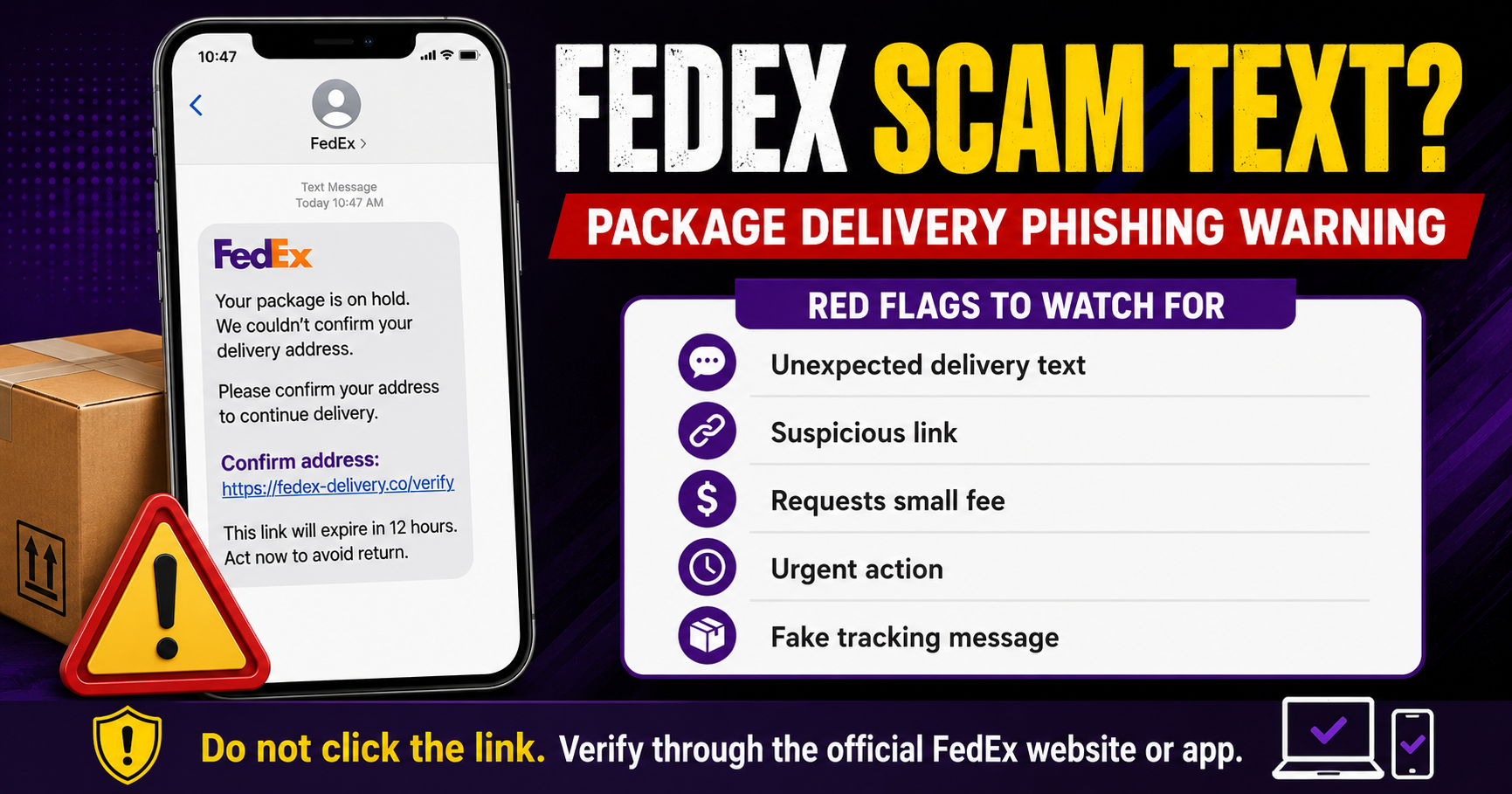
A FedEx scam text may claim that your package is delayed, held, awaiting a signature, or needs a payment. FedEx scam calls use similar delivery problems to request money or information; some impersonators escalate to threats about a parcel supposedly containing illegal items.
Last reviewed: October 10, 2026. Jump to: Scam calls and verification · Scam texts · Check a message · Report fraud · FAQs
FedEx does send some legitimate tracking and delivery notifications. However, scammers frequently impersonate FedEx to steal payment-card information, passwords, verification codes, addresses, and other personal information.
The safest response to an unexpected FedEx text is to avoid its link and verify the shipment independently through FedEx.com, the official FedEx app, or the retailer that sent the package.
Searching for FEDEXWHT, FEDEXCV, FEDEXDPK or FEDEXMC? See our October 2026 FedEx variant update. FEDEXWHT and FEDEXCV now have documented voicemail/domain reports; FEDEXDPK remains an unverified trending term. The same guide also covers FEDEXMC, FEDEXPM, FEDEXVW and FEDEXRK.
FedEx scam calls: fake delivery problems and parcel-seizure threats
FedEx scam calls are a documented form of impersonation. FedEx’s U.S. fraud guidance describes callers using a supposed shipment problem to start a fraudulent conversation. That does not mean every call about a FedEx delivery is fake.
A more threatening version appears in FedEx’s India fraud warning: someone posing as a delivery representative claims that a parcel contains illegal items, then connects the recipient to fake law-enforcement officials demanding money to avoid arrest. This regional warning establishes the scheme; it does not establish a new U.S. outbreak or identify the callers behind today’s searches.
Do not pay to make a supposed criminal case disappear or accept a caller-arranged transfer as independent verification. If the person claims to be an FBI agent, see our FBI scam-call verification guide.
Does FedEx ever call customers?
Genuine shipment-related calls can occur. FedEx’s India guidance, for example, describes calls requesting import-clearance documents through its published process. Requirements and contact channels vary by country. A call about customs or an address issue deserves verification, rather than an automatic scam label.
How to check a FedEx caller or voicemail
- Ask for the shipment or invoice reference if you can do so without disclosing sensitive information. You do not need to remain on an intimidating call.
- End the call and check independently. Open FedEx.com yourself, check the shipment, and use the official contact page for your country.
- In the U.S. or Canada, call 1-800-463-3339 (1-800-GoFedEx) to ask about the claimed issue. Do not return a suspicious voicemail using its supplied callback number.
- Verify any bill separately. Legitimate international duties and taxes can exist. Confirm the shipment and amount through official FedEx billing or import tools before paying.
FedEx Canada specifically recommends obtaining a tracking or invoice number and independently calling customer service when a caller’s identity is uncertain. A reference number is something to investigate, not proof that the caller is genuine.
The FTC warns that caller ID can be spoofed. A displayed FedEx name, local number or recognized support number cannot authenticate an incoming call. Hang up on suspicious robocalls rather than pressing a key to reach an operator or unsubscribe.
Already paid or disclosed information? Contact the bank or payment provider promptly and ask about recovery options. Save the voicemail, call time, displayed number, callback number and receipts. Report U.S. fraud at ReportFraud.ftc.gov; report unwanted calls without a loss through DoNotCall.gov. Recovery is not guaranteed.
Is This FedEx Text Real or a Scam?
A FedEx text may be legitimate when it matches a shipment you are expecting and you previously requested tracking notifications, enabled delivery alerts, or are receiving an international shipment with verified duties or taxes.
A message is more likely to be a scam when it:
- Arrives when you are not expecting a FedEx shipment.
- Comes from a random personal number, foreign number, iCloud address, or unfamiliar email-to-text sender.
- Claims that immediate payment is required to release the package.
- Uses a shortened, misspelled, or non-FedEx web address.
- Asks you to confirm your card, bank login, password, PIN, or verification code.
- Threatens to return, destroy, or permanently hold the package unless you act immediately.
- Claims you won a gift or prize that you never entered.
Do not judge the message by its appearance alone. Open FedEx.com yourself and enter the tracking or waybill number manually.
Does FedEx Send Legitimate Text Messages?
Yes. FedEx offers legitimate tracking and delivery notifications, but the method can depend on the service and country.
Examples documented by FedEx include:
- Tracking alerts requested through FedEx tracking or FedEx Delivery Manager.
- In the United States, texting FOLLOW plus a door-tag number to 48773 for updates.
- Delivery, delay, and status notifications for an enrolled shipment.
- Secure email or SMS links involving the FedEx Import Tool when duties or taxes are due on certain international shipments.
- Verified WhatsApp delivery notifications in certain countries where FedEx offers that service.
What Does a FedEx Scam Text Say?
Common messages may claim:
- “Quick update about your package.”
- “Shipment delivery status update.”
- “Delivery follow-up required.”
- “Your package is being held.”
- “Package release payment required.”
- “Your shipping address is incomplete.”
- “A signature is required before delivery.”
- “Confirm your FedEx waybill identifier.”
- “Your package will be returned if you do not respond.”
- “Pay a small redelivery, customs, tax, or handling fee.”
The exact wording changes frequently. Scammers may include a recipient name, delivery time, tracking number, or package status to make the message more convincing.
How the FedEx Text Scam Works
- You receive a message claiming that a shipment requires attention.
- The message creates urgency with a delivery deadline, package hold, or return warning.
- You are instructed to open a link, confirm an address, or make a small payment.
- The link opens a page designed to resemble FedEx.
- The page collects contact, login, card, or banking information.
- The information may be used for unauthorized charges, account theft, identity fraud, or additional phishing attempts.
A small redelivery or package-release payment can be bait. The initial amount may be minor, but the real objective may be to capture the complete card number and security code.
FedEx Waybill Identifier Text: Is It Real?
A FedEx air waybill number is generally another name for a shipment tracking number. A scammer can invent a number, copy one from another shipment, or include a real number that has no connection to you.
Copy the number without opening the message link, visit FedEx.com directly, and enter it into the official tracking tool.
Then compare:
- The shipment origin and destination.
- The retailer or sender.
- The expected delivery date.
- The package status.
- Whether the official tracking page actually shows a payment, signature, or address issue.
A tracking number that produces a result is helpful context, but it does not automatically validate a separate payment link.
FedEx Package Release Payment Warning
Unexpected messages demanding payment to “release” a package are a major warning sign, especially when they request gift cards, cryptocurrency, wire transfers, payment apps, or card information through an unfamiliar website.
However, some legitimate international shipments can involve duties, taxes, customs charges, or clearance fees. FedEx states that U.S. recipients of certain international shipments may receive a secure email or SMS link to its FedEx Import Tool after the shipment arrives.
Because both real billing notices and impersonation scams exist, verify the shipment through FedEx.com before paying. Confirm that:
- You are expecting an international package.
- The tracking number belongs to your shipment.
- The official tracking or billing page shows the same amount.
- The payment page is securely hosted on an official FedEx service.
- The request does not involve gift cards, cryptocurrency, or a person’s payment-app account.
FedEx Text From an iCloud Address or Personal Name
A message claiming to be FedEx but sent from an individual @icloud.com address should be treated as a scam. An iCloud address is not an official FedEx corporate domain.
The same caution applies when the sender appears as an unfamiliar individual’s name. Scammers may send messages through compromised accounts, email-to-text services, or spoofed sender information.
Do not contact or publicly accuse the person named in the message. The displayed name may be fake, spoofed, or connected to a compromised account. Report and delete the message instead.
FedEx Text From a Foreign or London Phone Number
A foreign telephone number does not prove fraud because international shipments and regional FedEx services can involve different sender IDs. Nevertheless, an unexpected U.S. delivery warning from a foreign or ordinary personal number should be treated as unverified.
Do not call the number or use its link. Confirm the package through FedEx.com or the retailer’s order page.
FedEx WhatsApp Message: Real or Fake?
FedEx uses verified WhatsApp business notifications in certain international markets. Therefore, a FedEx WhatsApp message is not automatically fraudulent.
Location and enrollment matter. A U.S. consumer should not assume that an unexpected WhatsApp message is legitimate merely because it says “verified FedEx” or provides an accurate delivery time.
Verify the tracking number independently and compare the sender with the official FedEx communication channels published for the country handling the shipment. Do not send payment or sensitive information through the chat.
FedEx Signature Required Text
Some genuine FedEx shipments require a direct, indirect, or adult signature. Scammers know this and may use a signature claim to make a message sound urgent.
Enter the tracking number at FedEx.com. The official shipment details should show whether a signature or authenticated-delivery step applies. Do not pay an unexpected “signature fee” through a text-message link.
Warning Signs of a Fake FedEx Website
- The domain contains misspellings such as “Fedx” or extra words.
- The website uses an unrelated country-code or unusual domain ending.
- The page asks for a full Social Security number, bank login, card PIN, or one-time code.
- The site demands immediate payment without showing verifiable shipment details.
- Links, buttons, policies, or customer-service pages do not work.
- The payment recipient is an individual rather than a recognizable FedEx billing service.
A padlock symbol or HTTPS connection does not prove that a site is legitimate. Scam websites can also use encryption.
How to Verify a FedEx Message Safely
- Do not open the link in the message.
- Open the official FedEx app or type FedEx.com into your browser.
- Enter the tracking, door-tag, or waybill number manually.
- Check the retailer account where you placed the order.
- Compare the shipper, destination, status, and delivery date.
- Use published FedEx contact information if the message remains unclear.
- Do not use the telephone number supplied in a suspicious message.
What If You Clicked the FedEx Scam Link?
If you opened the page but entered nothing, close it. Do not download files, install an app, approve browser notifications, or grant device permissions.
If you entered information:
- Card information: Contact the card issuer, lock or replace the card if advised, and monitor for small test charges.
- Bank information: Contact the bank’s fraud department immediately.
- Password: Change it immediately anywhere it was reused and enable multi-factor authentication.
- One-time code: Contact the affected account provider because the scammer may already be attempting access.
- Personal information: Watch for identity-theft and follow-up phishing attempts.
Save the text, sender information, website address, screenshots, transaction details, and any bank communications.
What If a FedEx Charge Appears on Your Statement?
A fraudulent delivery text and an unfamiliar FedEx statement charge are related concerns, but they are not the same issue.
A descriptor such as 1800GOFEDEX 10010007 MEMPHIS TN may be connected to a shipment, shipping label, FedEx account invoice, FedEx Office purchase, pickup, adjustment, duty, tax, or unauthorized transaction.
Review the detailed 1800GOFEDEX 10010007 Memphis TN charge guide for possible explanations and verification steps.
If the card was entered on a fake delivery page, do not assume a later charge is legitimate merely because the descriptor includes FedEx. Contact the card issuer and FedEx through independently verified contact information.
How to Report a FedEx Scam Text or Call
- Use your phone’s “Report Junk” or “Report Spam” option.
- Forward the text to 7726, which spells SPAM.
- Review and report the message through the official FedEx fraud page.
- Report impersonation or financial loss at ReportFraud.ftc.gov.
- Report significant internet-related financial fraud at IC3.gov.
- Contact your bank or card issuer immediately if money or payment information was involved.
FedEx currently directs U.S. customers with unauthorized FedEx account or credit-card charges to its fraud team at 1-800-584-2681. Verify current contact information on FedEx.com before calling.
FedEx Contact and Company Resources
- FedEx Customer Service Phone Number, Tracking and Claims – Review FedEx support numbers, tracking options, claims information, and complaint resources.
- FedEx Corporate Office Headquarters – Find FedEx headquarters information, corporate contacts, and consumer comments.
- FedEx Complaints and Reviews – Read FedEx customer ratings, complaints, and reviews or share your own experience.
- 1800GOFEDEX 10010007 Memphis TN Charge – Investigate an unfamiliar FedEx credit-card or bank-statement descriptor.
- Official FedEx Tracking – Enter a tracking, door-tag, or waybill number directly.
- FedEx Fraud Prevention – Review current fraud warnings and reporting guidance.
- FTC Fake Shipping Text Guidance – Learn how package-delivery phishing messages work.
Related TIAS Scam Warnings
- USPS Scam Text PDF Warning
- NAOBL Plan Suspended Text Scam
- Traffic Citation Text Scam Warning
- Robinhood Alert Scam Text
- Visa Click to Pay Scam Warning
FedEx scam calls and texts: frequently asked questions
Does FedEx text customers about deliveries?
Yes. FedEx offers legitimate tracking and delivery notifications. A message is safer to trust when you requested alerts and it matches a shipment that can be confirmed independently on FedEx.com.
Would FedEx text from an iCloud address?
An individual iCloud address is not an official FedEx corporate domain. Treat a FedEx message from an unfamiliar @icloud.com address as a scam.
Is a FedEx text from a London or foreign number fake?
Not necessarily, because regional and international services use different communication channels. However, an unexpected foreign sender should be treated as unverified. Check the shipment directly through FedEx.com.
Is a verified FedEx WhatsApp message legitimate?
FedEx operates verified WhatsApp services in certain countries, but availability varies by market. A verification badge alone does not prove that a payment request applies to your shipment. Confirm the tracking number and regional contact channel independently.
Can a scam FedEx text contain a real tracking number?
Yes. Scammers can copy or reuse tracking numbers. Enter the number on FedEx.com, then confirm that the sender, destination, status, and requested action match your shipment.
Is a FedEx text asking for a signature real?
Some legitimate shipments require signatures. Confirm the requirement through the official tracking page and do not pay an unexpected signature fee through a text link.
Does FedEx request package-release payments by text?
Unexpected payment demands are a common scam warning. Legitimate international shipments can involve duties or taxes, and FedEx may send certain verified payment notifications. Confirm the shipment and amount directly through FedEx before paying.
What is a FedEx waybill identifier?
An air waybill number generally serves as a shipment tracking number. A waybill number in a text does not by itself prove that the message or payment link is genuine.
Are FedEx scam calls real?
Yes. FedEx documents phone impersonation involving shipment problems. Its India site also warns about fake parcel seizures followed by payment demands from supposed police. That does not authenticate any particular call or prove a new local campaign.
Can I trust a call showing the FedEx phone number?
No. Caller ID can be spoofed. End an uncertain call and contact FedEx yourself through its official website or independently verified customer-service number.
What if a caller says my parcel contains illegal items?
Do not send money to avoid arrest or disclose sensitive information to someone reached through the caller’s transfer. Verify independently with FedEx and the relevant authority using contact information you obtain yourself.
FedEx Calls and Texts: Verify the Shipment Independently
FedEx sends legitimate delivery notifications, but unexpected messages involving urgent links, personal information, or payment should be treated as unverified.
Do not rely on the sender name, tracking number, WhatsApp badge, or FedEx logo. Verify the package independently on FedEx.com, through the official app, or through the retailer that shipped the order.
Have You Received a FedEx Scam Call or Text?
Share your experience below to help other consumers recognize current FedEx impersonation messages.
- Did the message mention a package hold, waybill, signature, or release payment?
- Did it come from a foreign number, personal name, iCloud address, or WhatsApp account?
- Did the tracking number match a real shipment?
- Did the message request payment or personal information?
- Were you able to verify it through FedEx?
Do not post a complete tracking number, address, telephone number, payment-card information, login credentials, or verification code in the comments.
Page updated: October 3, 2026.
Disclaimer
ThinkItsAScam.com is an independent consumer-information website and is not affiliated with FedEx Corporation, Federal Express, FedEx Ground, FedEx Office, any FedEx contractor, WhatsApp, Meta, a bank, or a card issuer.
This article discusses phishing messages and delivery scams that may misuse the FedEx name. It does not claim that FedEx itself is fraudulent. Communication methods, short codes, payment procedures, regional services, and fraud-reporting instructions can change. Verify current information through official FedEx channels.
Leave a Reply