Consumers searching for “561 area code scam,” “561 scam call,” “561 text scam,” “561-594-0653,” or “is the 561 area code safe” are usually trying to figure out whether a call or text from a Palm Beach County, Florida number is real.
The 561 area code itself is not a scam. It is a legitimate Florida area code used in Palm Beach County. The risk is that scammers can spoof local numbers, including ordinary-looking 561 numbers, to make a call or text appear more trustworthy.
If you received an unexpected call or text from a 561 number, do not assume it is legitimate just because it looks local. Verify the message independently before clicking a link, calling back, paying money, or sharing personal information.
Quick Verdict
Proceed With Caution — Real Area Code, Possible Spoofed Scam Calls or Texts.
A 561 number on caller ID does not prove the caller is actually located in Palm Beach County or connected to a legitimate business, agency, bank, delivery company, or local resident.
If the message asks you to click a link, call back urgently, pay a fee, verify your identity, share a security code, or provide bank or credit card information, treat it as suspicious until you verify it through a trusted source.
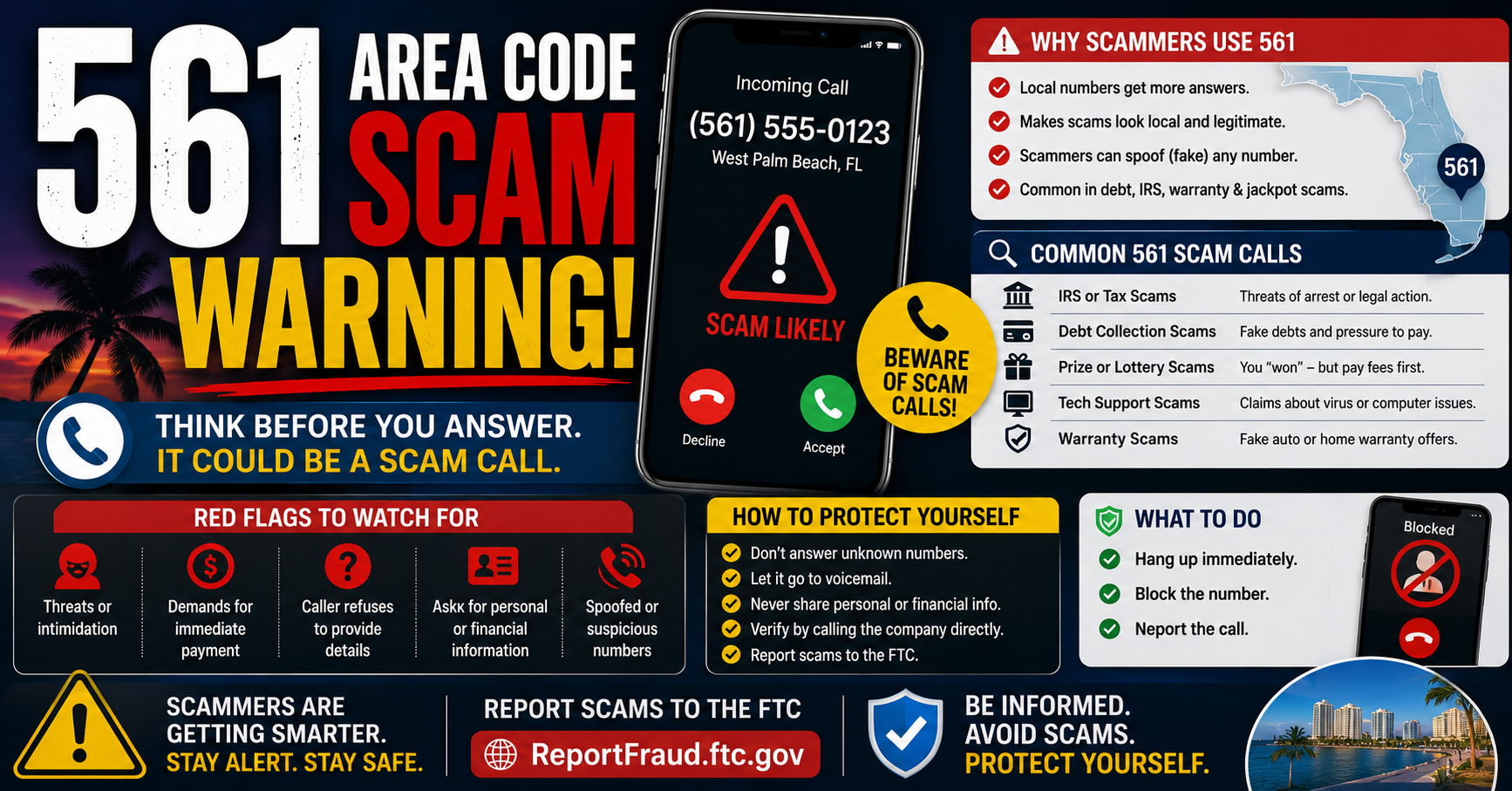
Why Are People Calling the 561 Area Code a Scam?
People are searching for the 561 area code scam because they may be receiving unexpected calls, texts, voicemails, or “wrong number” messages from numbers that appear to be local to Palm Beach County.
Scammers often use local-looking numbers because people are more likely to answer a call or open a text if it appears to come from their own area. This tactic is sometimes called local number spoofing or neighbor spoofing.
A 561 scam call or 561 text scam may involve:
- A fake missed call asking you to call back.
- A text that looks like it was sent to the wrong person.
- A fake bank, delivery, tax, loan, Medicare, or utility warning.
- A message claiming there is a problem with your account.
- A caller asking you to confirm personal information.
- A request for a one-time passcode or verification code.
- A demand for payment by gift card, wire transfer, Zelle, Cash App, crypto, or prepaid card.
Is the 561 Area Code Legit or a Scam?
The 561 area code is legitimate. The area code itself is not the problem.
The scam risk comes from the message, caller behavior, or link being used. A real 561 number can be spoofed, meaning the number displayed on your phone may not be the true source of the call or text.
That means you should judge the communication by what it asks you to do, not only by the number shown on caller ID.
What About 561-594-0653?
Some people may be searching for a specific number such as 561-594-0653. If you received a text or call from that number, proceed carefully, but do not assume the person or business assigned to the number is responsible.
Phone numbers can be spoofed. Caller-report websites can also change over time. The safest approach is to focus on the content of the message.
Be especially cautious if the message from 561-594-0653 or any other 561 number:
- Arrived unexpectedly.
- Uses vague language such as “Are we still meeting?” or “Call me back.”
- Tries to start a friendly conversation with a stranger.
- Asks you to click a link.
- Mentions an account, delivery, tax issue, loan, prize, or unpaid bill.
- Requests personal or financial information.
Common 561 Area Code Scam Patterns
Wrong Number Text Scam
You may receive a casual text that looks accidental, such as a meeting reminder, appointment note, or friendly message meant for someone else. If you reply, the sender may try to build trust and move the conversation toward investing, crypto, romance, business opportunities, or payment requests.
Fake Bank or Fraud Department Call
The caller may claim there is suspicious activity on your bank account, debit card, credit card, Zelle, PayPal, Cash App, Venmo, or crypto account. They may ask you to verify a code or move money to a “safe” account. Do not do this.
Delivery or Package Text
A 561 text may claim that USPS, FedEx, UPS, Amazon, or another delivery company needs an address update or small redelivery fee. These messages often include links to fake websites that steal payment details.
Government, Court, or Tax Threat
Some scam calls claim you owe taxes, missed jury duty, ignored a citation, or failed to respond to a government notice. Scammers use fear to make victims act quickly.
Loan, Debt, or Benefits Call
A caller may mention tax benefits, debt relief, American loans, Medicare, health coverage, or financial assistance. Be careful with any unexpected call that asks for your Social Security number, bank account, date of birth, or payment information.
Warning Signs of a 561 Scam Call or Text
- The caller creates urgency or fear.
- You are asked to click a link from a text message.
- The caller asks for passwords, PINs, or verification codes.
- The message says you must pay immediately.
- The caller refuses to let you hang up and verify independently.
- You are told not to tell anyone else.
- The caller asks for gift cards, crypto, wire transfers, or payment apps.
- The text contains spelling mistakes, strange wording, or a suspicious link.
- The call comes from a local-looking number, but the message has nothing to do with you.
What to Do If You Receive a 561 Scam Call
- Do not provide personal information.
- Do not share verification codes.
- Do not press buttons if the robocall asks you to respond.
- Hang up if the call feels suspicious.
- Do not call back using the number from caller ID.
- Look up the company, agency, bank, or office independently.
- Call using a number from an official website, statement, card, or account portal.
- Block the number if it appears to be spam.
- Report the unwanted call when appropriate.
What to Do If You Receive a 561 Scam Text
- Do not click any links.
- Do not reply, even to say “stop,” unless you know the sender is legitimate.
- Do not download attachments or images from suspicious messages.
- Take a screenshot if you want to keep evidence.
- Forward spam texts to 7726, which spells SPAM.
- Use your phone’s “Report Junk” or “Report Spam” option if available.
- Block the sender after reporting.
- Delete the message if it is clearly fraudulent.
What If You Clicked a Link From a 561 Text?
If you clicked a suspicious link but did not enter information, close the page and avoid interacting with it further.
If you entered information, act quickly:
- Change any passwords you entered.
- Change reused passwords on other accounts.
- Enable multi-factor authentication where possible.
- Run a security scan on your phone or computer.
- Watch for follow-up scam calls, texts, or emails.
- Contact your bank or card issuer if you entered payment information.
What If You Gave Personal or Payment Information?
If you gave personal, banking, credit card, Social Security, Medicare, or account-login information to someone calling or texting from a 561 number, treat it seriously.
- Contact your bank or credit card issuer immediately.
- Ask whether your card or account should be replaced.
- Dispute unauthorized charges.
- Change affected passwords.
- Secure your email account first if it was involved.
- Place fraud alerts or credit freezes if sensitive identity information was shared.
- Save screenshots, phone numbers, voicemails, links, and payment records.
- Report financial loss to the proper authorities.
How to Verify a Real Local Call
Some 561 calls are legitimate. Doctors, contractors, schools, local businesses, government offices, and neighbors may use 561 numbers.
To verify safely:
- Let unknown calls go to voicemail.
- Listen for specific, verifiable details.
- Search the business or agency separately.
- Call back using a number from an official website or prior paperwork.
- Check your real account, app, or statement directly.
- Do not rely only on caller ID.
How to Report 561 Scam Calls or Texts
You can report suspicious calls or texts through several channels:
- Forward suspicious text messages to 7726.
- Report financial fraud to the FTC at ReportFraud.ftc.gov.
- Report unwanted calls to DoNotCall.gov.
- File an unwanted call or text complaint with the FCC.
- Report internet fraud or financial-loss scams to the FBI IC3 at IC3.gov.
- Report suspicious charges to your bank or credit card issuer.
Related Resources
Helpful official and consumer resources:
- ChargeOnMyCard.com – Research unfamiliar credit card charges, billing descriptors, and recurring payments.
- FCC Caller ID Spoofing Guide – Learn how caller ID spoofing works.
- FTC: How to Block Unwanted Calls – Review unwanted-call reporting and blocking tips.
- FCC Consumer Complaint Center – Report unwanted calls, texts, and spoofing issues.
- ReportFraud.ftc.gov – Report fraud, scams, and financial loss to the FTC.
- Florida PSC 561/728 Area Code Summary – Official information about the 561 and 728 area codes.
Related Scam Warnings
If an incoming caller claims to be your cable provider and offers a large discount for gift-card prepayment, see our Xfinity Scam Calls guide.
Consumers researching 561 area code scam calls and text scams may also want to review:
- FedEx Scam Text Warning
- Traffic Citation Text Scam Warning
- USPS Scam Text PDF Warning
- NAOBL Text Scam: 1-877-658-1917 Warning
- Robinhood Alert Scam Text
- Visa Click to Pay Scam Warning
- Walmart Scam Calls
- Geek Squad Subscription Scam Warning
Have You Received a 561 Scam Call or Text?
Share your experience below to help other readers recognize similar calls and texts.
- What 561 number appeared on caller ID?
- Did the call or text mention 561-594-0653?
- What did the message say?
- Did it ask you to click a link, call back, pay, or verify information?
- Did the caller claim to be from a bank, delivery company, government agency, utility, or local business?
- Were you able to avoid the scam?
Please do not post passwords, full account numbers, Social Security numbers, private addresses, or other sensitive personal information in the comments.
Disclaimer
ThinkItsAScam.com is an independent consumer information website. This article is for educational purposes and discusses scam calls, spam texts, caller ID spoofing, and suspicious messages that may appear to come from 561 area code numbers. The 561 area code itself is legitimate, and a displayed phone number may be spoofed. This article should not be interpreted as an accusation against any legitimate phone number owner, carrier, business, agency, or resident.
Leave a Reply