If you received a ClinCard from a clinical trial, research study, university, hospital, or medical research site, you may be wondering if it is real or a scam. Searches like “ClinCard scam,” “ClinCard legit,” “Greenphire ClinCard scam,” “My ClinCard app scam,” and “why was my ClinCard declined” usually come from participants who are confused or frustrated by how the prepaid card works.
The short answer is that ClinCard appears to be a legitimate prepaid payment card used for clinical trial participant payments and reimbursements. However, many users report problems such as declined transactions, difficulty withdrawing funds, confusing PIN issues, inactivity fees, customer service frustration, and uncertainty about who can actually fix account problems.
ClinCard itself should not automatically be treated as fake. The bigger issue is that participants need to understand the card rules, spend or withdraw funds carefully, and verify any payment issue through the clinical trial site that issued the card.
Quick Verdict
Legitimate Clinical Trial Payment Card, But Proceed With Caution.
ClinCard is commonly used by research sites to pay clinical trial participants. It may be issued through Greenphire/Suvoda programs and used as a prepaid debit card, virtual card, or related patient payment method.
That said, a real ClinCard can still create frustrating problems. Before assuming your card is empty, frozen, hacked, or fake, check your balance, understand the fee rules, confirm your PIN, and contact your study coordinator if cardholder support cannot resolve the issue.
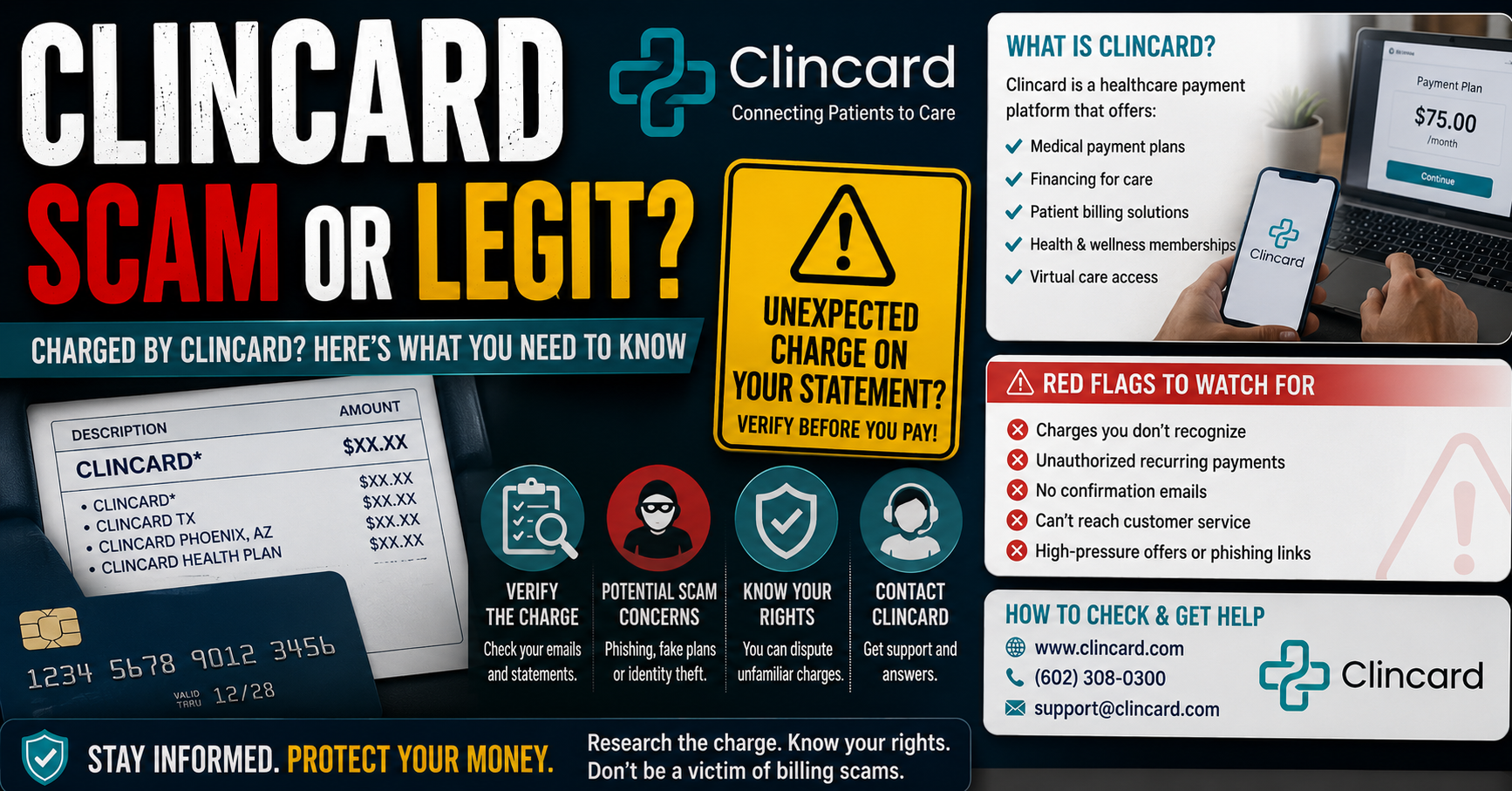
Why Are People Calling ClinCard a Scam?
People often call ClinCard a scam because they expected easy access to their clinical trial payment but ran into problems using the card. Common complaints involve declined purchases, ATM fees, inactivity fees, blocked accounts, hard-to-reach support, confusing cardholder portals, and balances that seem to disappear over time.
Those complaints are serious, but they do not automatically mean the ClinCard payment system is fake. In many cases, the issue may be tied to prepaid card rules, inactivity charges, merchant holds, PIN settings, account verification, or the way a research site set up the participant record.
The safest way to think about it is this: ClinCard may be legitimate, but it is not always simple for participants to use.
Is ClinCard Legit or a Scam?
ClinCard appears to be a legitimate clinical trial payment card. It is used by research sites, hospitals, universities, and study sponsors to pay participants for study visits, travel reimbursement, stipends, or other approved payments.
However, participants should not ignore warning signs. If someone contacts you claiming to be from ClinCard, Greenphire, Suvoda, a hospital, or a study team and asks for your Social Security number, bank password, verification code, or payment to “activate” your card, verify directly with your study coordinator before responding.
A legitimate ClinCard payment should come through the research study or site that enrolled you. If you never joined a study and suddenly receive a message about a ClinCard payment, treat it as suspicious.
Common ClinCard Complaints
Many ClinCard complaints are not about a fake card. They are about the experience of using a prepaid card that has rules and fees participants may not have expected.
Declined Transactions
A ClinCard may be declined if the purchase amount is higher than the available balance, if the merchant places a temporary hold, if the PIN is required, if the card has not been activated properly, or if the transaction type is restricted.
Difficulty Withdrawing Funds
Some users prefer to withdraw cash quickly after each payment. Depending on the card program, ATM fees, ATM limits, bank rules, or balance mismatches can make withdrawals confusing. You may need to know your exact available balance before requesting a cash advance at a bank.
PIN Problems
Some in-person transactions require a 4-digit PIN. If your PIN does not work or your birthdate is not accepted when setting the PIN, your study coordinator may need to confirm your participant details.
Inactivity Fees
One of the biggest complaints is that funds can be reduced by monthly inactivity or maintenance fees after a period of no card activity. This is why many participants try to use or withdraw their funds soon after receiving a payment.
Customer Service Frustration
Some cardholders say support can be scripted or limited, especially when the issue involves study details, identity information, fraud disputes, or locked accounts. In those cases, your clinical trial site coordinator may be more helpful than general cardholder support.
How to Use a ClinCard Safely
If you receive a ClinCard for a study, take a few minutes to understand how it works before trying to spend the funds.
- Activate the card using the official instructions provided by the study site.
- Set or confirm your PIN before trying a debit transaction or ATM withdrawal.
- Check your balance before each purchase.
- Spend or withdraw funds soon after payment if you want to avoid inactivity problems.
- Keep the card until the study is fully complete, because future payments may be loaded to the same card.
- Save payment confirmations, receipts, and screenshots of balances.
- Use the cardholder portal or the phone number on the back of the card for balance checks.
- Contact your study coordinator if your personal details, PIN setup, or account access do not work.
Should You Spend the ClinCard Balance Quickly?
Many participants choose to use the card soon after receiving payment because inactivity fees can reduce a remaining balance if no funds are added or removed for a long period.
That does not mean you must spend recklessly. It means you should understand the rules. If you plan to leave money on the card, check the fee schedule and cardholder agreement so you know when inactivity charges may begin.
Common ways to avoid losing funds to inactivity may include making a purchase, withdrawing the balance, using the card before the inactivity period begins, or receiving another study payment that counts as card activity. Rules can vary, so check the terms that came with your card.
What to Do If Your ClinCard Is Declined
If your ClinCard is declined, do not panic. Try these steps:
- Check your available balance through the official cardholder portal, app, or phone number on the back of the card.
- Make sure the purchase amount is not higher than your available balance.
- Ask the cashier to run the card for a specific amount if your balance is lower than the purchase total.
- Try a PIN transaction if signature or credit-style processing fails.
- Check whether a restaurant, gas station, hotel, or rental merchant placed a temporary hold.
- Confirm that your card is activated.
- Contact the study coordinator if the cardholder system does not recognize your information.
What to Do If Your ClinCard Balance Looks Wrong
If your ClinCard balance is lower than expected, check for fees, holds, completed transactions, pending transactions, or previous study payments that were already used.
Take these steps:
- Log in to the official cardholder portal or app.
- Review all recent transactions.
- Look for monthly maintenance, inactivity, ATM, replacement card, or paper statement fees.
- Look for merchant holds from gas stations, hotels, restaurants, or online merchants.
- Screenshot the transaction history.
- Contact cardholder support using the number on the back of the card.
- Contact your clinical trial site coordinator if support cannot resolve it.
What If There Are Unauthorized Charges on Your ClinCard?
If you see transactions you did not make, treat it like a financial account issue.
- Call the customer service number on the back of the card.
- Ask whether the card should be frozen or replaced.
- File a dispute for unauthorized completed transactions.
- Save screenshots of the disputed charges.
- Tell your study coordinator what happened.
- Ask whether future study payments can be protected or moved to a replacement card.
- Monitor the cardholder portal for additional activity.
If your identity, address, date of birth, phone number, email, or other personal information may have been exposed, consider additional identity-protection steps.
Warning Signs of a ClinCard Phishing Scam
Because ClinCard is a real payment system, scammers could use the name in fake messages. Be cautious if you receive a text, email, or call that claims to be about ClinCard but seems unusual.
Warning signs include:
- You are told to pay a fee to receive your clinical trial payment.
- The message links to a domain that does not look official.
- The sender asks for your banking password or email password.
- You are asked to provide a one-time passcode.
- You are told to send money by gift card, crypto, wire transfer, Zelle, Cash App, or Venmo.
- You never participated in a clinical trial but are told you have a ClinCard payment.
- The message pressures you to act immediately or lose your funds.
- The caller refuses to let you verify with the research site.
If something feels wrong, do not click the link. Contact your clinical trial site, research coordinator, or study contact using information you already have from your enrollment paperwork.
Who Should You Contact First?
For basic card issues, use the official cardholder support number printed on the back of your ClinCard or the official cardholder portal.
For study-specific problems, contact your clinical trial site coordinator first. This is especially important if:
- Your birthdate is not recognized.
- Your PIN setup fails.
- Your name or contact information is wrong.
- Your payment was not loaded.
- You received less than the study promised.
- Your card is tied to a study you no longer recognize.
- Support says it cannot access the study details.
The study site may be the only party that can correct participant information, confirm payment amounts, or request additional help from the payment administrator.
Best Practices to Avoid ClinCard Problems
- Use or withdraw funds shortly after each payment if possible.
- Keep your card active if you leave a balance on it.
- Know your PIN before shopping in person or using an ATM.
- Check your balance before using the card.
- Avoid using the card at merchants that place large holds if your balance is low.
- Save the card until the study is fully over.
- Keep the study coordinator’s contact information.
- Read the fee schedule that came with your card.
- Do not share your PIN, login details, or verification codes.
Bottom Line: ClinCard Scam or Legit?
ClinCard appears to be a legitimate prepaid payment method used for clinical trial participant compensation. It is not automatically a scam simply because you received one from a research study.
However, participants should proceed carefully. ClinCard complaints often involve real frustrations, including declined transactions, access problems, fees, support delays, and confusion about how to withdraw or use funds.
If you receive a ClinCard, verify it through your study site, understand the card rules, spend or withdraw funds before inactivity fees become a problem, and contact your clinical trial coordinator if support cannot resolve your issue.
Related Resources
Helpful official and consumer resources:
- Suvoda Greenphire Patient Payments – Official information about Greenphire patient payment products.
- ClinCard Cardholder Portal – Cardholder access page for ClinCard users.
- ClinCard Cardholder FAQ – Official cardholder FAQ information.
- ClinCard Terms and Conditions – Review cardholder terms, fees, and usage rules.
- CFPB Prepaid Cards – Consumer information about prepaid cards.
- BBB ClinCard Prepaid Card Profile – Review consumer complaints and business profile information.
- ReportFraud.ftc.gov – Report scams, phishing, or fraud to the FTC.
- ChargeOnMyCard.com – Helpful if you see an unfamiliar merchant descriptor or transaction on a payment card.
Related Scam Warnings
Consumers researching ClinCard scam concerns may also want to review these related payment, phishing, and verification warnings:
- MyInsuranceInfo.com Scam or Legit?
- Visa Click to Pay Scam Warning
- Robinhood Alert Scam Text
- Geek Squad Subscription Scam Warning
- FedEx Scam Text Warning
- USPS Scam Text PDF Warning
- 561 Area Code Scam Warning
Have You Had Trouble With a ClinCard?
Share your experience below to help other clinical trial participants understand what to expect.
- Was your ClinCard declined?
- Were you able to withdraw your funds?
- Did inactivity fees reduce your balance?
- Did customer service resolve the issue?
- Did your study coordinator help?
- Did you see unauthorized transactions?
Please do not post your full card number, PIN, date of birth, study ID, medical information, address, phone number, account login, or other sensitive personal details in the comments.
Disclaimer
ThinkItsAScam.com is an independent consumer information website. This article is for educational purposes and discusses consumer confusion, complaints, cardholder fees, support issues, phishing risks, and prepaid card concerns related to ClinCard. ClinCard appears to be a legitimate clinical trial payment card, but users should verify payment details with their study site, cardholder portal, and official cardholder support. This article is not an accusation against ClinCard, Greenphire, Suvoda, Fifth Third Bank, clinical trial sites, universities, hospitals, sponsors, or legitimate research organizations.
Leave a Reply