If you are searching for “TruthFinder scam,” “Truth Finder scam,” “TruthFinder legit,” “is TruthFinder safe,” or “TruthFinder billing complaints,” you are probably trying to decide whether to use the service, cancel a subscription, dispute a charge, or trust information in a background-style report.
The short answer is that TruthFinder appears to be a real people-search service, not a fake website by default. However, consumers should proceed with caution because public-record search sites can have accuracy problems, billing complaints, subscription confusion, and legal limits on how reports can be used.
TruthFinder should not be used casually for high-stakes decisions. Before paying, read the billing terms, understand what the report can and cannot prove, and remember that people-search reports may include outdated, incomplete, or mixed-up information.
Quick Verdict
Legitimate People-Search Service, But Proceed With Caution.
TruthFinder appears to be a real service that compiles public-record and people-search information. That does not mean every report is accurate, complete, current, or appropriate for legal screening decisions.
Consumers should be especially cautious about subscription billing, automatic renewal, cancellation confirmation, report accuracy, and any use that could fall under tenant screening, employment screening, credit decisions, insurance decisions, or other FCRA-related purposes.
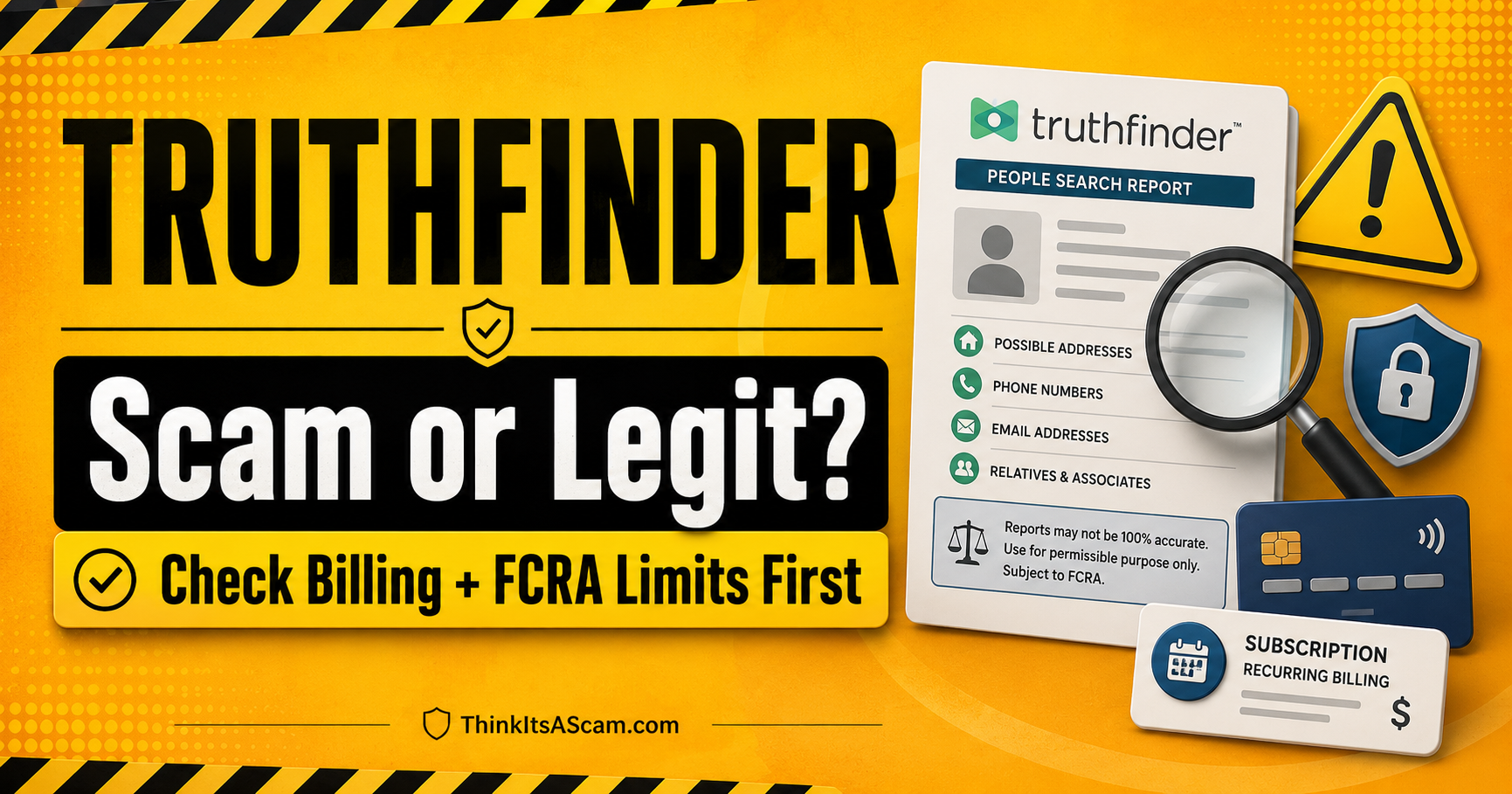
Is TruthFinder Legit or a Scam?
TruthFinder appears to be legitimate in the sense that it is an actual people-search and public-records website. The concern is not that the site is necessarily fake. The concern is whether the service is worth paying for, whether users understand the billing model, and whether the reports are reliable enough for the way people want to use them.
Many consumers search “TruthFinder scam” after seeing warnings during the search process, paying for a membership, finding information they believe is inaccurate, struggling to cancel, or seeing a recurring charge they did not expect.
That makes this a “proceed with caution” topic rather than a simple fake-site warning.
Why Are People Calling TruthFinder a Scam?
People often call TruthFinder a scam because the experience can feel more aggressive or confusing than expected. Common concerns include:
- Marketing that makes reports sound more detailed or urgent than expected.
- Subscription billing instead of a simple one-time report purchase.
- Automatic renewal charges.
- Difficulty canceling or confirming cancellation.
- Reports that include outdated, incorrect, duplicated, or mixed-up records.
- Information that appears to be available from public databases elsewhere.
- Confusion over whether reports can legally be used for screening decisions.
- Concerns about personal information appearing on the site.
These complaints do not automatically prove TruthFinder is fake, but they are important warning signs for consumers to review before paying.
What TruthFinder Does
TruthFinder is generally described as a people-search or background-report-style website. It may compile information from public records, government records, commercial data providers, online sources, and other databases.
Depending on what is available, a report may include names, addresses, possible relatives, phone numbers, email addresses, social media information, criminal or court-related records, property information, or other public-record-style data.
The important point is that the information may be compiled from multiple sources. That does not guarantee it is current, verified, complete, or connected to the correct person.
TruthFinder and the FTC Case
Consumers should know that TruthFinder and related companies have faced federal scrutiny. The Federal Trade Commission announced action involving TruthFinder and Instant Checkmate over claims related to background-report accuracy and Fair Credit Reporting Act concerns.
For consumers, the practical lesson is simple: do not treat a TruthFinder report as guaranteed truth. A report can contain outdated, incomplete, or incorrect information, and it should not be used as the only source for important decisions.
Can You Use TruthFinder for Tenant, Employee, or Credit Screening?
Be very careful. People-search reports should not be used for decisions that require legally compliant consumer reports unless the service is specifically approved for that purpose and follows the proper legal requirements.
Do not use a TruthFinder report by itself to decide whether to:
- Hire someone.
- Reject a job applicant.
- Screen a tenant.
- Deny housing.
- Approve or deny credit.
- Set insurance eligibility.
- Make a high-stakes decision about someone’s rights, employment, housing, finances, or reputation.
If you need employment screening, tenant screening, credit screening, or another legally regulated background check, use a properly compliant screening provider and follow the required disclosure, authorization, adverse-action, and dispute procedures.
TruthFinder Billing Complaints
One of the biggest areas of consumer frustration involves billing. Users may believe they are paying for one report, but later discover they signed up for a recurring membership or additional services.
Before entering your card information, check:
- The total price.
- Whether the charge is recurring.
- How often you will be billed.
- Whether there is a trial period.
- Whether add-ons are preselected.
- The cancellation method.
- Whether cancellation stops future charges immediately or at the end of the billing cycle.
If you do subscribe, save screenshots of the checkout page, cancellation page, confirmation emails, and account settings.
What to Do Before Paying for TruthFinder
- Decide whether you really need a paid report.
- Search free public records first if the information is basic.
- Read the membership and billing terms carefully.
- Look for recurring billing language before entering your card.
- Understand that report information may be inaccurate or outdated.
- Do not use the report for employment, tenant, credit, or insurance decisions.
- Use a payment method that allows disputes if billing problems occur.
- Set a reminder to cancel if you only need short-term access.
What to Do If You Were Charged by TruthFinder
If you see a TruthFinder charge you do not recognize, do not assume the worst immediately. It may be a recurring membership charge, a trial conversion, an add-on, or a subscription someone in your household started.
Take these steps:
- Check your email for TruthFinder receipts or account messages.
- Log in to your TruthFinder account if you recognize the service.
- Review your membership status and billing history.
- Cancel any subscription you do not want to continue.
- Save cancellation confirmation.
- Contact TruthFinder support if the charge appears incorrect.
- Contact your bank or card issuer if you believe the charge is unauthorized.
- Monitor your statement for additional charges.
How to Cancel a TruthFinder Subscription
If you want to cancel, use the cancellation options inside your TruthFinder account or contact support through the official TruthFinder website. Do not rely only on closing a browser window, deleting an app, or ignoring emails.
After canceling:
- Save the cancellation confirmation.
- Take a screenshot of the account status.
- Check your email for confirmation.
- Watch your card statement for another billing cycle.
- Contact your card issuer if charges continue after cancellation.
Are TruthFinder Reports Accurate?
TruthFinder reports may include useful public-record information, but they should not be treated as guaranteed accurate. Public-record search tools can mix people with similar names, include old addresses, show outdated phone numbers, duplicate records, or list court information without enough context.
Before relying on a report, verify important details through direct sources such as court records, official county databases, state agencies, or the person or organization involved.
Never assume someone has a criminal record, lawsuit, lien, judgment, or other negative history based only on a people-search report preview or summary.
What If TruthFinder Has Your Personal Information?
If your personal information appears on TruthFinder, you may be able to request suppression or removal through the privacy or suppression process used by TruthFinder’s corporate family.
Before submitting removal information, make sure you are using the official suppression process and not a third-party look-alike site. Be careful about giving unnecessary personal details to random removal services that advertise online.
Warning Signs of a Fake TruthFinder Message
Because TruthFinder is a real brand, scammers could use the name in fake emails, texts, ads, or support messages. Be cautious if you see any of these warning signs:
- The message claims you must pay immediately to avoid legal trouble.
- The sender asks for your bank password or email password.
- The link goes to a misspelled or strange domain.
- You are asked to pay with gift cards, crypto, wire transfer, Zelle, Cash App, or Venmo.
- The message says a report has been created about you but gives no clear account details.
- A fake support agent asks for a one-time passcode.
- The offer claims to remove all of your information from the internet instantly.
- The message uses threats, urgency, or scare tactics.
If you are unsure, do not click the link. Go directly to the official TruthFinder website or contact support through a verified channel.
What If You Paid and Feel Misled?
If you paid for TruthFinder and believe the billing or report was misleading, document everything.
- Save the receipt.
- Screenshot the checkout page if still available.
- Save the report page or search flow that led you to purchase.
- Keep cancellation confirmations.
- Contact TruthFinder support and request a resolution.
- Dispute unauthorized or incorrect charges with your card issuer if needed.
- File a complaint with the FTC or BBB if the issue is not resolved.
Bottom Line: TruthFinder Scam or Legit?
TruthFinder appears to be a legitimate people-search service, but it deserves caution. The service is not automatically fake, but consumers should understand the subscription model, billing terms, report accuracy limits, privacy concerns, and legal restrictions before using it.
The safest approach is to treat TruthFinder as a public-record search tool, not a guaranteed background check. Do not use it for employment, tenant, credit, insurance, or other legally sensitive screening decisions. If you only need one search, be especially careful that you do not accidentally keep a recurring subscription active.
Related Resources
Helpful official and consumer resources:
- Official TruthFinder Website – Main TruthFinder site.
- TruthFinder Help Center – Official help and support information.
- PeopleConnect Suppression Center – Privacy suppression tools for PeopleConnect-affiliated sites.
- FTC TruthFinder and Instant Checkmate Action – Federal Trade Commission announcement.
- BBB TruthFinder Profile – Business profile, reviews, and complaints.
- CFPB Fair Credit Reporting Act Resources – FCRA compliance and consumer-reporting information.
- ReportFraud.ftc.gov – Report fraud, scams, or deceptive business practices to the FTC.
- ChargeOnMyCard.com – Helpful if you are researching an unfamiliar TruthFinder or subscription-related card charge.
Related Scam Warnings
Consumers researching TruthFinder scam concerns may also want to review these related billing, subscription, data, and verification warnings:
- MyInsuranceInfo.com Scam or Legit?
- ClinCard Scam or Legit?
- Visa Click to Pay Scam Warning
- Geek Squad Subscription Scam Warning
- Robinhood Alert Scam Text
- FedEx Scam Text Warning
- 561 Area Code Scam Warning
Have You Had a Problem With TruthFinder?
Share your experience below to help other readers understand what to expect.
- Did you feel the report was accurate or inaccurate?
- Were you surprised by recurring billing?
- Were you able to cancel successfully?
- Did you receive a refund?
- Did your personal information appear on the site?
- Did you use the suppression or opt-out process?
- Did you receive a suspicious TruthFinder email, text, ad, or support message?
Please do not post full names, addresses, phone numbers, Social Security numbers, account logins, payment details, report screenshots with private data, or other sensitive personal information in the comments.
Disclaimer
ThinkItsAScam.com is an independent consumer information website. This article is for educational purposes and discusses consumer concerns, FTC action, billing complaints, report accuracy issues, privacy concerns, and legal-use limitations related to TruthFinder. TruthFinder appears to be a real people-search service, but consumers should review current terms, verify billing, and avoid using people-search reports for legally restricted screening purposes. This article is not legal advice and is not an accusation that every TruthFinder service, employee, affiliate, customer, or report is fraudulent.
Leave a Reply